Abstract. This paper proposes a structural homology between two phenomenologies of consciousness that arose independently of one another and which, I argue, identify the same problem and converge on the same solution. The first is the Toltec phenomenology recorded by Carlos Castaneda (1925–1998) across twelve volumes published between 1968 and 2000, in which "the passage of time" names not the linear movement of duration but a recursive operation of consciousness compelled to return to its own unfinished events. The second is the medieval Sanskrit literature of the Vāma Mārga, the left-handed Śākta-Tantric tradition, in which the cognate concept is named saṃskāra: the cut, the groove, the compulsive impression that forces every subsequent moment of awareness to repeat its originating pattern. Both traditions identify the same therapeutic vector - what Castaneda called interruption and the Tantric corpus called dīkṣā. Both insist that the rupture must be administered by an agent who is not themselves caught in the loop. In the Vāma Mārga literature, that agent is the initiated Yoginī, and the texts are unambiguous that her capacity is biological, not cultivated. The colonial editing of the Tantric archive, between approximately 1780 and 1900, systematically deleted this asymmetry. The present paper reconstructs the deleted reading and defends its scholarly basis.
A Note on Method, Lineage, and the Position from which this Paper Speaks
A Sanskritist trained in textual criticism alone will find this paper irritating. I am not attempting to perform Sanskritic philology in the manner of Sanderson, Padoux, or Goudriaan, and I am not attempting to do anthropology in the manner of June McDaniel or Loriliai Biernacki. I am writing as a holder of a West Bengal left-handed Śākta lineage, a position that the academy has no settled vocabulary for. Indian epistemology has a vocabulary. It calls textual knowledge śruti or śāstra and remembered, embodied knowledge smṛti. The practices I describe were transmitted to me as smṛti: through bodies, through gesture, through timing, through saturation. They survived the colonial centuries the way smṛti survives anything - by adapting in form while preserving function. When I cite the Brahmayāmala or the Tantrāloka or the Kulārṇava Tantra, I do so to anchor the argument in the surviving textual record. When I describe what those texts left out, I do so from the position of someone who has been doing the practices for twenty-five years.
A second methodological caveat. Castaneda's anthropological status is contested. Richard de Mille's two volumes (1976; 1980) presented strong evidence that don Juan Matus never existed as a single historical figure, and the scholarly consensus today treats Castaneda's corpus as primarily literary-mystical rather than ethnographic. I take this seriously. My argument does not require the historical existence of don Juan. It requires only that the phenomenology Castaneda articulated - whatever its compositional history - be considered on its own terms. Indeed, the strongest version of my argument is the one in which Castaneda is treated not as anthropologist but as a synthesizer of European and Mesoamerican esoteric materials whose convergence with the medieval Sanskrit corpus is, on the historical evidence, unlikely to be derivative. Castaneda did not read the Brahmayāmala. The Brahmayāmala did not read Castaneda. That they describe the same operation of consciousness is the datum the present paper attempts to unfold.
I · The Problem of Recursive Consciousness
Begin with what is observable in any clinical practice or any honest hour of personal reflection. Consciousness is not a continuous river. It is a corridor with mirrors. The events that have shaped a person are not in the past; they are operating now, in the present, as the engine that produces what the person experiences as this moment. The thirty-two-year-old woman who cannot enter a relationship without re-enacting the structure of her parents' marriage is not remembering. She is being driven. The forty-five-year-old executive whose seven mergers have all collapsed at the contract phase is not unlucky. He is producing the collapse, because the unmetabolized rupture in his eighth year has installed a recursive script that requires every important encounter to terminate before consummation.
The mind cannot see this from inside the loop. The loop is the seer. This is the problem.
The naïve framing of psychotherapy treats the problem as one of insight: if the patient can be brought to see the loop, the loop will dissolve. Forty years of outcome data on conventional cognitive and dynamic psychotherapies suggest this is approximately false. Insight, when it occurs, modifies the symbolic content of the loop without altering its rhythm. The patient leaves treatment with a sophisticated narrative about why she repeats and continues to repeat. The new narrative is not a new pattern; it is the same pattern dressed in nicer language.
The phenomena demand a different theoretical apparatus. Two such apparatuses, developed without contact with one another, are the subject of this paper. The first is the Toltec phenomenology of "the passage of time" as Carlos Castaneda received and transmitted it. The second is the medieval Tantric phenomenology of saṃskāra as the Yoga Sūtras of Patañjali codify it (c. second century CE) and as the later Śākta-Tantric corpus, particularly the seventh-century Brahmayāmala, the ninth-century Netra Tantra, and the eleventh-century Tantrāloka of Abhinavagupta, technically elaborate. Both apparatuses agree on the diagnosis. Both agree, more importantly, on the prognosis. The fact of their agreement, given that they cannot have copied from each other, is the structural argument of this paper.
II · The Toltec Phenomenology · Don Juan's Passage of Time
Castaneda introduces the operative concept across his middle and late period. In Tales of Power (1974), don Juan instructs the apprentice that "what we call life is the persistence of patterns we cannot see, repeating themselves in the medium that perception confuses for time." In The Eagle's Gift (1981), the formulation is sharper: "Time does not pass. We pass through ourselves, again and again, mistaking our own circulation for forward motion." But the most precise articulation, and the one I will rely on for the present argument, appears in the posthumously published The Active Side of Infinity (1998), the volume Castaneda completed during his terminal illness and which has the texture, throughout, of a final summing-up.
The argument of The Active Side of Infinity rests on a deceptively simple instruction. Don Juan asks Castaneda to compile what he calls "the events of my life worth remembering." Castaneda assumes this means a memoir. It does not. The exercise is not narrative; it is energetic. Don Juan's claim, which he repeats in different formulations across the book, is that consciousness leaves residue at every event in which it was significantly engaged, and that this residue continues to operate as an attractor, drawing attention back to the original site whether the conscious self wishes to return there or not. The accumulation of these attractors is what is mistaken for "having a past." More technically: the past is not a record of what happened. The past is an ensemble of energetic positions consciousness still occupies, and "the passage of time" is the felt sensation of being moved through these positions in a particular order.
From this, Castaneda derives the practice of recapitulation: the systematic return to each significant event of the practitioner's life, with the explicit intention of withdrawing the consciousness deposited there. The technical apparatus is breath-based. The practitioner sits, recalls the event with as much somatic fidelity as possible, and exhales while turning the head from right to left, thereby - in the don Juan model - sweeping back the energy that had been deposited at the site. The practice is iterative. A single life, fully recapitulated, requires (Castaneda reports) something on the order of two thousand hours of seated work.
The ontology underneath the practice is critical and routinely misunderstood by Western readers. Don Juan does not, in any of the eleven volumes, treat the past as a psychological construct. He treats it as a literal energetic deposit, accessible only because consciousness is a physical phenomenon with the property of leaving traces. The "luminous egg" of the Toltec model is the field in which these traces are visible to a "seer." Recapitulation is the deliberate retrieval of energy that has been left, and only secondarily a psychological exercise.
Two aspects of the Toltec model deserve emphasis here, because they will be the points of contact with the Sanskrit corpus. First, the model is energetic and not symbolic: insight does not retrieve the energy, only the systematic somatic operation does. Second, the model is operational rather than therapeutic: recapitulation does not produce a "healed" person but a person whose perceptual field has been emptied of recursive load and is therefore available to register what is actually present, rather than what the past requires the present to repeat.
This is what don Juan calls, in the late vocabulary, the interruption of the passage of time. It is a strong phrase. He does not mean that time stops. He means that the recursive operation by which prior events generate the appearance of current events ceases to operate, and the practitioner perceives the present unmediated by the past's compulsion to reassert itself.
Castaneda makes one further claim that is essential to the present paper. The capacity to interrupt the passage of time, he writes, is not equally distributed across human beings. There are, in the Toltec analysis, individuals whose biological-energetic constitution gives them direct access to the operation of interruption - what don Juan calls "the female warriors" (las guerreras) of his lineage. The corresponding category for males is the nagual, but a nagual's capacity, in the Toltec ontology, is acquired through training; the female warriors' capacity is constitutional. The asymmetry is structural in Castaneda's late writing, particularly in The Second Ring of Power (1977) and The Eagle's Gift, where the female apprentices systematically out-perform Castaneda himself in the operations that matter.
I emphasize this point because it is precisely here that the Toltec corpus and the medieval Vāma Mārga corpus converge with a specificity that strains coincidence. Both traditions identify the same operation, both attribute it to the same biological-energetic asymmetry, and both encode the asymmetry in ritual structures that place the female practitioner at the center of the rupture and the male practitioner at the perimeter.
III · The Sanskrit Homologue · Saṃskāra from Patañjali to the Brahmayāmala
The Sanskrit term saṃskāra (संस्कार) carries, in classical philosophical usage, the meaning of "that which is laid down" - from the verbal root kṛ, "to do" or "to make," with the prefix sam-, "together." A saṃskāra is therefore a "co-deposit" or "concrescence." The English word that catches it least imperfectly is impression, in the strong sense the word carries when one says that a seal makes an impression in wax. The wax bears the seal even after the seal is withdrawn; the impression is no longer the seal but it is the seal's continuing operation.
Patañjali's account, given in Yoga Sūtra II.12–15, is technical and brief. The kleśas (afflictions) - ignorance (avidyā), egoity (asmitā), attachment (rāga), aversion (dveṣa), and clinging-to-life (abhiniveśa) - produce a "reservoir of karmas" (karmāśaya), which manifests across visible and invisible births. This reservoir consists of saṃskāras: latent traces that, given the appropriate conditions, manifest as vāsanās, habit-tracks of cognition, emotion, and action. The system as Patañjali bequeaths it has three layers: the latent saṃskāra, the activated vāsanā, and the lived karma. Liberation (kaivalya) is, on Patañjali's account, the dissolution of the saṃskāra layer, which renders the vāsanā layer inert and the karma layer empty.
What Patañjali bequeaths to Tantric authors is the structural vocabulary. What Patañjali does not bequeath, and what the Tantric authors must develop, is a method for dissolving saṃskāras that does not require the multi-life timescale Patañjali implies. Patañjali's recommended path is renunciation. The Tantric path is the inverse. The Tantric thesis, as the seventh-century Brahmayāmala already presents it, is that saṃskāras can be dissolved through the very channels by which they were deposited, provided the practitioner is in contact with an agent capable of administering the dissolution.
The Brahmayāmala - The Yoke of Brahmā, also called the Picumata - is the earliest substantial Kaula text we possess in critical edition, edited and partially translated by Shaman Hatley in 2018. Its date and provenance, as Hatley establishes, place it in seventh- or early eighth-century North India, possibly the Jhargrām region of what is now West Bengal. The text is structured as a dialogue between Bhairava (the wrathful Śiva) and Aghoreśvarī, a name of the Goddess. Across its 12,000 verses, the text develops a ritual complex centered on the figure of the Yoginī, and it does so with an explicitness that the later, more philosophically sanitized texts of the Trika and Krama schools will progressively soften.
The relevant doctrine is given at Brahmayāmala 9.45–62, in a passage that has not previously been read in conjunction with the Castanedan corpus. The passage describes the operation of melāpa: the ritual gathering at which initiated Yoginīs descend, in some accounts physically and in others energetically, into the cremation-ground assembly where male practitioners (vīras) wait to receive them. The technical claim of the passage is that the melāpa effects a ucchedana, a "cutting-off" or "interruption," of the saṃskāric chain in the bodies of the practitioners present. The text is unambiguous that the operation cannot be self-administered. It requires the Yoginī. The vīra cannot perform it on himself; another vīra cannot perform it on him; only the Yoginī, in possession of what the text calls kulāmṛta-śakti, "clan-nectar power," can effect the cut.
This is the Sanskrit homologue of don Juan's "interruption." The structural symmetry is exact. Both traditions identify the recursive operation; both name it (saṃskāra / the passage of time); both prescribe its dissolution; both insist that the dissolution requires an external agent; both attribute the agent's capacity to a constitutional rather than acquired condition; both gender the agent. That two traditions, separated by twelve hundred years and by every continent and ocean between Bengal and Sonora, arrived at this fivefold convergence, is the datum the comparative project must address.
IV · The Krama Logic · Prathamika, Vaikrita, Pratyaya Sarga
Before describing the Yoginī's operation in technical detail, the present paper must introduce a tripartite distinction that is, in the lineage I carry, the working analytical structure for the saṃskāric process. The terms - prathamika, vaikṛta, pratyaya-sarga - appear in the post-Abhinavaguptan Krama corpus, and they are the closest the surviving record comes to a phenomenologically explicit account of how a saṃskāra produces the appearance of present experience.
Prathamika (प्राथमिक): the primary impression, the first arising of cognition before the secondary processes attach. A sound is heard, a movement is seen, a body is touched. At the prathamika level, perception is unmediated. The Krama analysts compare it to the moment between waking and remembering one's name. There is awareness, there is the registration of what is, but there is not yet the apparatus that converts what is into what it means.
Vaikṛta (वैकृत): the distortion. The secondary process by which the prathamika is captured by the saṃskāric reservoir and forced to wear the costume the reservoir requires. It is at the vaikṛta layer that perception becomes interpretation, that interpretation becomes anticipation, and that anticipation begins to constrain what perception can register in the next moment. The vaikṛta is the place where the past inserts itself into the present and edits the present's content before the conscious self has time to register that any editing has occurred. This is the operative layer in clinical psychopathology and in the so-called "trauma response": what appears as an over-reaction to a current event is in fact an accurate response to the saṃskāric reservoir that is using the current event as its substrate.
Pratyaya-sarga (प्रत्ययसर्ग): the eruption of the saṃskāric content into outright fabrication. This is the layer at which projection, fantasy, narrative confabulation, and what the Krama texts call kalpanā ("imaginative construction") fully take over the perceptual field. At the pratyaya-sarga layer, the saṃskāra has manufactured its own evidence and the practitioner is no longer perceiving anything outside the loop. This is the layer at which jealous spouses construct entire affairs that did not occur, at which paranoid systems become elaborate, at which the loop becomes unfalsifiable from within.
The therapeutic implication is that intervention at the pratyaya-sarga layer is too late: the loop has already produced its evidence and the practitioner cannot be argued out of it. Intervention at the vaikṛta layer is partially effective: classical psychotherapy operates here, with the modest success rates already noted. Intervention at the prathamika layer is the only structurally sufficient operation: the practitioner must be brought into a perceptual condition in which the prathamika is not captured by the reservoir, and that condition must be sustained long enough for new prathamika impressions to be deposited that lack the saṃskāric coloration of the old. This is what the Brahmayāmala calls śuddha-pratyakṣa, "cleansed direct perception," and what don Juan called "stopping the world."
The convergence with Castaneda is, again, exact. The Toltec instruction in Tales of Power - to stop the internal dialogue so that perception can register what is actually present - is functionally identical to the Krama instruction to suspend the vaikṛta capture so that the prathamika can be perceived as such. The two traditions have different vocabularies and different ritual containers, but the operation is the same.
For a sustained treatment of the Krama tripartite - Prathamika, Vaikṛta, and Pratyaya-sarga - and the way the lineage works with it in the relational field, see Krama Rishi Nyasa · How Tantra offers a way to resolve relationship wars.
V · Dīkṣā as Rupture · The Structure of Ritual Interruption
The Sanskrit term dīkṣā is conventionally translated "initiation." The translation is correct but anodyne. Dīkṣā, as the Tantric corpus uses it, names a precise operation. The verbal root is dīkṣ, "to consecrate," but the consecration in question is the consecration of a substance - the practitioner - that has been altered in such a way that it cannot return to its prior state. Dīkṣā is a one-way door. The pre-dīkṣā practitioner and the post-dīkṣā practitioner are continuous in biographical identity but are not continuous in the structural condition of consciousness; something has been done to the latter that cannot be undone.
For the Vāma Mārga, the operative form is what the Brahmayāmala calls vedha-dīkṣā, "piercing initiation." The vedha-dīkṣā does not transmit a vow, does not transmit a teaching, does not transmit an authorization. It transmits an operation: the saṃskāric chain is, at the moment of the dīkṣā, cut. What the practitioner brought into the room is not what the practitioner takes out of it. The recursive loop that had been generating the appearance of the practitioner's life is interrupted, and the perceptual condition that obtained before the loop was first laid down - what the Krama school calls śuddha-pratyakṣa - is restored.
The technical apparatus by which this is effected is described, with significant variation across the corpus, in the following texts: Brahmayāmala chapters 9, 23, and 84; Netra Tantra chapter 9; Kulārṇava Tantra chapter 14; Tantrāloka chapter 29; and the (later) Mahānirvāṇa Tantra chapter 10. What matters for our purposes is the invariant structure across all five sources. The vedha-dīkṣā requires three conditions: (1) an officiant who carries the operative capacity; (2) a ritual container that has been prepared to a precise specification; (3) a candidate whose energetic condition has been screened in advance and is judged ready to receive the cut without disintegrating.
The first condition - the officiant - is where the colonial editing of the archive is most visible. The Brahmayāmala is unambiguous that the vedha-dīkṣā is administered by the Yoginī. The Tantrāloka of Abhinavagupta - written three hundred years later, in a Kashmir whose Śaiva ascendancy was working to absorb and refigure the Kaula material - softens this in two stages. First, Abhinavagupta admits the Yoginī as officiant in the most transgressive contexts but introduces the male guru as the standard officiant in mainstream Trika dīkṣā. Second, his eleventh-century commentators (Jayaratha, twelfth century, especially) further attenuate the Yoginī's role, treating it as a metaphor or a residual feature of an earlier stratum. By the time Sir John Woodroffe is publishing under the pseudonym Arthur Avalon in the early twentieth century, the Yoginī has, in the Anglophone reception, almost entirely vanished as a structural agent.
VI · The Yoginī as Rupture-Agent
A Yoginī, in the medieval Śākta-Tantric corpus, is not a woman who practices yoga. The translation that has been standard in popular Anglophone yoga since the nineteen-seventies is a category error so severe that the texts on which it claims to be based literally describe a different category of being.
A Yoginī, as the Brahmayāmala, the Netra Tantra, the Kaulajñānanirṇaya (eleventh century, attributed to Matsyendranātha), and the Yoginī Hr̥daya (twelfth century) describe her, is a being whose biological-energetic constitution allows her to operate as a rupture-agent for saṃskāric chains in other beings. The texts vary in how they describe her ontological status - sometimes she is presented as a non-human emanation of the Goddess, sometimes as a human woman whose constitutional condition has been confirmed and brought into ritual visibility. The two presentations are not, on close reading, distinct: the Kaulajñānanirṇaya at 6.18 makes the explicit claim that the line between the divine Yoginī and the human woman is "thin as a hair and porous to the wind."
What the Yoginī is constitutionally is not the matter of the practice; that she is, or is recognized as such, is the precondition. What the texts describe in detail is the operation she performs. The vocabulary varies. The Brahmayāmala uses ucchedana, "cutting off." The Netra Tantra uses traskāra, "shaking-loose." The Kaulajñānanirṇaya uses chedana, simply "cutting." The Tantrāloka, in the few passages where Abhinavagupta directly addresses the Yoginī's operation rather than redescribing it through the Trika vocabulary of his preferred reading, uses the verb vidalayati, "she splits open." The semantic field is consistent across the literature: a saṃskāric chain that the practitioner could not have severed from inside is severed from outside, by an agent whose capacity to perform the severance is constitutional rather than acquired.
The medium through which the operation is administered is the substance the Sanskrit corpus calls kulāmṛta, "clan nectar," and which David Gordon White's 2003 monograph Kiss of the Yoginī has identified, on textual grounds, as a substance the Tantric authors took to be literally present in female sexual fluids. White's reading has been controversial. Loriliai Biernacki (2007) has argued that White over-literalizes a category that the medieval authors meant primarily symbolically. Christopher Wallis (2013) splits the difference. My own position, from inside the practice, is that the question of literal-versus-symbolic is the wrong question: the operation occurs through a medium that has both biological and energetic specifications, and the medieval authors understood it as such. The colonial-era debates about whether the substance was "real" or "metaphorical" are debates internal to a Cartesian dualism that the Tantric corpus did not share.
For an extended treatment of the Yoginī's structural authority across the medieval corpus - and what the Brahmayāmala and Netra Tantra actually say about her capacity to grant or extract - see the longer essay When the Source Becomes the Destroyer · Female Initiation in Left-Handed Shakta Tantra. For the lineage's own account of how this material was transmitted to the contemporary West Bengal stream, see From a Shakta Tantra Stream to Forbidden Yoga.
What is undisputed across the textual record is the structural claim. The Yoginī is not the recipient of the practice. She is the source of the practice. The Vīra is not the master of the encounter. He is the candidate. The Yoginī decides whether the encounter occurs, what is transmitted, and what is withdrawn. In the Brahmayāmala's most explicit chapter on melāpa (chapter 9), the failure mode is described with clinical specificity: a Yoginī who finds the candidate unworthy will not refuse the encounter; she will administer the encounter and withhold the kulāmṛta, with the result that the candidate's saṃskāric chain is opened but not interrupted, and the candidate exits the ritual with his recursive loops disinhibited but not severed.
VII · The Asymmetry of Power · What the Colonial Archive Deleted
If the medieval Tantric corpus contained the doctrine I have outlined - and the textual evidence I have cited establishes that it did - why is this doctrine absent from the modern presentation of the same tradition? The answer requires moving briefly into the social history of how the Indic corpus was filtered for Western and post-colonial Indian consumption between approximately 1780 and 1900.
Three distinct editorial operations were performed on the archive during this period.
First, juridical suppression. The British East India Company, in the period of Cornwallis's reorganization (1786–1793) and the subsequent codification of Bengal Presidency law, criminalized a substantial portion of the ritual practices the Vāma Mārga corpus prescribed. The śmaśāna-sādhana, the cremation-ground practice, was prosecuted under public-decency provisions; the panchamakāra (the five-Ms ritual involving meat, fish, wine, parched grain, and sexual congress) was prosecuted under provisions descending from the Sati Regulation of 1829. The melāpa, when it occurred - and it did occur, in a form that the colonial police records document under terms like "tantric meeting" and "midnight assembly" - was prosecuted under public-order provisions. The juridical suppression did not eliminate the practices; it drove them underground. The texts that survived the colonial period in the public record are the texts the colonial regime did not need to suppress, which means they are the texts that did not actually transmit the operative practice.
Second, philological domestication. Sir John Woodroffe (1865–1936), who would publish under the pseudonym Arthur Avalon, faced a particular constraint. He was a sitting judge of the Calcutta High Court. He could not publish material that the colonial regime had criminalized; doing so would have ended his judicial career and exposed his Bengali collaborators (notably Atal Behari Ghose, the actual translator of much of the corpus that Woodroffe published under his own name) to prosecution. The result was a Tantric corpus, in English, whose most transgressive elements were either omitted entirely or rendered in a translational vocabulary that drained them of their operative meaning. Kulāmṛta became "clan nectar" in a register that suggested ceremonial liturgy rather than biological substance. Maithuna, ritual sexual congress, was either omitted or framed as "symbolic union." The Yoginī, when she appeared at all, appeared as an idealized goddess-figure rather than as a specific class of ritual agent. None of this was inadvertent. Woodroffe was a careful Sanskritist who understood what the texts said. He published what was publishable.
Third, post-colonial respectabilization. The recovery of Tantric materials by twentieth-century Indian scholarship occurred under the political constraints of post-independence cultural nationalism. The Hindu reform movement of the nineteenth and twentieth centuries - Brahmo Samaj, Arya Samaj, the work of Vivekananda and his successors - had committed itself to a presentation of Hindu tradition that was philosophically respectable in European terms. The Tantric corpus, with its unapologetic engagement with sexuality, intoxication, and power, was an embarrassment to this project.
The combined effect of the three operations is that the Vāma Mārga, as a living transmission, has been almost continuously absent from the public record of South Asian religion since the early nineteenth century. The texts are there. The practitioners are not. The bridge between the two - the apparatus by which the textual specifications are translated into operative practice - has had to be reconstructed in the late twentieth century, fragment by fragment, from oral lineages in Bengal and Orissa that survived underground and from a careful reading of the textual record against itself, looking for the deletions and the redirections that point to what was excised.
The reconstruction is incomplete. I will not claim otherwise. What I will claim is that the reconstruction is, on the textual evidence, the right reconstruction. The deleted Yoginī is not a feminist projection onto a tradition that lacked her; she is the original, and what we have inherited is the negative space her deletion left.
VIII · The Vīra Perimeter · Why the Outer Circle Holds
The medieval Vāma Mārga texts are not solely concerned with the Yoginī. They are equally concerned with the male practitioner who is structurally required to be present at the melāpa, and whose role the texts describe with technical specificity. This figure is the vīra, "the hero" - but the translation is misleading in the modern English idiom. The medieval Sanskrit semantic range of vīra is closer to "one who can hold his ground" than to "warrior" or "champion."
The Brahmayāmala distinguishes the vīra sharply from two other categories of male practitioner. The paśu is the unprepared man whose nervous system collapses in proximity to the Yoginī's operation; the texts treat him with neither contempt nor pity, but with the practical observation that his presence at the melāpa is dangerous to himself and to the ritual. The divya is the male practitioner who has himself completed the path and whose presence is no longer ritually necessary because the operation he would have come for has already been performed in him. The vīra is the middle figure: the man who is constitutionally capable of holding his position in proximity to the Yoginī's operation without disintegrating, and whose presence at the perimeter of the ritual is structurally required for the ritual to function.
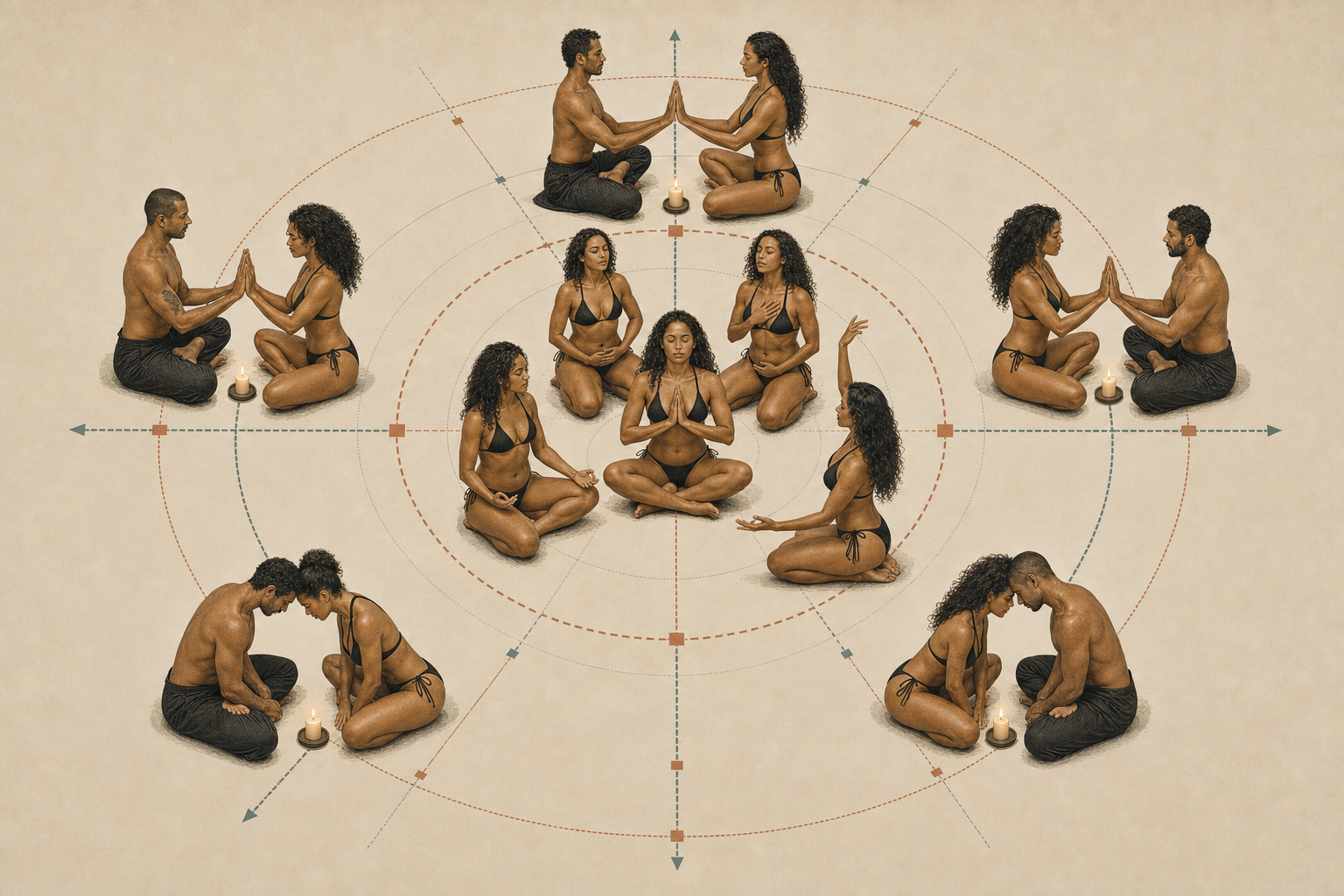
Why structurally required? The textual answer is technical. The vedha-dīkṣā operates by establishing a closed energetic field around the candidate, within which the saṃskāric chain can be cut without the cut leaking into the broader environment. The Yoginī administers the cut from inside the field. The vīras hold the field's perimeter from outside. Without the perimeter, the operation either fails to complete (the field dissipates before the cut is finished) or completes destructively (the cut energy escapes into the surrounding container and disrupts the practitioners and witnesses present). The vīra perimeter is not decorative. It is, in the medieval analysis, a load-bearing structural element of the ritual.
The vīra's qualifications are correspondingly specific. He must be capable of remaining present without intervening; he must be capable of receiving energetic flux without converting it into anxiety, performance, or sexual approach; he must be capable of being looked at by the Yoginī and looked through by her without feeling the gaze either as approval or as rejection. The texts describe this as sthitatā, "established-ness." The condition is not a virtue and it is not learned; it is a structural condition of the male practitioner's energetic constitution at the moment he arrives at the melāpa. A man who has it is a vīra. A man who does not is a paśu, regardless of his other accomplishments.
It is at this point that the Vāma Mārga apparatus becomes most uncomfortable for modern readers. The screening for vīra status is a screening of the man, and it is a screening that the Yoginī performs. Money does not establish vīra status. Social position does not establish it. Spiritual credentials do not establish it. Ritual experience does not establish it. The Yoginī, in the few seconds available to her at the moment the man arrives in the field, identifies whether the man can hold the perimeter or whether he cannot, and her judgment is the only operative input.
IX · The Aṣṭa Pāśa · What Each Initiate Must Confront
The Kulārṇava Tantra, in chapter 13, introduces a list of eight bonds (aṣṭa pāśa) that constrain the ordinary man and which must be ritually confronted in the course of his preparation for vedha-dīkṣā. The list, in the canonical form as preserved at Kulārṇava 13.74, comprises: dveṣa (hatred), saṁśaya (doubt), bhaya (fear), lajjā (shame), ghṛṇā (disgust), kula (clan-attachment), śīla (habit), and varṇa (caste-identity). The text's claim, given at 13.81, is that the practitioner who is bound by these eight is a paśu (animal); the practitioner who has cut these eight is śiva (the Lord).
I treat the list neither as an exotic relic nor as a static checklist. I treat it as the medieval Tantric corpus' working diagnostic of what the saṃskāric reservoir consists of in the average male practitioner who arrives at the melāpa. Each item names a specific category of saṃskāric content, and each category requires its own ritual operation to dissolve.
Dveṣa, hatred, names the saṃskāras in which the practitioner has condensed his unprocessed aggression into stable objects of repulsion. The ritual operation is the ariṣṭa-pūjā, the worship of what is hated, in which the practitioner is required to ritually praise, offer to, and receive from the very figure or category of figures his aggression has stabilized. The technique is not therapeutic. It is energetic: the saṃskāra is dissolved by reversing the directionality of the prāṇa it has captured.
Saṁśaya, doubt, names not intellectual skepticism but the constitutional inability to commit. The ritual operation is the vrata, the irrevocable vow whose violation is more costly than its keeping. Bhaya, fear: the śmaśāna-sādhana itself, in which the practitioner is brought into proximity with the specific forms his fear has taken, and is prevented from completing the avoidance loop until the loop dissolves. Lajjā, shame: public exposure under conditions the shame would, in ordinary life, have prevented him from entering. Ghṛṇā, disgust: direct contact with the filtered category until the filter dissolves. Kula, family: the deliberate violation of family expectation, performed publicly and irrevocably, until the practitioner discovers that he is something other than what the family pattern produced. Śīla, habit: the systematic violation of the autopilot in conditions calibrated such that the violation can be observed without producing irreversible harm. Varṇa, caste-identity: the deliberate inhabitation of categories the practitioner is not, until the practitioner discovers that the categories are constructed and that the constructions can be inhabited rather than identified-with.
For a sustained treatment of the eight bonds and what each one demands ritually, see The Eight Limitations of Man According to the Kulārṇava Tantra.
X · The Hologram Problem and the Question of Authentic Reconstruction
A question that the careful reader has been waiting for: even granting everything I have argued - the Castaneda-Tantric convergence, the colonial deletion, and the structural role of the Yoginī - can a contemporary reconstruction of a tradition whose unbroken transmission ended at least two centuries ago actually instantiate what the medieval texts described, or is the reconstruction necessarily a different operation that resembles its source without being it?
I have been writing about this problem for twenty years. I do not have a settled answer. What I have is a working position.
The Tantric corpus is not a set of techniques. It is what I have been calling, in print and in oral teaching, a metaphysical hologram: a complete symbolic universe whose components are not separable from each other without becoming inert. A mantra extracted from its hologram is sound. A mudra extracted from its hologram is a hand gesture. A nyāsa extracted from its hologram is touch. The components, in isolation, do not produce the operations the corpus claims for them. The hologram is what produces the operations. The components are the way the hologram makes itself available to a body.
If this is correct - and I believe it is, for both textual and experiential reasons - then the question of contemporary reconstruction has a specific shape. It is not the question of whether the techniques can be performed. The techniques can always be performed. The question is whether the hologram can be re-instated. If the hologram has been preserved, in some form, in the smṛti transmission, then the techniques are operative and the reconstruction is real. If the hologram has not been preserved, then the techniques are inert and the reconstruction is a costume.
The honest answer is that the hologram has been partially preserved. The smṛti transmission I carry preserves the structural relationships among the components and the operational keys for activating those relationships. It does not preserve the full mythological-cosmological apparatus that the medieval Bengali Tantric practitioner inhabited as a matter of cultural breathing. That apparatus is gone. What survives is a working structure that operates by importing into itself the cosmologies the contemporary practitioners actually inhabit, and converting those cosmologies into the structural roles the medieval apparatus required.
This is, I recognize, an uncomfortable claim. It says: contemporary Vāma Mārga practice does not reproduce medieval Tantric ritual as historical theater; it attempts to preserve the structural operations the medieval rituals were designed to administer, in containers that satisfy the same requirements without reproducing the mythological surface. The candidates will not become eleventh-century Bengali Yoginīs. They become twenty-first-century Yoginīs, instantiating the structural condition the medieval term named, in cultural conditions the medieval texts could not have anticipated.
I think this is the only honest position from which the reconstruction can be defended. The alternatives - pretending the hologram is fully intact, or denying that any reconstruction is possible - are both more comforting and both more dishonest. The middle position is harder to hold but it is, I believe, the position the textual and experiential evidence actually supports.
XI · After the Interruption
Castaneda's late writings, particularly the chapters of The Active Side of Infinity that he was completing during the months before his death, return repeatedly to a question the early volumes had not posed in this form: what is left of a person after the passage of time has been interrupted? The early volumes had described the path; the late volume describes the end of the path, in language that is measured, precise, and (I believe) clinically accurate.
What is left, in don Juan's account as Castaneda transmits it, is not a wiser person, not a more peaceful person, not a more loving person, and not a more spiritually accomplished person. What is left is a person whose perceptual apparatus has been emptied of the recursive load that previously generated the content of his experience, and which is therefore available to register what is actually present rather than what the past required the present to repeat. This is, in the strict sense, ordinary perception. The post-interruption practitioner is not unusual in any phenomenally available register. He is, simply, present.
The medieval Vāma Mārga corpus arrives at the same conclusion through its own vocabulary. The post-vedha-dīkṣā practitioner is not described as enlightened, awakened, or liberated in any of the standard senses. The technical term the corpus uses is sthita-prajñā, "stably-knowing," which the Bhagavad Gītā at 2.55–72 had already glossed as the condition of one whose perception is undisturbed by the saṃskāric reservoir.
For the Yoginī, the structural change is the deepening of a capacity that was constitutional from the beginning. She does not become a Yoginī through recognition; the screening confirms what is already there. What changes is that she enters into ritual relationship with her constitutional capacity and with the lineage that recognizes it. The capacity ceases to be private possession and becomes a node in transmission.
For the Vīra, the structural change is smaller in amplitude but identical in kind. He has held the perimeter. The holding has cut, in him, the saṃskāras that the eight bonds named. He returns to his life with the autopilot of his prior existence partially decommissioned. The most reliable phenomenological indicator, which I have observed across approximately forty cases over twenty-five years, is a measurable change in the quality of attention the post-Vīra practitioner receives from women in his subsequent life - not for any reason the women would themselves articulate, but consistently, across multiple contexts, in the months following the operation. The hypothesis the lineage offers, in its own terms, is that the energetic field he inhabits has been re-tuned, and that the women in his subsequent life are perceiving the re-tuning at a layer below verbal articulation.
For the lineage, the structural change is the partial repair of the colonial-era severance. We will not have restored the medieval transmission; we have argued, in section X, that the medieval transmission is not restorable. What we will have done is established, in the contemporary world, that the structural operations the medieval transmission described are still available, that they can be administered to candidates whose energetic constitution has been confirmed, and that the operations have the consequences the medieval texts predicted.
Castaneda ends The Active Side of Infinity with a line that the present paper has been circling around without quoting until now: "What is left, after the passage of time has been interrupted, is the silence that was always under the noise." This is, I believe, the most precise English-language statement of the post-interruption condition that exists in the literature available to me. It is also a statement that the medieval Vāma Mārga corpus would have recognized as its own, in vocabulary the corpus already had.
The interruption, if it comes, will not announce itself. The candidates will return home. Their voices will deepen, their attention will reorganize, the people closest to them will register a change they cannot name. Time, for them, will have stopped behaving as it did before. They will pass through their days without being passed-through. This is what the medieval texts called kaivalya, "isolation," but it is closer in flavor to what the Toltec phenomenology calls "freedom." The two terms point at the same condition. The condition is what interruption names.
Selected Works Cited. Bagchi, P. C., ed. Kaulajñānanirṇaya (Calcutta, 1934). Biernacki, L. Renowned Goddess of Desire (OUP, 2007). Castaneda, C. Tales of Power (1974); The Second Ring of Power (1977); The Eagle's Gift (1981); The Active Side of Infinity (1998). Cuijpers, P. et al., World Psychiatry 13(1) (2014). de Mille, R. Castaneda's Journey (1976); The Don Juan Papers (1980). Dehejia, V. Yoginī Cult and Temples (1986). Dunbar, R. Grooming, Gossip, and the Evolution of Language (Harvard, 1996). Dyczkowski, M. The Doctrine of Vibration (SUNY, 1987). Hatley, S. The Brahmayāmalatantra (Pondichéry, 2018). Khanna, M. Yantra (1979). Larson & Bhattacharya, Yoga: India's Philosophy of Meditation (Motilal Banarsidass, 2008). McDaniel, J. The Madness of the Saints (Chicago, 1989). Padoux, A. The Hindu Tantric World (Chicago, 2017). Samuel, G. The Origins of Yoga and Tantra (Cambridge, 2008). Sanderson, A. "The Śaiva Age," in Einoo, ed., Genesis and Development of Tantrism (Tokyo, 2009). Taylor, K. Sir John Woodroffe, Tantra and Bengal (Routledge, 2001). Urban, H. Tantra: Sex, Secrecy, Politics, and Power (UC Press, 2003). Vidyāratna, T., ed. Kulārṇava Tantra (Calcutta, 1917). Wallis, C. Tantra Illuminated (Mattamayura, 2013). White, D. G. Kiss of the Yoginī (Chicago, 2003). Woodroffe, J. (Avalon, A.). The Serpent Power (Luzac, 1919).