
Before We Begin: A Word from Michael Wogenburg
Hello. I am Michael Wogenburg, and I have lived inside the tantric traditions for more than twenty years.
My guru once said something to me that I have never managed to forget. He said: nobody will ever understand the entire tantric traditions. There are simply too many. Some of us will only ever understand one leaf of the hibiscus flower in the background of the Kali image.
One leaf. Of one flower. In the background of one image of one goddess.
It took me years to understand what a liberation that sentence was. Because it means you can give up the whole exhausting war over what is the real tantra, the right tantra, the wrong tantra. That war is pointless. There are probably thousands of tantras. No living person has read them all, no living person ever will, and every teacher who claims to hold the whole truth is holding, at best, a leaf, and usually a photograph of a leaf.
So I will not offer you the truth tonight. I can offer you an angle. One angle into these traditions, through one extraordinary book that almost nobody has ever read.
What you do with it is yours. Whether it is worth your time, I don't know. Whether it will change the world, whether it will make a better world, whether it will make a better person out of you, I honestly don't know, and I have grown suspicious of anyone who promises such things.
But if you are interested in the history of humanity, in magic, in mysteries, in what human beings can do with their lives beyond fighting and killing each other, then come with me. Come with me into a valley in the Himalayas, twelve hundred years ago, to a book written against death itself.
Come with me into the Netra Tantra.

Prologue: A Cold Night in the Valley
Come with me to Kashmir, somewhere around the year 820. It is winter in the valley. The Himalayas stand on every horizon like a court of white judges. In the capital, in a palace of carved deodar wood, a king cannot sleep. He has reasons. Kings in this valley die badly and they die often. The chronicle that a poet named Kalhana will write three centuries from now, the Rajatarangini, the River of Kings, reads in places like a catalogue of assassinations: kings poisoned, kings cut down by their own ministers, and, strangest of all to our ears, kings killed by sorcery. Kalhana records the case quite plainly. A man versed in the hostile science called kharkhota used his craft against a king, and the king burned with fever until he died. Nobody in that world found this implausible. Sorcery was a weapon of state, as real as cavalry.
So our sleepless king does what kings in his world do. He sends for a particular man.
The man who comes through the snow is hard to classify. He is a Brahmin, but he is something more specific than a priest. He has undergone secret initiations. He knows the Veda, but the books he actually works from are newer, stranger, and they are not public. At court they call him the rajapurohita, the royal chaplain, or sometimes the rajaguru, the king's own guru. His job description, if we wrote one today, would read: protect the king's body, the queen's body, the bodies of the royal children, the army, the harvest, and the kingdom itself, against fever, demons, hostile magic, the evil eye, childhood disease, snakebite, bad planets, and death.
Under his arm, wrapped in cloth, he carries his professional manual. It is a book in the form of a conversation between a god and a goddess. It is built around a deity of overwhelming gentleness, a white god of nectar, and around a weapon of three syllables. The book calls itself by several names. The Conqueror of Death. The Method of the Lord of Nectar. But the name that history kept is the simplest and the most mysterious.
The Tantra of the Eye. The Netra Tantra.
For roughly twelve hundred years, this book has existed. For most of that time, almost no one on earth could read it. There was no English translation, no German, no French, nothing, until fragments began to appear in our own lifetime. The complete scholarly translation is being finished only now, in the 2020s, by a small team working between Oxford and Nepal.
Tonight I want to open this book for you. I want to show you where it came from, what is actually inside it, how its rituals worked in procedure, step by step, and why a manual of medieval court magic turns out to contain, in its quiet middle chapters, one of the most beautiful maps of the human inner body ever drawn.
This is a story about fear, and about the technologies an entire civilization built against fear. Stay with me. We begin with the most basic question of all.
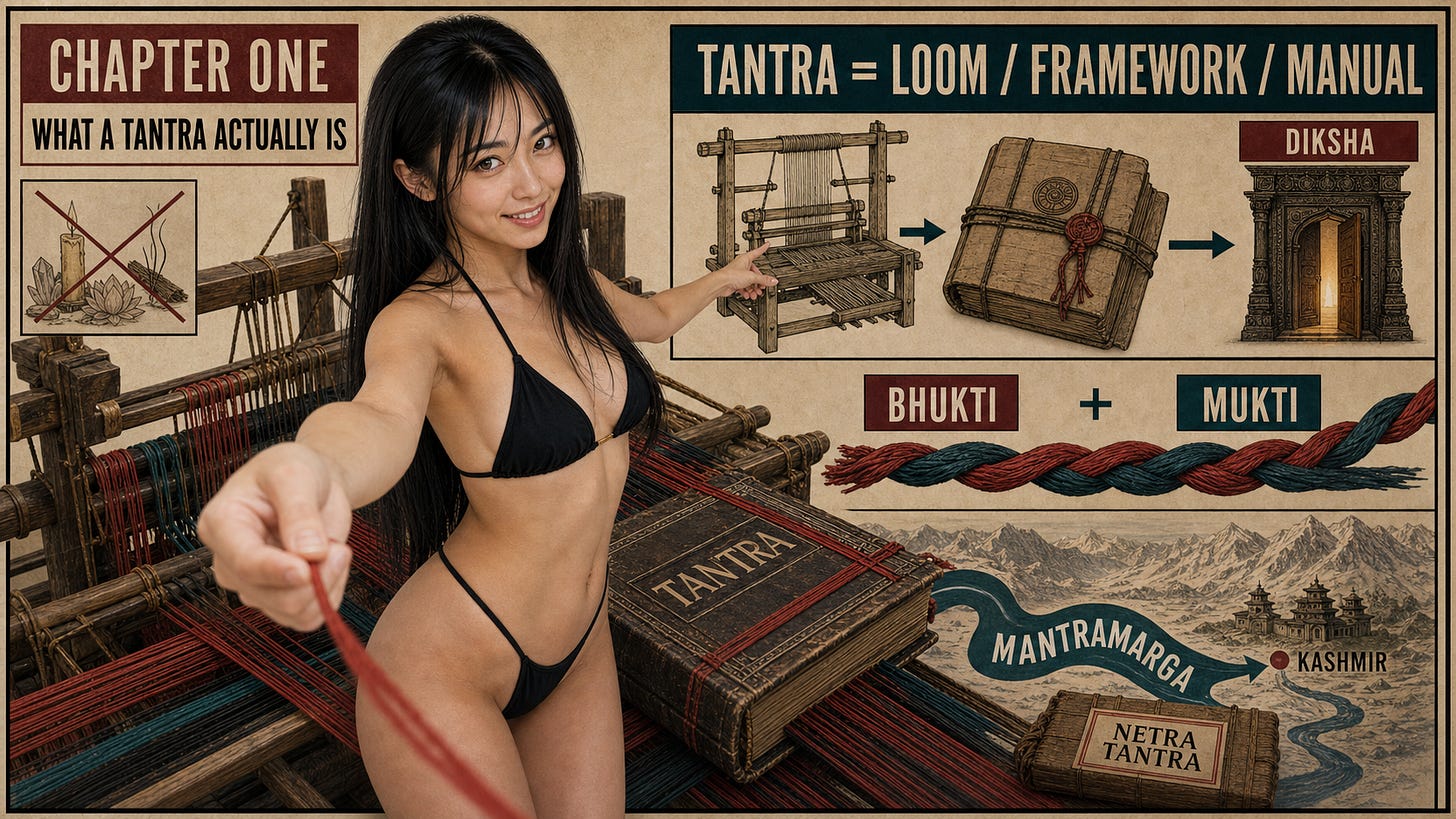
Chapter One: What a Tantra Actually Is
Before we can open the Tantra of the Eye, we have to deal with a word that has been so badly mistreated in modern times that it almost cannot be used in public anymore.
Tantra.
Say it today and most people think of candlelit workshops and slow breathing exercises for couples. The word has been turned into a synonym for spiritualized sexuality. The historical reality is larger, stranger, and far more interesting.
The word itself comes from the Sanskrit root tan, which means to stretch, to extend, to weave. A tantra, in the oldest usage, is a loom, and then by extension a framework, a system, and finally a book that lays out a system. When medieval Indians said tantra, they meant something close to what we mean when we say manual or treatise. There are tantras on astronomy. There are tantras on medicine. The famous collection of animal fables, the Panchatantra, is simply the Five Treatises.
But from roughly the fifth or sixth century of our era onward, the word attached itself to a particular new wave of religious literature, and this is the sense that concerns us. These books presented themselves as direct revelation. Their standard format is a dialogue: the Goddess asks, and Shiva answers, or sometimes the reverse. The teaching descends from the mouth of the deity, through chains of perfected beings, down into the world of men. The traditions called this category of scripture agama, that which has come down.
And here is the crucial point. These books understood themselves as something other than commentary on the Veda, the ancient public scripture of the Brahmins. The Veda was available, at least in principle, to the upper castes through birth. The tantras were available to no one through birth. They could be entered only through initiation, diksha, a ritual rebirth conferred by a guru, one person at a time. A tantra is, by its own definition, a closed book. It says so constantly. Conceal this. Do not give this to the uninitiated. The secrecy was structural.
What did these closed books actually offer? The tradition answered with two words: bhukti and mukti. Enjoyment and liberation. Worldly power and final freedom. The older Vedic religion had tended to treat these as a fork in the road: pursue the world, or renounce it. The tantric scriptures made the scandalous claim that a married householder, a merchant, a soldier, a king, could pursue both at once, through mantra, through ritual, through the body itself. Power in this life, liberation at the end of it, and no requirement to abandon the world in between.
The branch of this literature we are entering tonight belonged to what its own practitioners called the Mantramarga, the Path of Mantras, the great river of medieval Shaivism, the religion of Shiva. By the ninth century this path had become the dominant religious force of the Indian world, with an influence that stretched from Afghanistan to Java. Within it there were calmer currents and wilder ones. There were the orderly Siddhanta scriptures, concerned with temple ritual and respectable liberation. And there were the Bhairava tantras, named for Shiva in his fearsome form, books that moved closer to the cremation ground, to female deities, to possession, to power. Beyond even these lay the Kulamarga, the clan path of the yoginis, where the famous transgressive rites lived, the practices with wine and flesh and ritual sexuality that gave the left-handed current its name and its scandal.
The Netra Tantra is classified among the Bhairava tantras. But as we will see, it is a strange and diplomatic member of that family. It is a wild book wearing court dress.
One more thing before we travel to Kashmir. You may wonder how many of these scriptures exist. The honest answer is that nobody knows, because the literature is a graveyard. Hundreds of tantras are known today only as titles, quoted in other books, the books themselves gone. Of those that survive, the majority sit unedited and untranslated in manuscript archives in Kathmandu, Srinagar, Pune, London, Paris. The number of scholars alive who can actually read this material at the highest level would fit in a single seminar room. Every tantra that gets edited, translated, and explained is a small resurrection.
The Netra Tantra is in the middle of exactly such a resurrection right now. Which is one reason this is the perfect moment to tell its story.
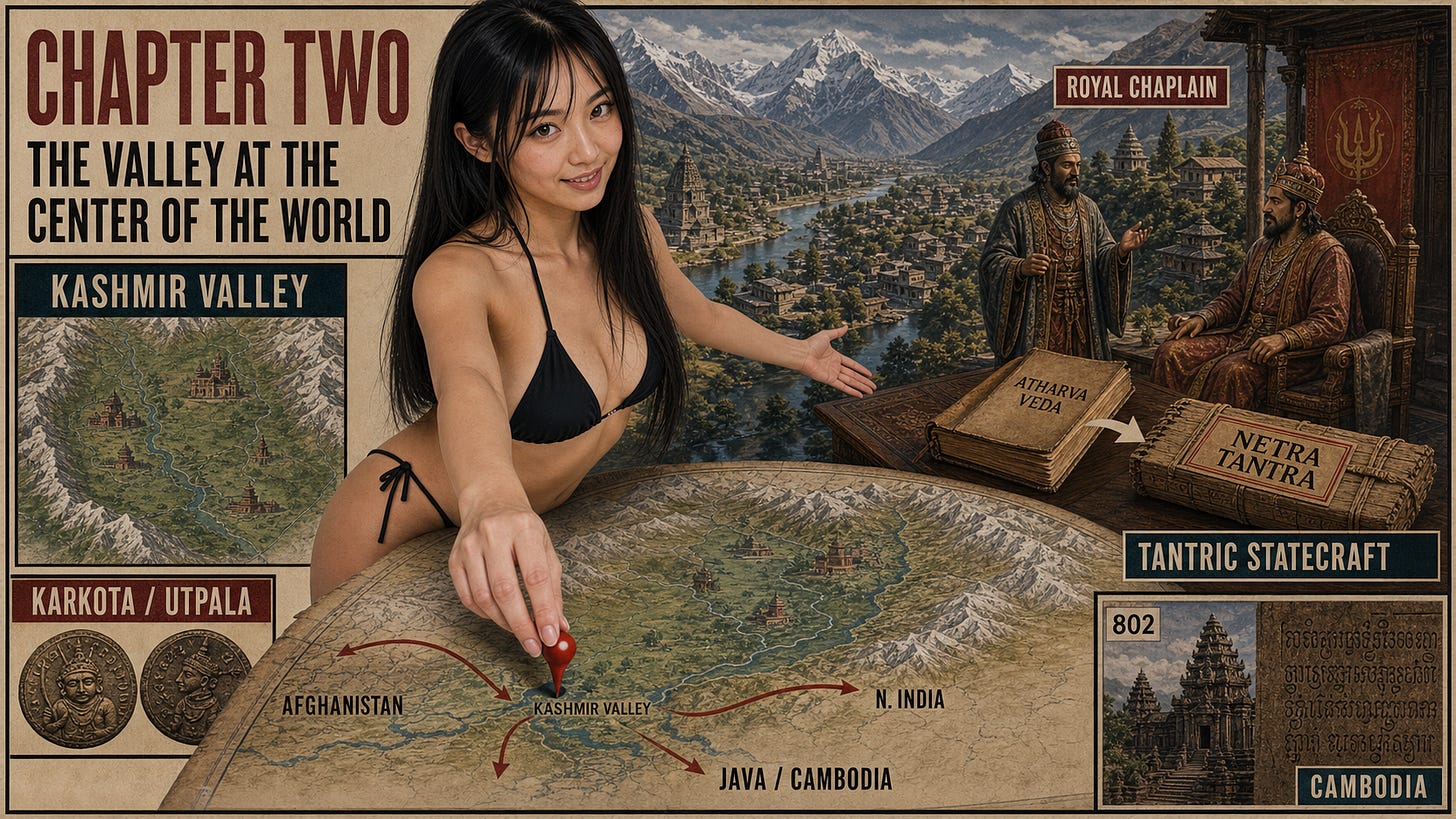
Chapter Two: The Valley at the Center of the World
Now, Kashmir. And you must briefly forget everything the modern news cycle has attached to that name. In the eighth and ninth centuries, the Valley of Kashmir was one of the intellectual capitals of Asia. It is a high, fertile, almond-shaped basin in the Himalayas, walled by mountains, watered by the Vitasta river, accessible only through a handful of passes. Geography made it defensible, and defensibility made it rich, and riches made it learned. Sanskrit poetics, logic, medicine, aesthetics, Buddhist philosophy, Shaiva theology: in field after field, if you trace the greatest names of the age, an astonishing number of them lead back to this one small valley.
In the eighth century the Karkota dynasty ruled here, and under its most ambitious king, Lalitaditya, Kashmir briefly projected power across great stretches of northern India. Armies marched, temples rose, embassies traveled as far as China. After the Karkotas came the Utpala dynasty in the ninth century. It was somewhere in this world, between roughly 700 and 850 by the best modern estimate, that the Netra Tantra was composed.
To understand why such a book was written, you have to understand a quiet revolution that was happening at the courts.
For a thousand years and more, Indian kings had employed a royal chaplain, the purohita, whose qualification was mastery of the Atharva Veda, the most magical of the four Vedas, full of charms against fever, rivals, demons, and bad luck. The purohita was the king's ritual bodyguard. His Atharvanic rites protected the realm.
Then the tantras arrived, and they simply outcompeted the old magic. This is the thesis of Alexis Sanderson, the Oxford scholar whose work over the last decades reconstructed this entire world, in a famous study of religion and the state in early medieval India. The new tantric specialists offered kings a more powerful product: initiations that divinized the royal body, mantras of tested potency, protective rites, hostile rites against enemy kingdoms, and a complete ritual technology for every royal need from coronation to war. Step by step, at court after court, the Vedic chaplain was eclipsed by the tantric guru, or, just as often, the chaplain himself quietly took tantric initiation and added the new weapons to his arsenal.
The reach of this system is breathtaking. In the year 802, on a mountain in Cambodia, a king named Jayavarman the Second had a Shaiva ritualist perform a great tantric rite that declared him universal sovereign and founded what would become the Khmer Empire, the civilization that built Angkor. An inscription records the event. The same broad ritual culture that anointed god-kings in Cambodia was at work in the courts of Kashmir. Tantric Shaivism was, among many other things, the political theology of medieval Asia.
And this is the world that explains our book. Sanderson demonstrated, in careful detail, that the Netra Tantra is best understood as the working scripture of exactly this figure: the Shaiva officiant operating in the space of the royal chaplain. The text gives itself away constantly. Its rites of appeasement list the king first. Its instructions cover the protection of the royal family, the women of the palace, the prince, the army. It describes the great lustration ceremony, the nirajana, in which the monarch, his weapons, his horses and elephants are ritually bathed in protective power before the season of war. Later Kashmirian sources prescribe its rituals specifically for the royal household, and a ritual manual called the Amritesha Diksha Vidhi lays out initiation for the king's family using precisely this deity.
So picture the author, or more likely the authors, for the text shows clear signs of being assembled over time from older materials. Picture learned ritualists in ninth-century Kashmir, men who knew the older scriptures intimately, especially the great Svacchanda Tantra, the dominant Bhairava text of the valley, deciding to compile a new manual. Leaner than the Svacchanda. Focused on protection. Organized around a single deity and a single three-syllable mantra. A book a working court magician could actually use.
They named it after an eye.
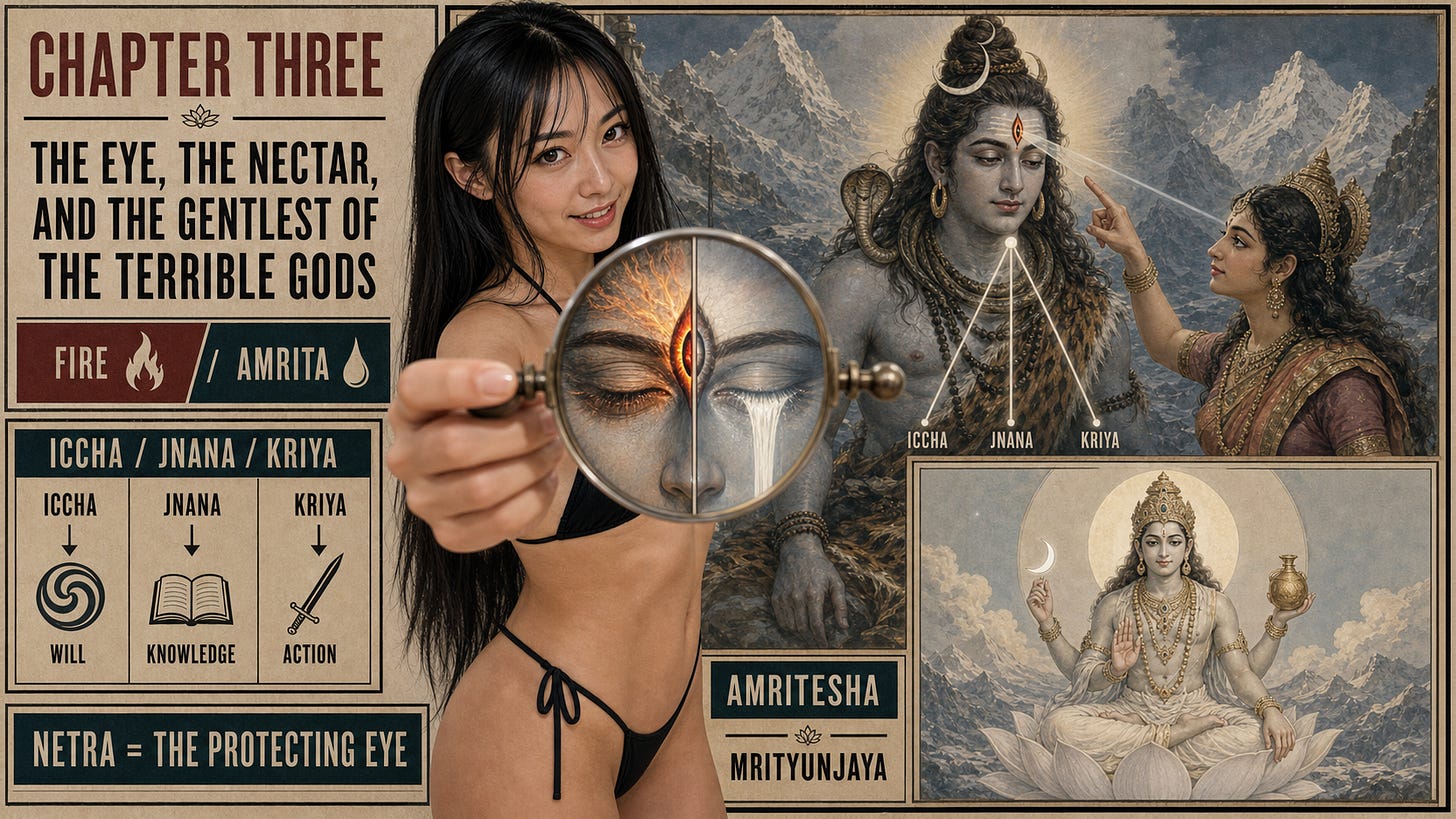
Chapter Three: The Eye, the Nectar, and the Gentlest of the Terrible Gods
Why an eye?
Every tradition that remembers Shiva remembers the third eye. It sits closed in the middle of his forehead, and the mythology is unanimous about what happens when it opens. When Kama, the god of desire, fired his arrow of flowers at the meditating Shiva, hoping to wound him into love, Shiva's third eye opened and a needle of fire reduced the god of desire to a smear of ash. The eye is the most feared weapon in the Hindu cosmos. It ends things. At the end of a world-age, it is this fire that burns the universe clean.
The first chapter of the Netra Tantra opens inside this mythology, and it does something lovely with it. The scene is Mount Kailasa. Shiva sits at ease among his hosts, with Parvati beside him. And the Goddess, seized by a question, takes hold of her husband's feet in the formal gesture of a student and asks him, in effect: explain your eye to me.
Her question is precise, and it is the question of a physicist as much as a lover. An eye, she observes, is by nature a watery thing, soft, luminous, made for grace. How can this same organ become fire? How did it burn Kama? How did it burn Time itself? How can one and the same eye be the source of the nectar that sustains the worlds and the flame that ends them? What is this thing in your forehead, she asks, which no one has ever explained, which is unknown to the sages, unknown to the gods, unknown even to me?
Shiva's answer fills the rest of the book. But its core arrives quickly, and it is the theological heart of everything that follows. The eye, he says, is his innermost essence, his vital power, the concentrated quintessence of his being. The text reaches for the most intimate language it has: the eye is like his very seed, the strongest of the strong, the essence of all vitality, the core of immortality. From it streams the triple power through which he wills, knows, and acts, the three goddesses Iccha, Jnana, and Kriya: Will, Knowledge, Action. Fire and nectar are its two faces because destruction and grace are one capacity. The eye that burned desire to ash is the same eye whose glance is amrita, deathlessness, for the one it protects.
Hold that double image, because the entire book lives inside it. A power that annihilates whatever threatens, and nourishes whatever it shelters. A flamethrower that is also a fountain.
The deity who embodies this power is the hidden hero of our story, and he deserves a proper introduction, because almost nobody outside the tradition has heard his name.
He is called Amritesha, or in fuller form Amriteshvara: the Lord of Nectar. He is also called Mrityujit and Mrityunjaya, the Conqueror of Death. Technically, by the classifications of the tradition, he is a Bhairava, one of the terrible forms of Shiva who preside over the wild scriptures. But open the visualization the text prescribes and you will not find a single skull.
The practitioner is told to see him white, radiant white, like jasmine, like the moon, like snow, the color that everywhere in this symbolic world means nectar, coolness, the substance of immortality. He sits on a white lotus. His face is serene. In his hands he holds the moon and a vase brimming with amrita, the elixir of deathlessness, and his gesture is the gesture of granting wishes and dispelling fear. Beside him sits his consort, Amrita Lakshmi, the Nectar Goddess of fortune, equally luminous. Together they are a vision not of terror but of inexhaustible, shining life.Think about what this means. The scariest classification of scripture in the Shaiva canon, the Bhairava stream, here produces its gentlest possible god: death's conqueror imagined as a being made entirely of the substance that cancels death. The logic is deeply Indian and deeply tantric. You do not defeat death with a bigger death. You defeat it with concentrated life.
Even the name of the book carries this medicine. Netra is the ordinary Sanskrit word for eye, but the tradition delighted in hearing inside it the verbal root ni, to lead, to guide, to protect. The Eye, read this way, is the Protector. The commentarial tradition explicitly connects the title to this protective sense: the Lord of the Eye is the one who watches over.
A god of nectar, a protecting eye, and a mantra of three syllables. Before we open the toolbox, let us walk the corridors of the book itself and see how it is built.
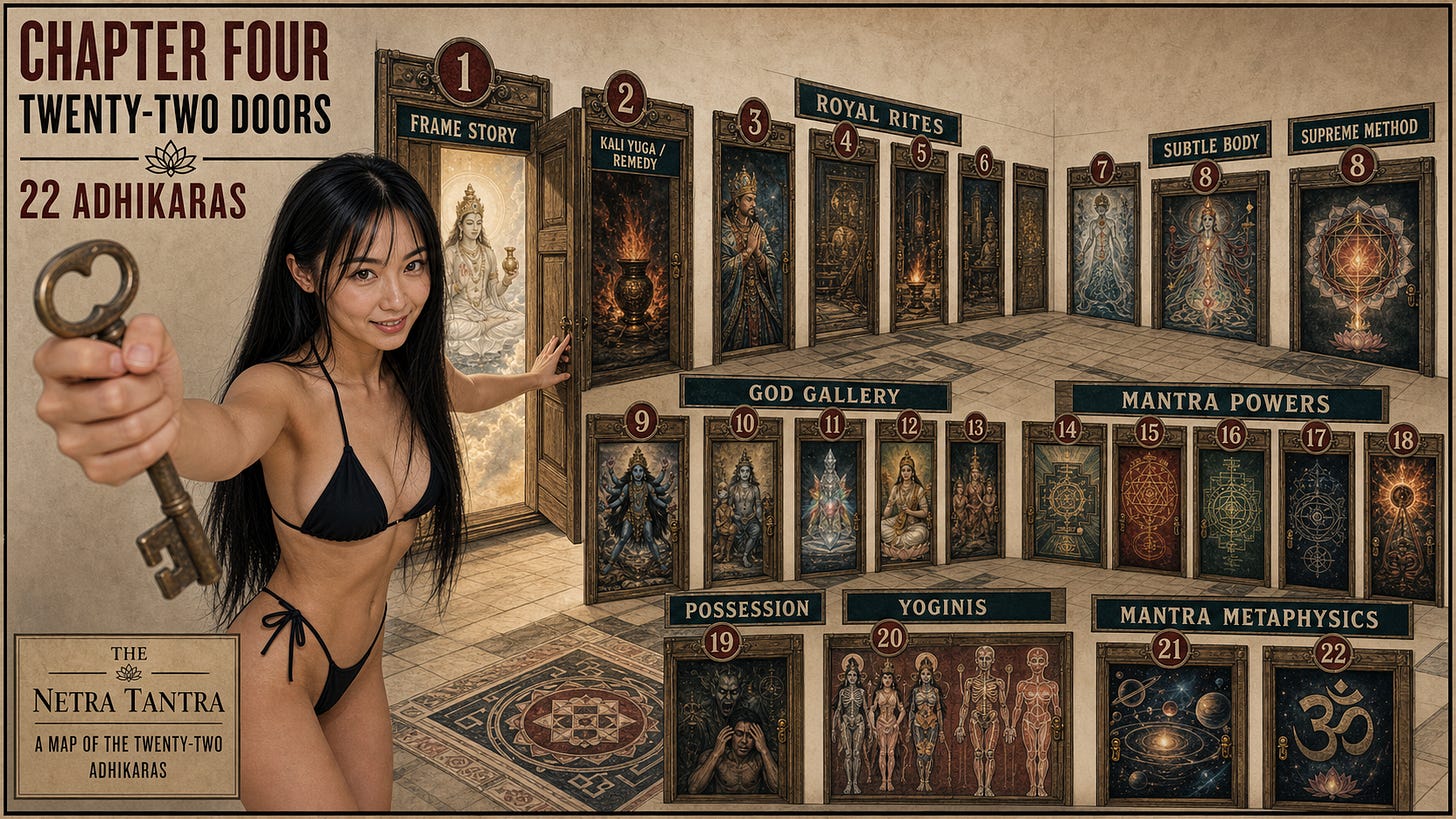
Chapter Four: Twenty-Two Doors
The Netra Tantra is organized into twenty-two chapters, which it calls adhikaras, and they are wildly uneven in length and mood. Reading straight through is like walking a corridor with twenty-two doors, behind which you find, in turn, a theology lecture, a ritual workshop, a yoga laboratory, an art gallery of gods, and a demonological emergency room.
Let me give you the floor plan, because we will spend the rest of our journey inside these rooms.
The first chapter, as we saw, is the frame story: the Goddess asks about the eye, and Shiva unveils Amritesha and the supremacy of his power. The second chapter shifts into the age of degeneration, the Kali Yuga. The Goddess looks at the suffering of beings, at the cruel entities that cause disease and disorder, at the special vulnerability of kings and their families, and asks for a remedy. The remedy Shiva gives is the mantra, and he gives it in code, through a cipher the tradition calls mantroddhara, the extraction of the mantra. We will crack that code together in the next chapter, because it is one of the most fascinating procedures in all of tantric literature.
Chapters three through six are the working core of the court ritualist. The worship of the Conqueror of Death, the rules of the fire offering, initiation, the consecration bath, and the great rites of appeasement and prosperity, shanti and pushti, performed above all for the protection of the king. Here are the diagrams, the lotus mandalas with names written into their hearts, the offerings, the amulets.
The chapter the text calls the subtle method turns the book inward, and it is the chapter scholars love most. After the gross method, sthula, the method of outer ritual, comes the subtle method, sukshma, and unfolds one of the earliest complete maps of the yogic interior body: the wheels, the channels, the knots, the supports, the spaces. If you have ever heard the word chakra, you have inherited a fragment of the world this chapter codifies. Then comes the supreme method, para, where ritual and visualization both fall away and what remains is recognition. Three chapters, three bodies, three ways of defeating death. This ascending staircase, gross to subtle to supreme, is the architecture of the whole work.
Chapters nine through thirteen are the art gallery, and they contain the book's most diplomatic surprise. Here the text systematically describes how Amritesha is to be worshipped through the forms of other gods. Through the orderly Siddhanta. Through the leftward current of Tumburu and his four sisters. Through the clan goddesses of the Kula. Through Vishnu, through the Sun, through Brahma. We will stand in this gallery later and ask what it means that a single deity is taught as the secret occupant of every other deity's image.
Chapters fourteen through eighteen return to the mantra: its powers, the protections it grants, the armor rite called kavacha, the magical accomplishments, the goddess of the mantra, and the purifications a mantra itself must undergo before it will work, because in this world mantras are living beings that can be asleep, wounded, or hostile.
And then comes the night side of the book. Chapter nineteen is the longest chapter, over two hundred verses, a full treatise on possession: the taxonomy of seizers, the symptoms by which the invading entity is identified, and the rites by which it is appeased or expelled. Chapter twenty continues into the yoginis, the powerful female spirits who reside even in the tissues of the human body. These two chapters are among the richest sources on demonology and possession that survive from the entire medieval world, and one major scholar has argued they are the oldest stratum of the book, the ancient core around which everything else crystallized.
Chapters twenty-one and twenty-two close the corridor with a meditation on what a mantra actually is, metaphysically, and a final exposition of the three syllables, unpacked phoneme by phoneme, as the body of the god himself.
That is the building. Now let us pick up the master key.
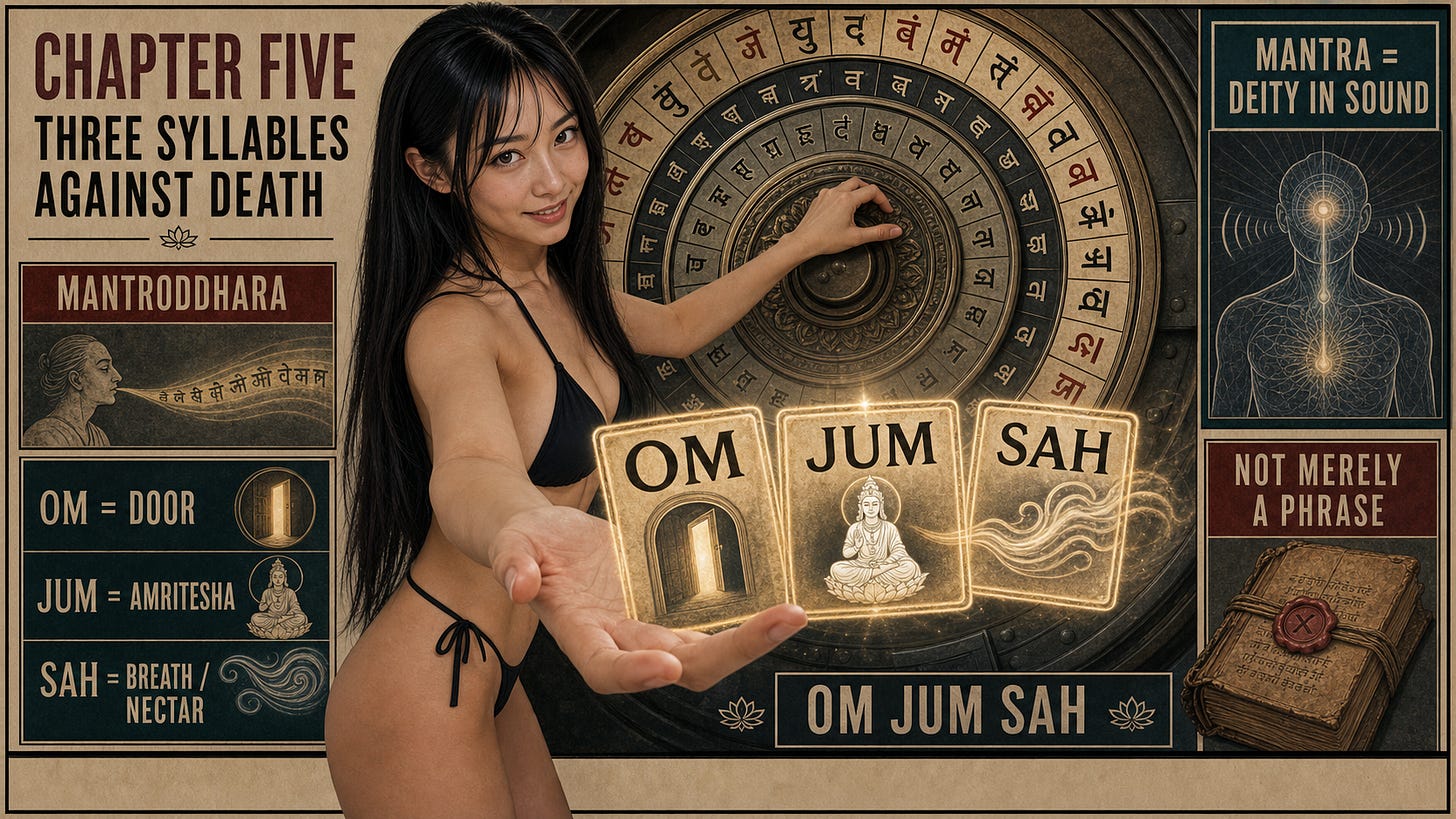
Chapter Five: Three Syllables Against Death
Here is the entire weapon, the thing the king's chaplain carried through the snow, the engine at the center of the whole book.
OM JUM SAH.
Three syllables. You can say them in under two seconds. The tradition holds that, properly conferred and properly used, they protect against fever, demons, sorcery, poison, the diseases of children, untimely death itself. Every ritual in the Netra Tantra, from the bathing of an emperor to the rescue of a possessed child, runs on these three sounds.
To understand why anyone believed this, you have to understand what a mantra is in this world, and you have to unlearn the modern assumption that it is a phrase with a meaning, something you could translate. OM JUM SAH does not translate. It is built mostly from what the tradition calls bija, seed syllables: compressed, meaningless-looking sounds that are held to be the deity in sonic form. A bija is to its god what a seed is to a tree. The full deity, with his white limbs and his vase of nectar, is the unfolded form. The syllable is the packed form. In this metaphysics, which the final chapters of the Netra Tantra spell out, the universe itself is vibration before it is matter, and a mantra is a thread of the original creative sound placed into a human mouth. You do not recite a mantra about Amritesha. In the act of correct recitation, the texts insist, the mantra is Amritesha, present, sounding, alive on the breath.
Because the mantra is the god, the text refuses to simply print it. This brings us to one of the most wonderful procedures in tantric literature, the cipher I promised you: mantroddhara, the extraction of the mantra.
In its second chapter, when Shiva finally agrees to reveal the great weapon, he does so in riddles spread across more than a dozen verses. The procedure works like this. The Sanskrit alphabet, all of it, is first laid out as a sacred diagram, because in this tradition the alphabet is the Goddess herself, the Matrika, the mother of all words and worlds. Then the text walks the initiate through the grid by clues: take the letter in such-and-such a position, join it with the sound that arises in such-and-such a place, crown it with the dot of resonance. Letter by letter, the practitioner assembles the syllables the way a safecracker feels out a combination. Scholars who have studied this passage, notably Patricia Sauthoff in the first full monograph on the text, map how verses seventeen through thirty-three of chapter two encode the extraction step by step.
Why the secrecy game, when any reader of the text could presumably work the puzzle out? Three reasons, and they take us deep into the tantric mind. First, initiation: the cipher guarantees that the mantra passes through a living teacher, because in practice you learn the solution from the mouth of the guru, and a mantra taken from a book, the tradition says flatly, is dead. Second, power: an extracted mantra has been built inside the practitioner's own awareness, letter by letter, which is already a meditation. And third, reverence: you conceal what is precious. The text is a sheath, and the cipher is the knot on the sheath.
Now let us look at the blade itself, because the three syllables are three different kinds of sound doing three different jobs, and the final chapter of the tantra unpacks them exactly this way.
OM you know. It is the most famous sound in all of Indian civilization, the pranava, the primal hum, the syllable the Upanishads call the bow from which the self is shot into the absolute. It opens the mantra the way a door opens a house.SAH is subtler. It is connected to the breath itself. In the yogic analysis, every creature's breathing already murmurs a mantra: the inhalation hisses sa, the exhalation sighs ham, so that all day and all night every living being unknowingly repeats hamsa, hamsa, the sound that is also the word for the wild gander, the great symbol of the free soul. SAH, ending in the unvoiced breath called visarga, a pure aspiration, is this life-breath distilled. It carries the nectar quality, the amrita, the cool out-flowing of life.
And between them sits JUM, the strange one, the seed that belongs to no dictionary. JUM is the bija of Amritesha himself, the dense sonic body of the Conqueror of Death. The J sound, the U vowel, and above them the anusvara, the humming nasal resonance written as a dot, which in tantric sound-theory is the bindu, the point where sound gathers into pure vibrating potency before dissolving into silence. Inside this one syllable, the tradition hears the entire victory over death compressed: a sound that rises, hums at the point of concentration, and melts upward past hearing.
So the weapon, read as the tradition reads it: the absolute opens, the deathless lord stands in the middle, the living breath seals it. Door, god, breath.
Now, how is it used? This is where your ears should lean forward, because here the text becomes pure procedure, and the procedures are beautiful.
The simplest use is japa, repetition, on a rosary, in fixed counts, hundreds of thousands of repetitions to bring the mantra to life in the practitioner. But the working applications are more surgical. Suppose the chaplain must protect a particular person: the queen, say, or a sick child, or the king riding to war. The core technique is to take the name of the person and encase it inside the mantra. The officiant writes or recites: OM JUM SAH, then the name, then SAH JUM OM. Forward, the name, and then the mantra again in reverse. The texts call this sampuṭa, encasement, and the image behind the word is a casket made of two bowls closed against each other. The name, which in this ritual world is a real substitute for the person, now sits inside a sealed container of divine sound. The mantra folded back on itself has no open end. Death finds no seam.
Notice what is happening here, because it answers a question every student of mantra eventually asks: why do some deployments run forward only, and some forward and backward? The mantra in ordinary recitation is asymmetrical, a directed arrow of sound: opening, deity, release. It flows like the breath it rides on, out from silence into the world. But when the work is enclosure, protection, sealing, the asymmetry is deliberately cancelled. The reversal closes the circuit. Sound goes out, sound comes home, and what lies between is locked inside the god. In the hostile and reversing rites of the wider tradition, recitation in reverse order, viparita, is itself a recognized technology, used to turn spells around, to send aggression back to its sender, to unmake what was made. Direction, in this science, is meaning. A mantra is a vector, and the ritualist is doing geometry with it.Around this core the Netra Tantra builds an entire arsenal. The mantra is installed on the body part by part, crown, face, heart, navel, feet, in the procedure called nyasa, which turns the practitioner's own body into the deity's body, on the logic the tradition states as a law: only a god can worship a god, and only a god can fight what gods fight. The mantra is written into diagrams. It is wrapped around names in protective wheels. It is recited over water that is then used to bathe the endangered. It is, in the kavacha or armor rite, distributed over the whole body of the protected person, syllable by syllable, until the man wears the god as chain mail.
Three syllables. The chaplain in our opening scene carried no sword through the snow. He did not think he needed one.
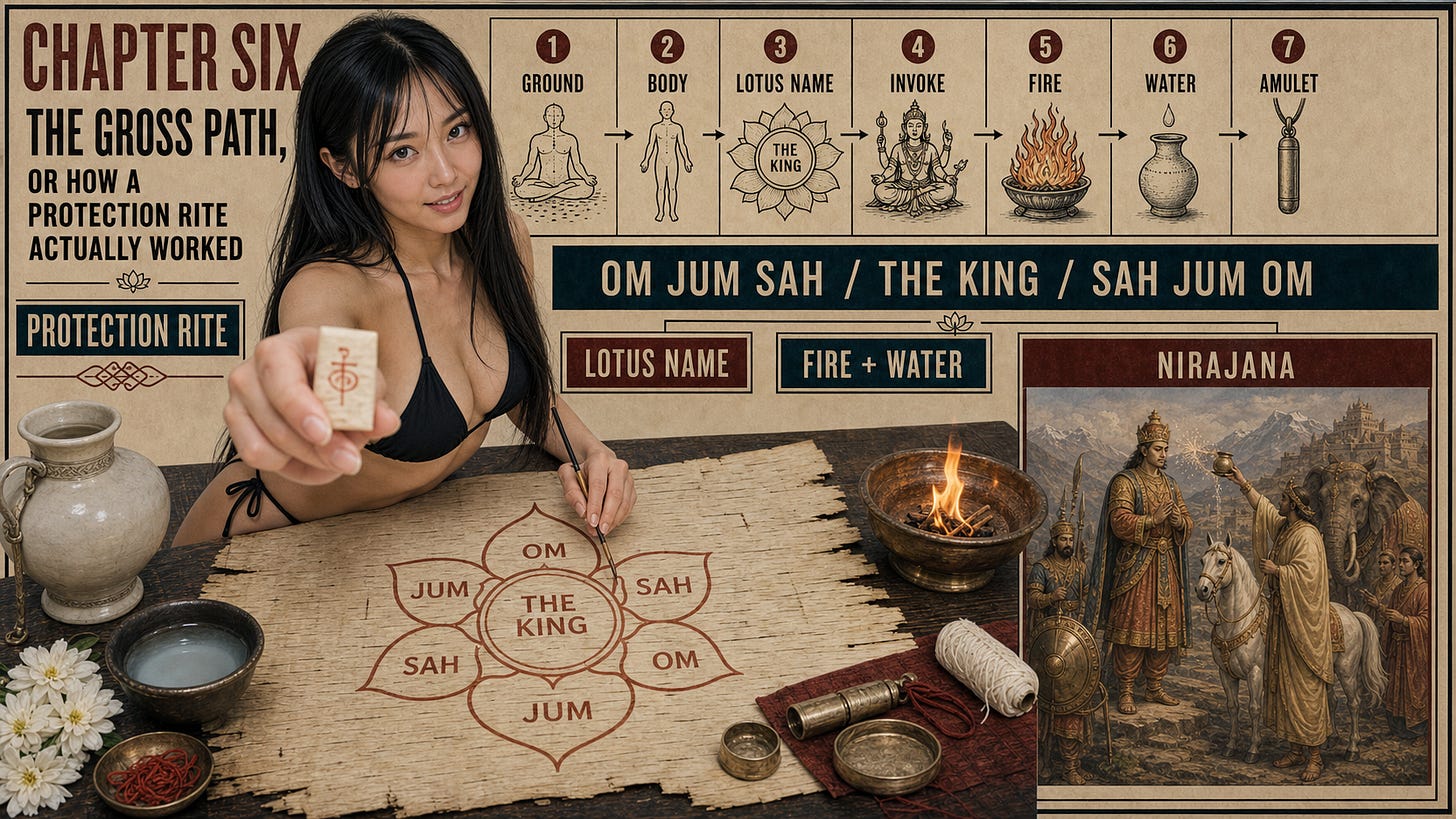
Chapter Six: The Gross Path, or How a Protection Rite Actually Worked
Now I want to do something the original text would approve of and most modern books about tantra never dare. I want to walk you through the procedure. Step by step, as a craft. Because the Netra Tantra is, before anything else, a working manual, and you have not understood a manual until you can see the work.
The text calls this whole level of practice sthula, the gross method: the path of outer ritual, performed with material things, for goals you can name. The two royal categories of goal are shanti, appeasement, the calming of dangers, diseases, demons, and bad influences, and pushti, prosperity, the active increase of health, wealth, power, and life. Below and around them spread the other classical aims of ritual action, down to the aggressive rites this text touches with notable restraint compared to its wilder cousins.
So. A protection must be performed. Perhaps the king has had evil dreams. Perhaps a prince is feverish, or the astrologers have flagged a dangerous planetary month, or an enemy kingdom is suspected of having commissioned exactly the kind of sorcery Kalhana describes. The officiant is summoned, and his work unfolds in recognizable stages.
First, the ground. A site is chosen and purified, smeared with the traditional cleansing substances, marked out. Ritual in this tradition always begins with the conquest of territory: a piece of ordinary earth is converted, by mantra and water and intention, into a zone where the rules are different.
Second, the body. The officiant purifies himself, and then, through nyasa, installs the mantra limb by limb onto his own frame, builds the god onto his bones. From this point in the rite he is, functionally, Amritesha. The logic is stark and consistent: a frightened man cannot expel fear, and a mortal cannot command the servants of death. The first thing the technology protects is the technician.
Third, the diagram. On the prepared ground, with colored powders, or on birch bark, the great writing material of Kashmir, with auspicious inks like yellow gorochana or saffron, a mandala is drawn. The Netra Tantra's protective diagrams are typically lotus designs: a heart, a ring of petals, an enclosure. And here comes the move at the center of the entire gross method. Into the heart of the lotus, the officiant writes the name of the person to be protected. The queen's name, the child's name, the king's name. Around that name, in the petals and the enclosing rings, he writes the syllables of the mantra, encasing the written name exactly as the spoken rite encases the spoken name. OM JUM SAH around a human name, written, sealed, locked.
Stop on this for a moment, because the underlying theory is one of the most interesting ideas in the book. In this ritual science, the name is the person. Modern scholarship on the text puts it precisely: the name functions as a full ritual substitute for the named. To write the queen's name inside the nectar lotus is to place the queen herself, in her subtle aspect, inside the protection. Action performed on the name travels to its owner. The same principle, of course, powers the dark side of the craft, which is exactly why hostile sorcerers also wanted your name, and why the counter-sorcery chapters of this literature treat names as assets to be guarded. Every defensive technology implies the offense it answers.
Fourth, the invocation. The deity is summoned into the diagram, or into a vase, the kalasha, a pot filled with water, herbs, jewels, and mantra, which becomes for the duration of the rite the throne and reservoir of the god. The officiant visualizes the white lord with his moon and his vessel of nectar, radiant at the center of the lotus, with the written name resting inside his light.
Fifth, the offering and the fire. Worship is presented: flowers, incense, lamps, food, all white where whiteness can be had, because in this rite everything speaks the color-language of nectar. Then the homa, the fire offering, the old Vedic engine retuned to tantric fuel: oblations of ghee, of sesame, of milk-rice, poured into consecrated fire with the mantra at every pour, in counts that scale with the gravity of the case. The fire carries; the mantra addresses; the count accumulates.Sixth, the application. The power raised must now be delivered to the endangered body. The water of the vase, saturated with mantra, is used to bathe or sprinkle the protected person: this is abhisheka, the consecration shower, the same gesture by which kings are crowned, here used as medicine. For continuing protection, an amulet: the diagram with the encased name, drawn small on birch bark, folded, sheathed in cloth or a metal capsule, and tied to the body, to the arm of a man, the neck of a child. The book devotes loving attention to these wearable seals, and the kavacha chapter extends the principle until the whole body is armored in distributed syllables.
And seventh, in the royal case, the spectacle. The grandest application of the gross method is the nirajana, the great lustration, performed for the monarch at the turning of the seasons or before the army marches. The king, his weapons, his horses, his elephants pass through ritual fire and water and light; the chaplain's mantras wash the entire apparatus of state. The kingdom itself receives the amulet.
Now, you may stand at the end of this procedure and ask the modern question. Did it work?
Ask first what work it was doing. In a world where a child's fever had no microbiology, where a king's sudden death had no autopsy, where misfortune arrived without explanation, this technology converted helpless terror into structured action, named the invisible enemy, and surrounded the threatened person with the focused attention of their entire community, concentrated through a specialist who radiated trained confidence. Whatever else one believes, that conversion is real, and every hospital chapel and bedside vigil in the modern world still runs a version of it. The Netra Tantra is a machine for metabolizing fear. Its gears are syllables.
But the text itself would consider everything we have done so far elementary. Outer ritual, it says plainly, is the gross method, taught for those who need form. The deeper conquest of death happens elsewhere: inside the body.
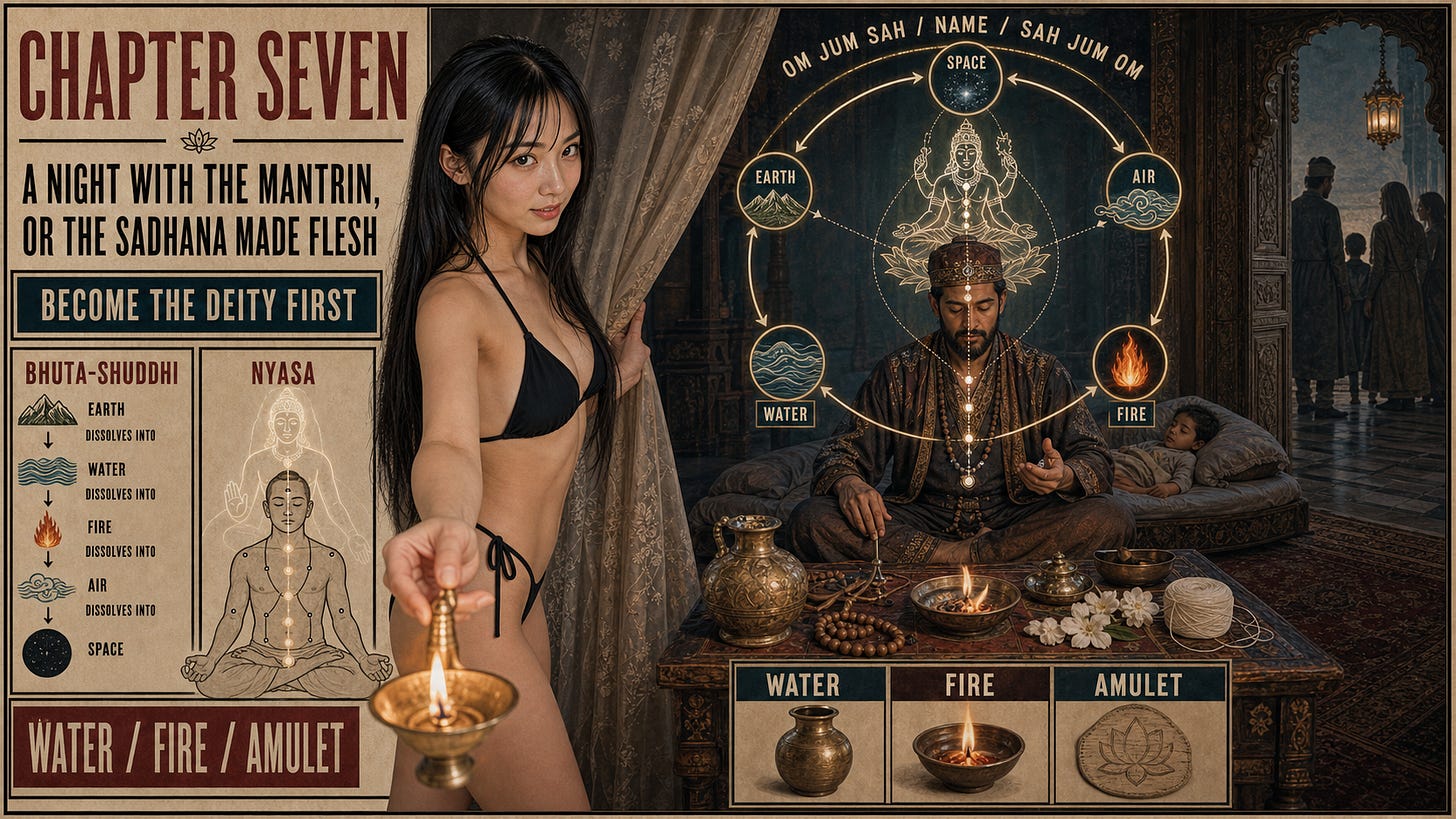
Chapter Seven: A Night With the Mantrin, or The Sadhana Made Flesh
I have given you the architecture of the rite. Now let me do what the old teaching books do, the ones that actually transmit something. Let me tell it as a night, and put you inside it, because a procedure described from outside is a recipe, and a procedure entered from inside is a practice. The details that follow are real. Where I have filled a silence in the text with the practice of the living tradition, you will feel no seam, but the sources at the end will show you every stitch.
A child is dying in the palace. Not the king's heir, this time, but close enough: a boy of five, nephew to the queen, who three nights ago woke screaming from a sleep he could not be pulled out of, and who now lies rigid, then slack, then rigid again, his eyes rolling to the whites, his small body burning. The court physician has done what the court physician does and has withdrawn. Now they have sent, as they always finally send, for the mantrin.
He does not hurry. Hurry is the first thing his training burned out of him. He has the boy moved to a clean room with one door. He asks three questions: when did it begin, where was the child when it began, and what did the child see. The answers matter, because in the science he serves, an affliction has an address and a face, and the cure begins by learning them. The boy, they say, had wandered at dusk to the empty tank behind the old shrine, the disused water, the lonely place, and had come back wrong. The mantrin says nothing, but inside he has already narrowed the field. The empty quarters, the abandoned water at the closing of the day. He knows the kind of thing that waits there.
Now watch what he does first, because it is the move a beginner always skips and a master never does. He does not begin work on the child. He begins work on himself.
He bathes. He sits. He performs the long purification the tradition calls bhuta-shuddhi, the cleansing of the elements, and it is worth slowing down to watch, because this is sadhana in its bones. With his eyes closed, he feels the solidity of his own body, the earth in it, the weight and resistance of flesh and bone, and with breath and a seed-syllable he dissolves that earth-quality down into water, into the fluid cohesion of the body, so that solidity loosens into flow. Then water he dissolves into fire, the body's heat, until cohesion gives way to the sense of bare warmth. Fire he dissolves into air, into movement and breath alone. Air he dissolves into space, into a sheer open emptiness where, for a long moment, he is no longer a man in a room but an awareness with no edges. The frightened mortal who walked into the palace is, for that moment, gone. There is no one there for death to threaten.
And then, from that emptiness, he builds himself back, but not as the man who entered. Through nyasa, the placing, he installs the deity onto his own body part by part. Touching the crown of his head, he sets there the syllable and the presence of the Lord of Nectar. Touching his forehead, his throat, his heart, his navel, his thighs, his feet, he distributes the god across his own frame, sealing each station with breath and sound and the touch of the fingers, until the body sitting in that room is no longer merely his. He has become, for the duration of the work, Amritesha, white as the moon, holding the vase of deathlessness. This is not metaphor inside the system and it is not vanity. It is the load-bearing law of the whole craft, and the tradition states it without blinking: only a god can fight what gods fight. A terrified man cannot command the servants of death. So the first thing the technology protects is the technician, and the first sadhana is the one performed on no one but the self.
Only now does he turn to the child.
He prepares the seat of the work. He has, by long practice, a small lustral vase, the kalasha, which he fills with clean water, and into the water he puts what the rite asks: a few leaves, a pinch of the cooling herbs associated with the nectar deity, a thread, sometimes a small gold object, because gold in this symbolic grammar is solidified light. Over this vase he will now spend the better part of the night doing one thing: pouring the mantra into the water until the water changes its nature. He sits with his spine like a stacked column of coins, the way his teacher arranged it the first night with two fingers against his back, and he begins the recitation.
Here is the mantra at work, the three syllables we cracked earlier. But for protection he does not let it run as a simple open arrow. He takes the boy's name, the true name, the one the family gives him quietly because in this world a name works as a handle on the very soul of its owner, and he encloses it. Om jum sah, he sounds, and then the child's name, and then sah jum om, the mantra again reversed, folding shut. Forward, the name, backward. He repeats it, and each repetition is a casket closing: the open, directional, outward-flowing sound of ordinary recitation is deliberately turned and sealed against itself, so that the name now rests inside a container of divine sound with no open end for the affliction to enter. The asymmetry of the living mantra, which in its natural state flows outward like the breath, is on purpose cancelled here, because the work tonight is not expression but enclosure. He counts on a rosary of rudraksha beads worn smooth by his teacher and his teacher's teacher, and he does not let his attention slide off the meaning of the sounds even once across many hundreds of repetitions, because a mantra recited with a wandering mind, the tradition says flatly, is a dead mantra, a sound with no one home.
While the eastern sky is still black he draws the diagram. On a square of clean birch bark, the writing skin of Kashmir, with ink the color of saffron, he draws a lotus: a center, a ring of petals, an enclosing boundary. In the heart of the lotus he writes the child's name. Around it, in the petals, he writes the syllables of the mantra, and around those, the enclosing wall of sound. The name of the boy now sits, written, inside the same sealed enclosure that the spoken rite built in the air, the written and the spoken protections folded one inside the other like two hands cupped around a flame in wind. This is the procedure people half-remember when they imagine someone writing a sacred letter on an object: take the substance, mark it with the syllable, charge it with the name. The substance here is bark, the mark is Sanskrit, the charge is a child's true name set in the middle of a god.Then the fire. He kindles a small homa, a fire offering, in a clay hearth, and feeds it with what the appeasing rites ask: ghee, white sesame, milk-cooked rice, each spoonful given to the flames on the back of a syllable, the fire carrying the offering upward, the mantra naming where it should go. The counts are not arbitrary. A light affliction takes one measure; a grave one, like a child whose breath the watchers can barely find, takes far more, and the mantrin will feed that fire past dawn if he must. The room fills with the smell of burning ghee and the low unbroken sound of the recitation, and the family, who were sent out, sit against the wall outside the one door and listen to it, and something happens to them too in the hearing, though the texts do not bother to record what, because the texts were written for the operator and not for the comforted.
When the vase-water has taken the mantra all night, it is no longer water. In the logic of the rite it is amrita, liquid deathlessness, the nectar that the white god pours from his vessel, now held in a clay pot in a sickroom. The mantrin lifts it and performs the abhisheka, the pouring-over, the same gesture by which kings are crowned, used here as medicine: he bathes the burning child in the charged water, or where the child is too fragile to be moved, he sprinkles it across the small body with a sprig of leaves, syllable by syllable, crown to feet, drawing the god down over the boy the way he drew the god onto himself at the start of the night. And then the last thing, the thing the family can keep when he is gone: he takes the small birch-bark lotus with the sealed name, folds it, binds it in a scrap of silk, and ties it at the child's throat or upper arm. The amulet. The kavacha, the armor, in its smallest and most portable form, a whole protective rite shrunk to a knot of cloth against a pulse.
Does the boy live?
The text does not promise. This is the honesty in it that I have come to trust. It gives the procedure, not the guarantee, the way an honest physician gives the treatment and not the certainty. Sometimes the fever broke at dawn and the family said the god had come, and sometimes it did not break and they said the affliction had been too strong or the karma too old, and the mantrin folded his vase and his beads and walked back out through the snow, and the science survived both outcomes because it had never promised to defeat death every time. It had promised only to meet it with form instead of helplessness, to give the terror an address and a procedure, to surround a dying child with the concentrated, trained, unhurried attention of a man who had spent the night becoming, as far as he was able, a god of nectar at a bedside. Strip away the birch bark and the Sanskrit, and ask whether we have stopped wanting exactly that at the bedsides of the people we cannot save. We have only changed the uniform.
That is the gross method, lived from the inside across one night. Hold it in your body, because the text is about to tell you something startling: that this entire night of fire and bark and charged water is the beginner's version. The real conquest of death, it says, happens with no vase and no fire at all, inside the body of the practitioner. It is time to open the seventh door the text itself opens, the chapter the yoga scholars treasure above all the rest.
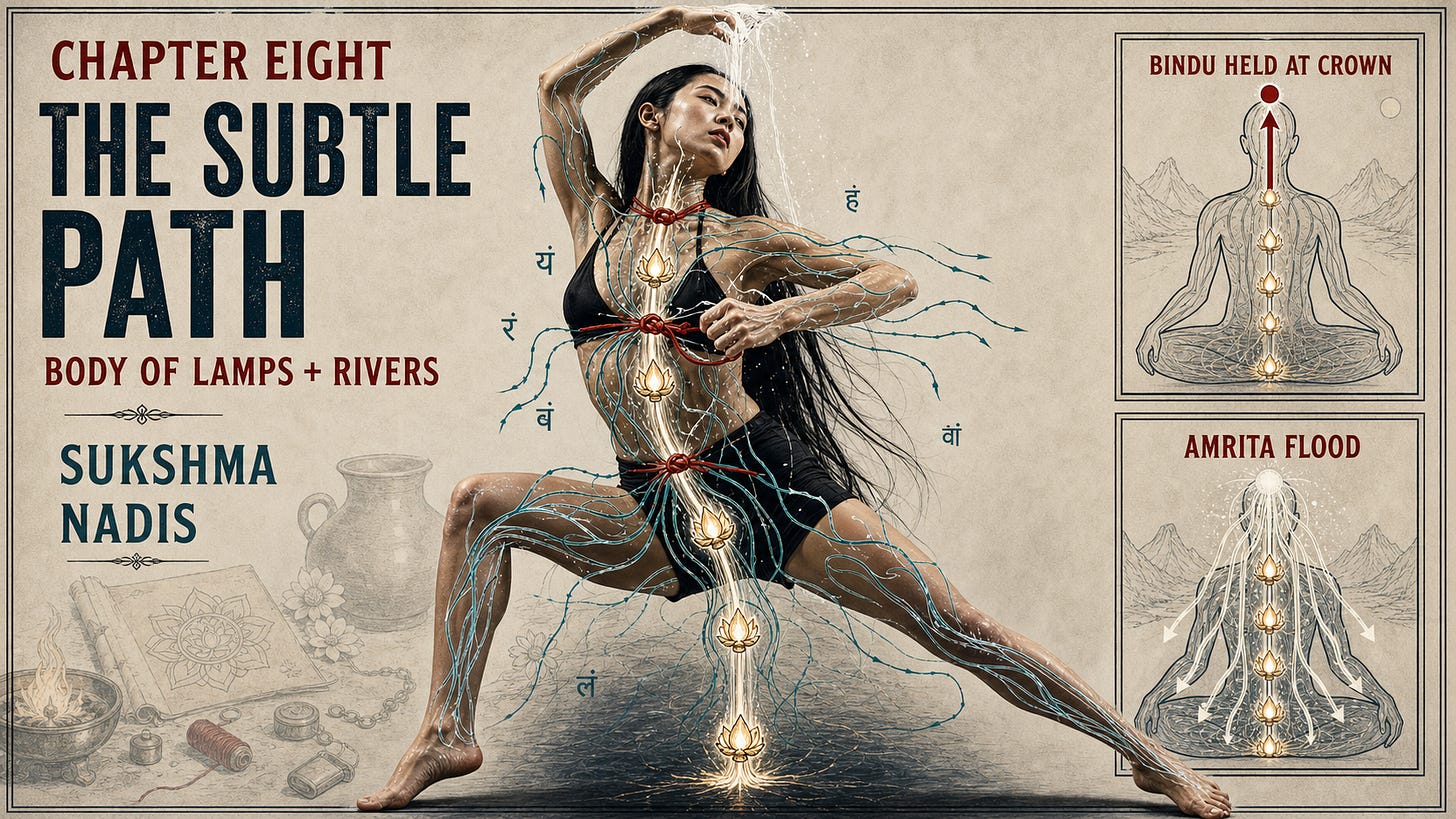
Chapter Eight: The Subtle Path, or The Body Made of Lamps and Rivers
This chapter of the Netra Tantra, the seventh of its twenty-two, is one of those rare stretches of medieval text where you can feel a tradition crossing a watershed. Scholars of yoga return to it again and again, it has now been separately edited and translated as a showcase of the whole work, and pieces of its interior map flowed onward into the later hatha yoga literature that eventually, centuries downstream and much transformed, reached the modern world. When a yoga teacher in Berlin or Los Angeles says the word chakra, a thin thread runs backward from that sentence through a thousand years of texts, and one of the early knots in the thread is tied here, in this chapter of a Kashmirian protection manual.
The premise of the subtle method, sukshma, is a complete change of venue. The gross method fought death in the outer world, with fire and birch bark and water. The subtle method announces that the decisive battlefield was always inside. The body, beneath its flesh, is traversed by a second anatomy, a physiology of life-force, and death is an event in that anatomy before it is ever an event in the flesh. Master the subtle body, and you have walked around behind death's lines.
So the chapter draws the map. And what a map it is. The text enumerates, station by station, an interior landscape of astonishing density: six wheels, the chakras, strung along the central axis from the base of the trunk to the head; sixteen supports, the adharas, points of concentration scattered through the body from the toes to the crown; three targets, the lakshyas, where the gaze of inner attention can be fixed; five voids, the vyomas, spaces of pure emptiness opening inside the subtle frame; the knots, granthis, where the flows are tied off and must be loosened; and the great web of channels, the nadis, the rivers of the life-breath, with the central channel running up the spine like a hollow stalk of lotus fiber.
If your eyes glaze at the numbers, hold instead the image the numbers serve. The chapter is teaching the practitioner to experience the inside of the body as an inhabited vertical country: rooted below, opening chamber by chamber upward, with a capital city at the crown of the head where Shiva himself resides. The practice consists of moving through this country with the breath and the mantra. The three syllables we cracked in chapter five are here taken inward and made into a vehicle: the uccara, the upward utterance, in which the sound JUM with its humming bindu is raised along the central channel, station by station, wheel by wheel, piercing the knots, ascending like a spark climbing a wick.
And then, at the summit, the chapter does something that makes historians of yoga sit up straight. It teaches the ascent twice, in two different versions, and the difference between them is a snapshot of Indian religious history in the act of turning.
In the first version, the practitioner raises the power to the crown of the head and holds it there, joined to Shiva at the summit. The underlying body-theory here is the older yogic anthropology of the seed: the vital essence, bindu, the same word as that dot of resonance above the syllable, must be drawn upward and retained at the crown, for the seed is life itself, and its downward loss is the slow leak through which death drains a man. Conquer the leak, ascend the essence, hold it in the head: immortality as perfect retention. This is the austere physics of the early yogis, and a vast literature of technique grew from it.
But the second version tells another story, and the great eleventh-century commentator on our text, of whom much more later, marks the difference explicitly, calling the first the method of the tantra and the second the method of the Kula, the clan path of the goddesses. In the second version, the power rises to the crown, reaches the abode of Shiva, and then the direction reverses. At the summit, the union of the ascended power with the god churns forth amrita, nectar, and the nectar pours back down, flooding the body, drenching every channel, every wheel, every tissue, down to the soles of the feet, an inner deluge of the substance of immortality. The Danish scholar Bjarne Wernicke-Olesen, one of the editors of the text, describes this as a genuine shift of anthropology: the older ideal of sealed retention giving way to a Shakta ideal of overflowing saturation. Immortality as flood.
Hold the two images side by side, because they are two complete theologies of the body. In one, the body is a leaking vessel, and salvation is the perfect stopper. In the other, the body is a dry garden, and salvation is the breaking of the dam. The first conserves; the second drowns. The Netra Tantra, courteous as ever, teaches both. But its heart is not hidden. This is the book of the Lord of Nectar. Its god holds a vase that pours.
And notice, finally, what has happened to the original assignment. The chaplain was hired to keep death away from a king's body. Chapter seven has quietly relocated the entire war. Death is now a pattern of flow inside the practitioner, and deathlessness is another pattern of flow, and the difference between them is trainable. The fee-paying client in the palace has faded from view. The subtle method protects the one who practices it.There is one more staircase to climb. Because the text now says: even this, the lamps and rivers and floods of nectar, is still imagery. Still something seen. Chapter eight asks what remains when even the inner landscape is allowed to dissolve.
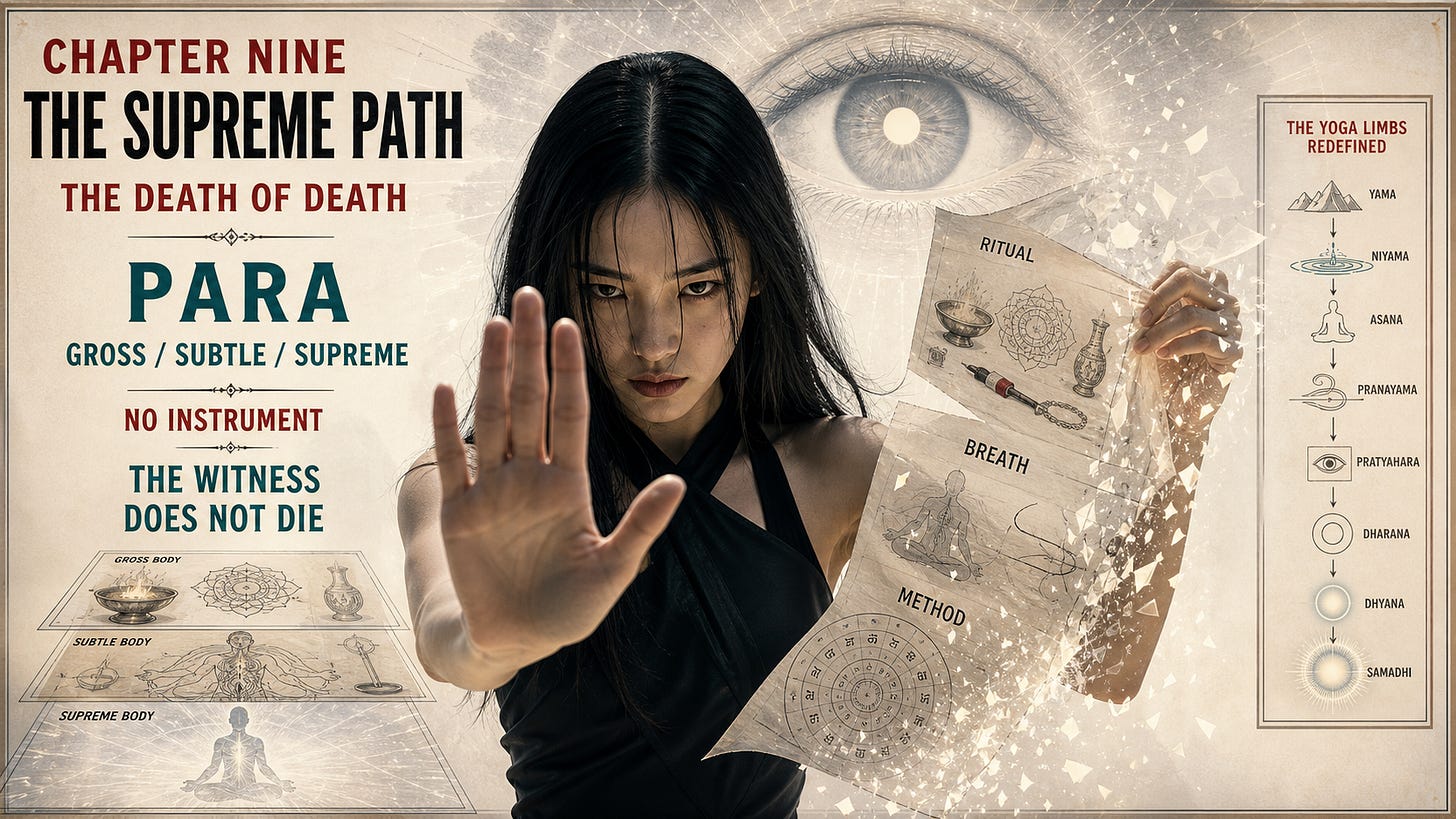
Chapter Nine: The Supreme Path, or The Death of Death
Chapter eight is short, and it is the summit of the book, and to modern ears it may be the strangest chapter of all, because at the top of this enormous machinery of protection there is suddenly nothing to do.
The text calls this level para, the supreme. And its method is the dismantling of method. The chapter takes the classical limbs of yoga, the famous ancillaries that every Indian student knew, posture, breath control, withdrawal of the senses, concentration, meditation, absorption, and redefines each one from the standpoint of ultimate reality. The scholar Somadeva Vasudeva, who has studied these systems closely, observes that the Netra Tantra's treatment here pushes so far toward transcendence that its closest cousins are the radical contemplations of the Vijnana Bhairava, the celebrated Kashmirian text of one hundred and twelve doorways into the absolute. In the supreme yoga, breath control no longer means counting breaths; it means resting in the power from which breath arises. Concentration no longer means fixing the mind on a point; it means recognizing the one who was always already concentrated, the witness that nothing has ever distracted.
You may recognize, from a certain distance, the logic of this staircase. The gross method fought death out in the world, with rituals, for a client. The subtle method fought death inside the body, with breath and nectar, for the practitioner. The supreme method declares the war itself a case of mistaken identity. What dies? The body dies, certainly; no Indian tradition is silly about that. But the body was never what you were. The light of awareness in which body, fever, demon, king, nectar, and lotus all appear, the Chit, consciousness itself, was never born, and the unborn does not die. Death is real for every object, and meaningless for the subject. The Conqueror of Death, at this altitude, is not a white god who defeats your enemy. He is the recognition that the enemy never had a target.
The three levels, the commentator will later say, correspond to three bodies of one and the same person: the gross body of flesh that ritual protects, the subtle body of breath that yoga transforms, and the supreme body which is simply consciousness, which needs no protection at all. Three readings of one human being, stacked like translucent pages.
And here the Netra Tantra reveals the shape that makes it more than a grimoire. The book meets you where your fear is. If your fear is fever and sorcery, it gives you fire and amulets, and means it. If your fear is the slow leak of life, it gives you the inner flood, and means it. And when you are ready to ask who exactly was afraid, it opens the last door, behind which there is no instrument at all, only the thing the first chapter promised the Goddess: the eye itself, the seeing that was never wet and never burned.
But we are not done. Because halfway up this staircase, the book does something almost without parallel in religious literature, something that tells us exactly what kind of civilization ninth-century Kashmir was. It opens its arms to every god in India.
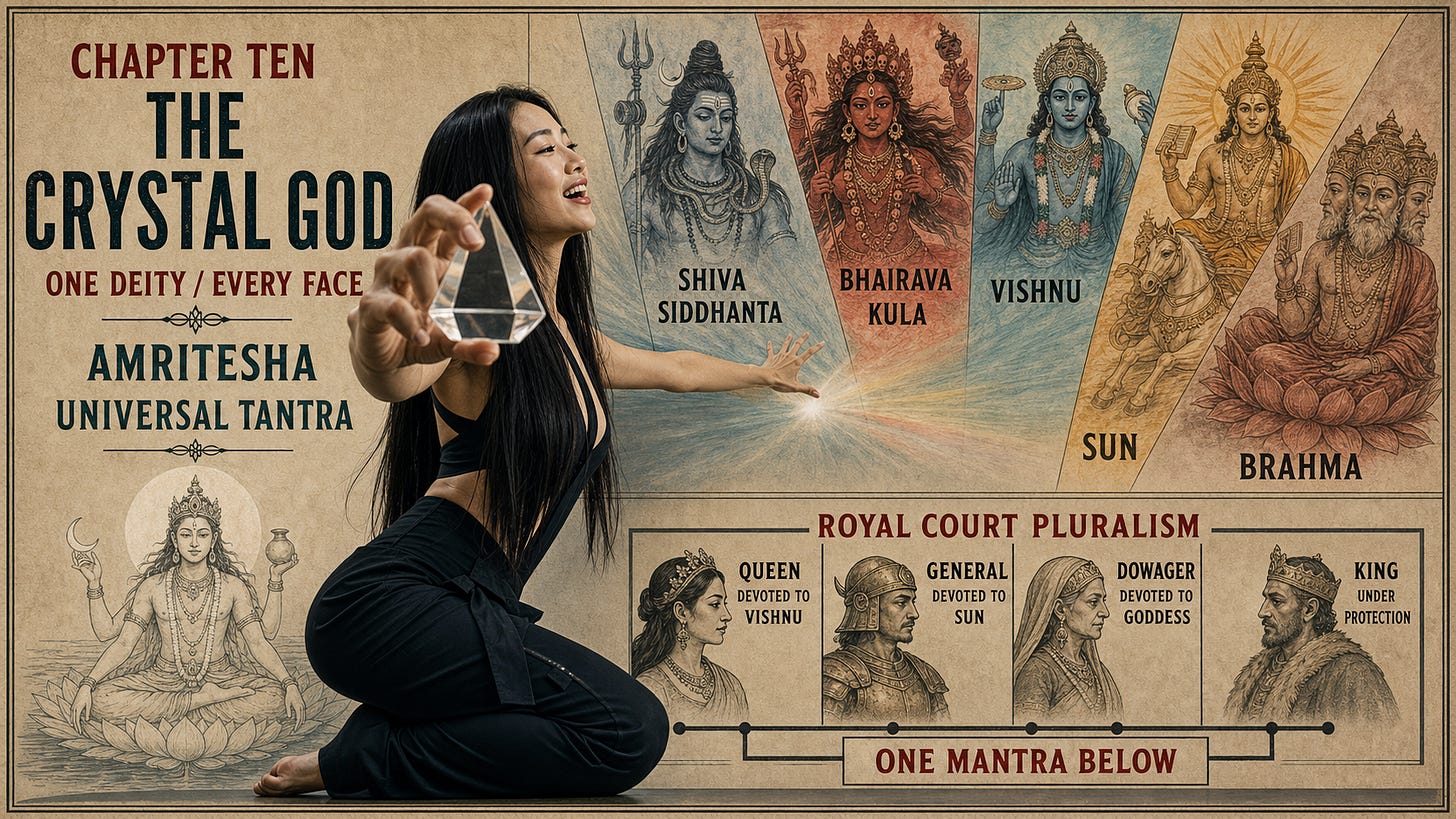
Chapter Ten: The Crystal God, or One Deity Wearing Every Face
Chapters nine through thirteen of the Netra Tantra form a gallery, and walking it, you pass visualization after visualization of deities who, by sectarian logic, should not share a building.
Here is the orderly Shiva of the Siddhanta. Here, from the leftward stream, is Tumburu, a nearly forgotten form of Shiva worshipped with his four sisters, brilliant white like snow or jasmine, attended by goddesses with names like Jambhani, the Crusher, and Mohani, the Bewitcher. Here is the mandala of Bhairava with his clan goddesses, the wild heart of the Kula. And then, astonishingly, the gallery leaves Shaivism altogether. Here is Vishnu, and the text's Vishnu is no generic icon: he is prescribed as a sixteen-year-old youth, beautiful, riding a ram, in a visibly erotic aspect, a form that startles even specialists. Here is the Sun god of the Saura cult. Here is four-armed Brahma, red as dawn, seated on the wild gander, holding his staff, his rosary, his water pot, and the four Vedas, a meditation image of a god who almost never receives one. The text pauses in this section to state, remarkably, that this teaching is open to all, women and men, of every caste and complexion.
What is going on? Has the book lost its sectarian mind?
The text gives its own answer, and it is one of the great images of Indian theology. Amritesha, it says, is pure and stainless like crystal. Hold a crystal against red silk and the crystal is red; against blue, blue. The Lord of Nectar has no form of his own to defend, and therefore every form is available to him. Whatever god you set him beside, he becomes, perfectly, while remaining colorless in himself. He pervades all the scriptures, the text says, and gives the fruits of all of them. Worship him in any tradition's shape, with any tradition's liturgy, and it is he, the deathless one, who receives the worship and returns the protection.
Modern scholarship has a name for what this makes the Netra Tantra: a universal tantra. Alexis Sanderson showed that the text deliberately overrides the boundaries between the branches of the Shaiva mantra-path, and even the boundary between Shaivism and everything outside it, by teaching one rite that can be inflected into the visual and liturgical dialect of any cult in the kingdom. And the moment you remember who the book's primary user was, the genius of the design snaps into focus. The royal chaplain served a court, and a medieval Indian court was religiously plural: the chief queen might be devoted to Vishnu, the general to the Sun, the dowager to the Goddess, the treasurer quietly funding a Buddhist monastery. A protector-priest whose god could appear inside every one of those devotions, without asking anyone to convert, was not merely a theologian. He was infrastructure. One mantra below, every god above; the kingdom's whole spiritual economy running on a single hidden current.
You may call this cynical statecraft or sublime theology, and the marvel of the text is that it gives you no way to separate the two. The crystal is a political instrument, and the crystal is a metaphysical truth, and the book sees no tension, because in ninth-century Kashmir the king's safety and the structure of ultimate reality were the same department.
There is a quieter implication, worth carrying with you long after tonight. The Netra Tantra is the rare scripture that builds, into its own ritual core, the proposition that the forms of the gods are clothing, and the wearer is one. It arrived at radical theological generosity centuries before the modern world began congratulating itself on the idea. It arrived there, characteristically, by way of a job requirement.
And now the corridor darkens. Because all of this shining machinery, the crystal god, the nectar, the lotuses of names, exists for a reason, and the reason has been waiting for us in the longest chapter of the book. It is time to meet what the Netra Tantra was actually afraid of.
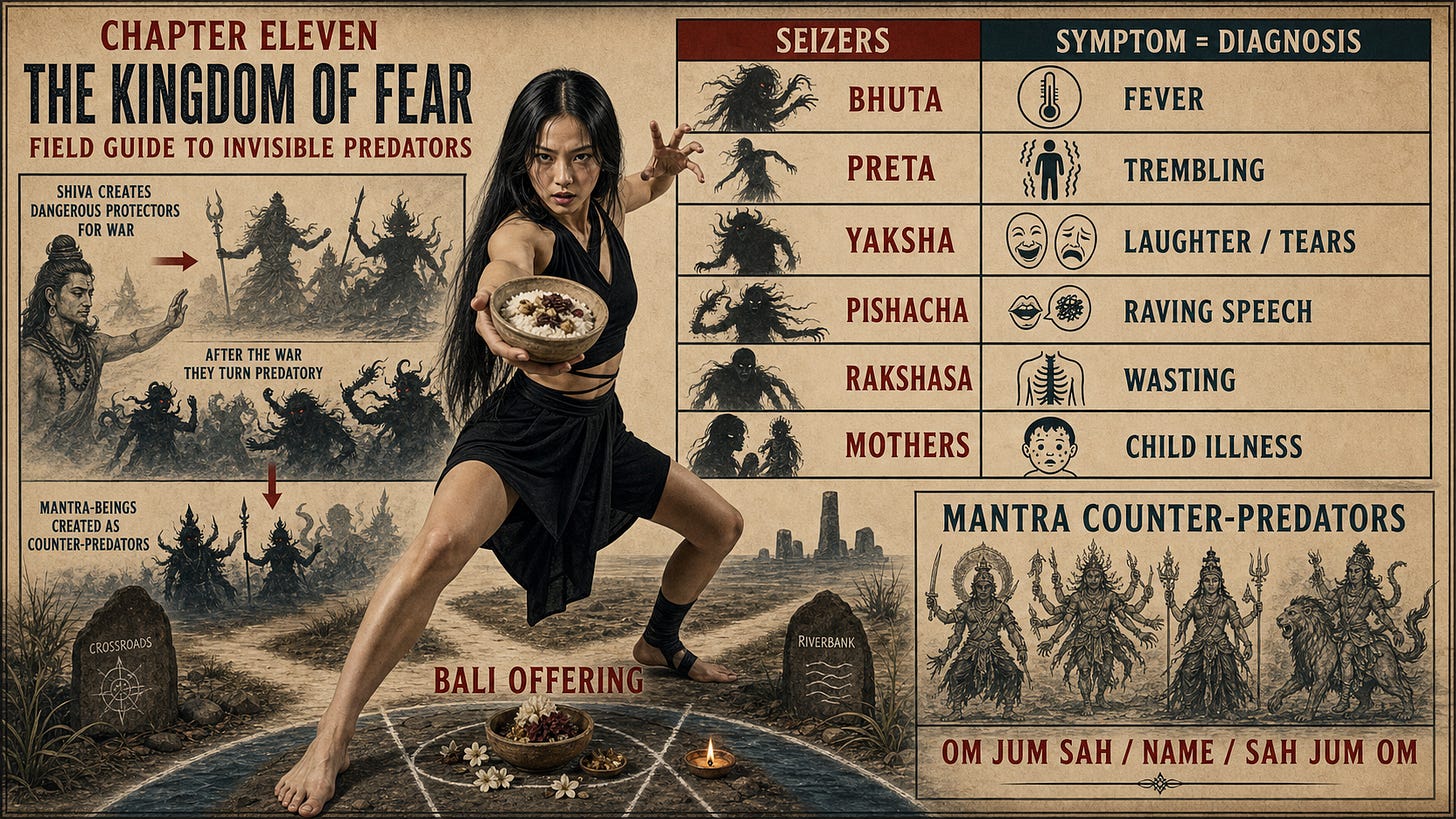
Chapter Eleven: The Kingdom of Fear, or A Field Guide to Invisible Predators
Chapter nineteen of the Netra Tantra runs to more than two hundred and twenty verses, the longest chapter in the book by far, and it is a sustained, systematic treatise on beings that seize human beings. The scholar David Gordon White, who has studied this material more closely than anyone, argues that this demonological core is the oldest layer of the text, the ancient sediment around which the courtly and yogic chapters later formed. If he is right, then the Tantra of the Eye began its life as something very old and very widespread: a manual for dealing with possession.
The chapter opens, as always, with the Goddess asking. She wants to know about the afflictions caused by the hungry dead and the wild spirits, the bhutas, pretas, yakshas, pishachas, rakshasas, the whole crowded zoology of the Indian invisible world, and how beings can be protected from them. And Shiva answers first with a story, a creation myth of the demonic, and it is a story worth hearing slowly, because it carries a very old wisdom about the nature of destructive power.Once, Shiva says, the gods were losing a war against the Daityas, the titans. To destroy them, I created armies of beings: the Mothers, the spirits, the Seizers, hosts upon hosts of them. And they did their work; the titans were crushed. But when the war ended, my creatures came to me and asked for a reward, and they asked for invincibility, and I granted it. And then, having no war left, the invincible ones turned on the worlds. They began to devour the very beings they had been created to protect, and even the gods could not stop them, because my own boon shielded them. So I created counter-beings: tens of millions of mantras, living male spell-beings, and vidyas, living female spell-beings, weapons of sound with wills of their own. Before the mantras, the seizers broke. The survivors I hurled into the empty places: the wilderness, the high lonely places, the waters.
Sit with this myth for a moment. Power raised for protection, which outlives its purpose and turns predatory; and a second creation, language itself weaponized, as the only remedy. The chapter is telling you, in mythic compression, exactly what it believes mantras are: living counter-predators, made of sound, created to hunt the hunters. And it is telling you where the danger lives: in the empty quarters, the abandoned, liminal, unpeopled places, which is precisely where village India, to this day, expects possession to strike, in the ravine, the burning ground, the crossroads at noon, the lonely spring. White traces this geography of fear forward a thousand years into modern Himalayan possession lore and finds the addresses unchanged.
From the myth, the chapter descends into clinic. And here the text becomes what I can only call diagnostic literature. The seizers, it explains, operate through openings. They strike the vulnerable: the frightened, the impure, the depleted, those in transitional states, and above all children, whose defenses are unformed. The mechanism of attack is often the gaze: the chapter speaks of the black glance, the shadow that falls, the look of the Mothers under which infants sicken. The Sanskrit demonology even has a category for the shadow-entity, the chaya, the dark reflection that attaches. Anyone who has encountered the Mediterranean evil eye, or the dozens of cultures with amulets against the harmful look, will recognize the family. White calls this shared world the demonological cosmopolis: a vast, ancient, international commons of beliefs about invisible predators, stretching from the Greco-Egyptian magical papyri to Chinese spirit medicine, in which the Netra Tantra sits as one of the most articulate surviving documents.
Then comes the taxonomy, and the taxonomy is the diagnosis. The possessed person presents symptoms, and the symptoms identify the possessor, the way a modern physician reads a fever pattern. One class of seizer makes the victim laugh and weep without cause; another produces trembling, another raving speech, another wasting, another the convulsions of what we would call seizure disorders. The text sorts the seizers into clans and families: the spirit-beings, the hungry ghosts, the flesh-eaters, the child-snatchers, the Mothers, and assigns each clan its signature presentation. Lists like these are, among other things, the medical archaeology of South Asia: epilepsy, psychosis, high fever delirium, postpartum infection, infant tetanus, all of them appear here, sorted not by pathogen but by predator.
And now, the procedures, because the chapter is relentlessly practical. The first decision the diagnostician makes is the one that will surprise modern readers most: most seizers are not to be destroyed. They are to be paid.
The core therapeutic act of this chapter is bali, the offering. Once the clan of the seizer is identified, the officiant prepares its prescribed reception: foods, fragrant substances, lamps, specific colors, served at the prescribed kind of site, the crossroads, the riverbank, the empty shrine, with the prescribed formulas. The logic is the logic of the original myth: these beings were created by Shiva himself; they have rights and ranks; they seize, very often, because they are hungry and have been excluded. The possession, read through this lens, is a breakdown in hospitality between the seen and unseen halves of the world, and the cure is a corrected relationship. The seizer, properly honored, releases its grip and withdraws to its own domain. Only against the implacable ones, the ones that will not negotiate, does the officiant escalate to the weapons-grade applications of the mantra, the living counter-predator that even invincible beings could not face, deployed now with the full machinery of nyasa, diagram, and fire.
Let me make one of these expulsions concrete, the way I made the protection rite concrete, because the procedure has a shape worth seeing.
Say the afflicted is a young woman who fell sick after walking home alone past the cremation ground at dusk, and who now will not eat, laughs at nothing, and speaks in a voice the family says is not hers. The mantrin, having become the deity as before, does not begin by attacking. He begins by reading. He watches the pattern: the timing of the fits, the things the voice says, the smells the patient cannot bear, the foods she suddenly craves or refuses. Each of these is a fingerprint. In the long taxonomy of the nineteenth chapter, the seizers are sorted into clans, and each clan has its signature, so that the symptom is the diagnosis: this presentation points to a hungry ghost of a particular kind, that one to a Mother of a particular family, this trembling to one seizer, that raving to another. He is doing, in his own idiom, differential diagnosis.
Having named the clan, he prepares its meal. This is the heart of the method and the part that most surprises us. He does not, in most cases, try to destroy the entity. He sets out the bali, the offering the texts prescribe for that specific kind of being: particular foods, particular colors, blood-red or milk-white or black, particular scents, cooked and arranged in the prescribed way and carried to the prescribed place, which is almost never the clean shrine. It is the threshold, the crossroad, the riverbank, the edge of the burning ground, the empty quarter where the thing lives. He goes out to the border between the worlds and lays a table there. Then, with the protective mantra sealing the patient behind him and the deity installed on his own body, he invites the seizer to come, to eat, to be honored, and to release its grip and go home. The logic runs straight back to the creation myth at the chapter's head: these beings were made by Shiva, they have rank and rights, and very often they seize because they are starving and unhoused. The possession is a broken hospitality between the seen and the unseen, and the cure is a corrected one. Only against the implacable few who will not be fed and will not leave does the mantrin escalate, and then he reaches for the weaponized mantra, the living counter-predator of the myth, deployed with the full apparatus of fire and sealed diagram.
I want you to notice the emotional intelligence buried in this system, because it is easy to miss under the exotic surface. A family in this world brings a convulsing child to the specialist. The specialist does not say: nothing is there. He does not say: the child is broken. He says: something powerful and hungry has taken hold, it has a name, I know its clan and its tastes, this has happened ten thousand times before, and there is a procedure. The terror is given shape, the shape is given a protocol, and the family is given work to do, offerings to prepare, a rite to attend. Whatever is happening neurologically to the child, something is also happening socially and psychologically to everyone in that room, and it is the opposite of helplessness.
The deepest chapters of the old left-handed traditions never treated the dark as a decoration. They treated it as a population, with a sociology, and they negotiated. Keep that in mind as we open the next door, because behind it the dark stops being something that attacks from outside. Behind the next door, the powers live inside your own body, and the question changes from how do I expel them to what happens if I invite them.
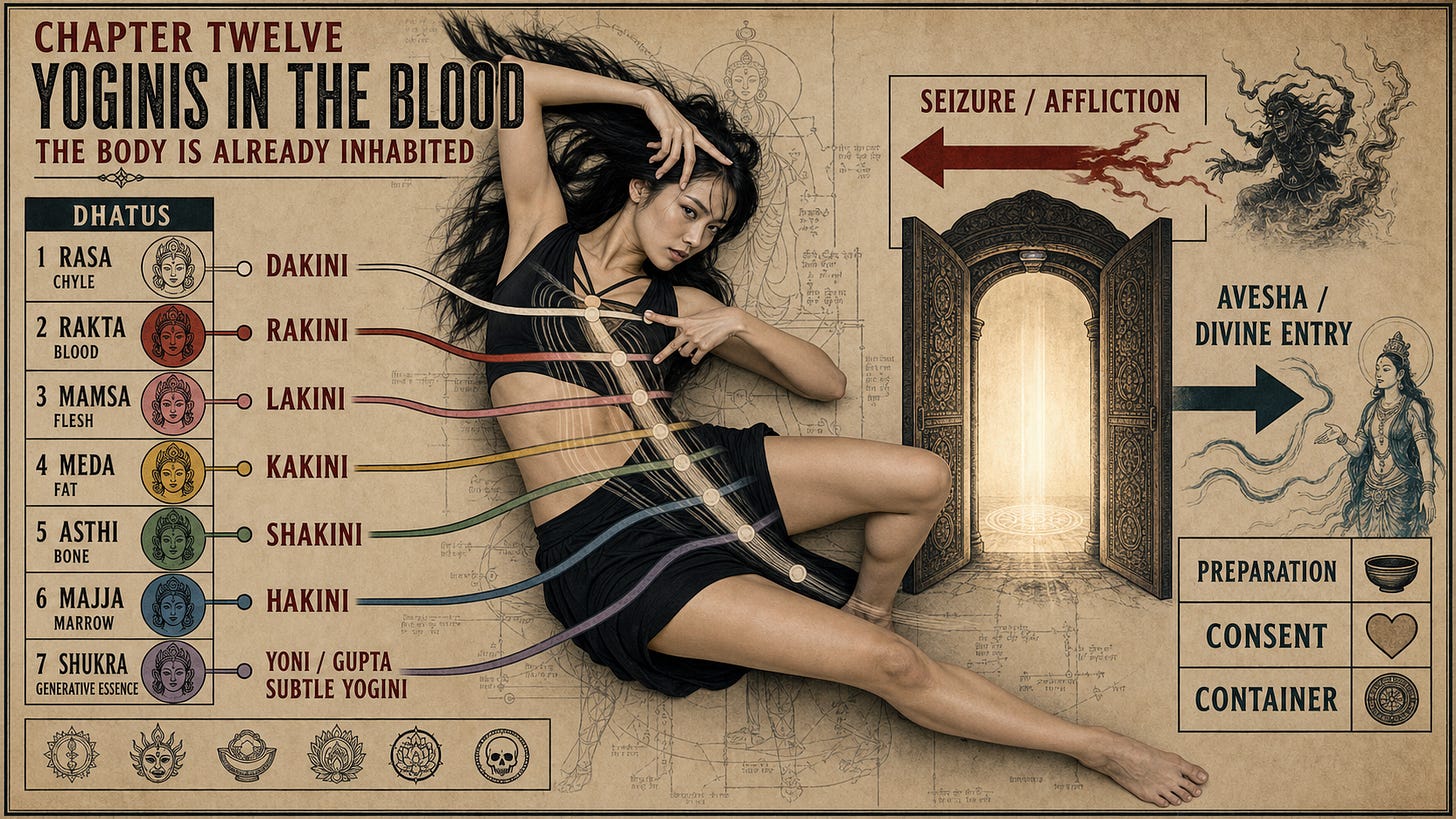
Chapter Twelve: The Yoginis in the Blood, or Possession as a Two-Way Door
Chapter twenty of the Netra Tantra concerns the yoginis. And if chapter nineteen was about the wild spirits of the outer waste, chapter twenty brings the matter home, into the tissues.The yoginis are among the most formidable figures of the entire tantric world: female powers, flying, shape-shifting, dangerous, divine, who haunt the cremation grounds and the mountain passes, who can devastate the unprepared and transfigure the initiated. Whole branches of the medieval tradition, the clan paths of the Kula, were organized around encountering them. Temples were built for them, open to the sky, circular, their walls lined with sixty-four niches, and you can still stand in their ruins in Odisha and Madhya Pradesh today.
What makes the Netra Tantra's treatment so arresting is the location it assigns them. The chapter knows the yoginis of the outer world, but it also maps a more intimate cohort: the goddesses associated with the dhatus, the seven bodily constituents of classical Indian medicine, the chain of tissues into which food is progressively refined: chyle, blood, flesh, fat, bone, marrow, and the generative essence. To each constituent, a goddess. Their names run in the old lists: Dakini, Rakini, Lakini, Kakini, Shakini, Hakini, names that later tradition would distribute across the chakras, and one of them, the Shakini, the text treats with particular attention. Your blood, in this anatomy, has a mistress. Your bone has a mistress. The very substance of your body is jointly administered by a committee of goddesses.
Think about what this does to the idea of possession. In chapter nineteen, possession was invasion: something out there got in. Chapter twenty quietly dissolves the boundary the whole way. There is no uninhabited body for the invader to break into. The body was occupied from the beginning, staffed at every level by female powers who, when honored, run the magnificent factory of digestion, growth, and vitality, and who, when disturbed, ignored, or depleted, can turn on the premises. Illness, in this picture, includes the possibility of a labor dispute with your own goddesses.
And here the text touches the live wire that runs through all the goddess-oriented traditions, the current that the left-handed paths made their specialty. Because if the powers are already inside, then the relationship can be cultivated, and possession has a voluntary mode. The broader literature of this world distinguishes them carefully. There is the affliction we met in chapter nineteen, the seizure of the unwilling and unprepared. And there is avesha in its honored sense: the deliberate, prepared, ritually contained entry of a deity into a practitioner, sought as the most direct form of contact with the divine that a human nervous system can host. The wider Kashmirian ritual culture around our text knew institutional forms of this, including oracular rites in which a deity is made to descend into a healthy medium and speak, and the philosophers of the tradition ranked avesha, immersion into the divine, among the highest spiritual attainments, to the point that the supreme non-dual realization itself could be described in its vocabulary: entry, permeation, being taken over by what you really are.
The same event, possession, sits at the very bottom of this civilization's map of disaster and at the very top of its map of grace. The difference is preparation, consent, and container. An unprepared psyche is shattered by the visitor; a prepared one is enlarged. The seizure that destroys a feverish child and the descent that illuminates a trained adept are, structurally, the same door swinging in two directions, and the entire technology of the tradition, the initiations, the purifications, the mantras, the gradual approach, exists to determine which way it swings.
If you have followed the deep grammar of the left-handed traditions anywhere, you will recognize this as their constant signature. The forces that polite religion fences out, desire, fury, intoxication, the body, the feminine, death itself, are reclassified as raw power: catastrophic when it floods the unprepared, transformative when channeled by the initiated. The Netra Tantra is, in its public function, a manual of fences, written to protect kings and children. But its twentieth chapter knows, and quietly records, that the things beyond the fence are also gods, and that the fence has a gate, and that the gate has always had keepers.
One more turn of the corridor remains, and it belongs to the man who saved this entire book for us: the philosopher who, two centuries after the chaplains, read this grimoire of fences and gates and declared that it had been about consciousness all along.
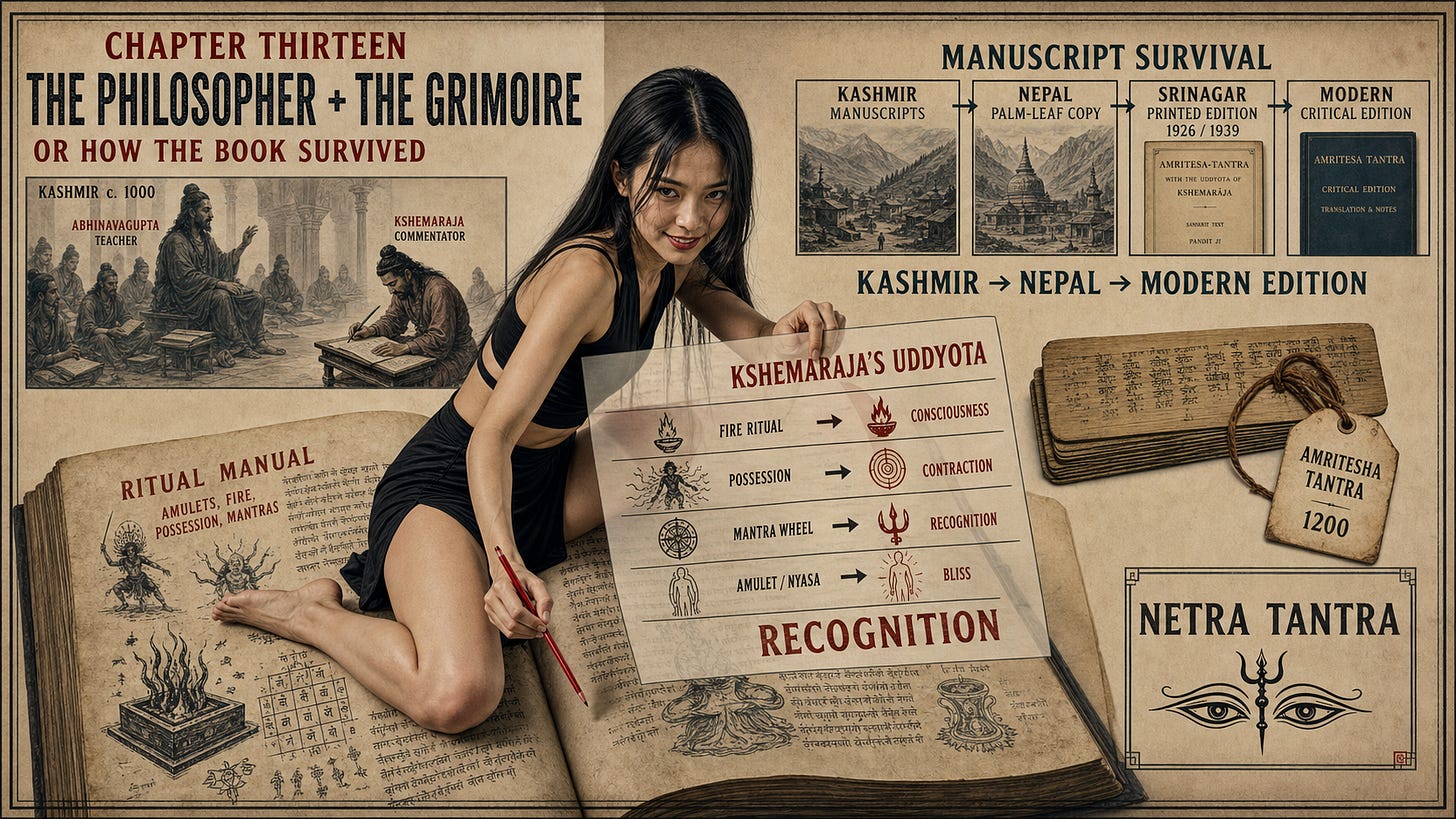
Chapter Thirteen: The Philosopher and the Grimoire, or How the Book Survived
Around the year 1000, in that same valley of Kashmir, lived the most dazzling intellectual circle the Shaiva world ever produced. At its center stood Abhinavagupta: philosopher, aesthetician, theologian, tantric master, a figure of such range that scholars compare him to Aquinas and Leonardo in the same breath. Around him gathered disciples, and the most industrious of them was a man named Kshemaraja.
Kshemaraja, working in the first half of the eleventh century, set himself a remarkable program. While his teacher built cathedrals of original philosophy, Kshemaraja wrote commentaries, and he chose his targets with strategic genius: the scriptures and hymns that people actually used. Among them, the Svacchanda Tantra, the great Bhairava text of the valley, and our Netra Tantra, on which he composed the commentary called the Netra Tantra Uddyota, the Illumination of the Tantra of the Eye.
You have to appreciate what a commentary meant in this world. A bare tantra, full of ciphers, ellipses, and workshop shorthand, is nearly unusable without a living teacher. A great commentary is a teacher fixed in amber. Kshemaraja goes through the text line by line, unpacking the ritual instructions, resolving the ambiguities, citing parallel scriptures. Without the Uddyota, much of the Netra Tantra would be guesswork for us. With it, the book opens.
But Kshemaraja did something more interesting than explain. He converted. His school, the Pratyabhijna, the doctrine of Recognition, taught that the entire universe is one infinite consciousness, freely appearing as every world and every being, and that liberation is simply recognizing, in your own first-person awareness, that the consciousness reading these words is that consciousness. Armed with this vision, Kshemaraja read the old protection manual the way a master organist reads a folk tune, and orchestrated everything. The deity of nectar becomes the bliss of pure awareness. Death becomes contraction: the shrinking by which infinite consciousness binds itself into a frightened, finite person. The mantra's three syllables become the pulse of consciousness opening, holding, releasing. The flooding nectar of chapter seven becomes the felt taste of recognition spreading through the embodied person. The three levels, gross, subtle, supreme, become three depths at which one and the same recognition can occur. Under his pen, a book written so court professionals could shield kings from fever becomes a treatise on the one Self wearing every mask, protecting itself, frightening itself, and finally remembering itself.
Purists may protest that this is creative misreading, and they have a point, and the point matters less than it seems. Every scripture that survives, survives by being reread. Kshemaraja's commentary bound the Netra Tantra to the prestige of Kashmir's high philosophy, and the binding held: the two texts traveled together for a thousand years, copied side by side. The grimoire survived inside the philosophy like a seed inside fruit.
And it needed the help, because the next thousand years were unkind. Kashmir's Hindu kingdoms fell; patronage shifted; the tradition of the chaplains guttered. The text survived in two thin streams of manuscripts. In Kashmir itself, copies passed down through the dwindling community of pandits. And far to the southeast, in the Kathmandu Valley of Nepal, that great refrigerator of Sanskrit literature, scribes had carried the book early and kept copying it; the oldest surviving manuscript anywhere is a Nepalese palm-leaf copy, finished by a scribe named Kirttidhara in the spring of the year 1200, in an elegant early script, under the title Amritesha Tantra. Eight hundred years old, and you can still read the colophon naming the man who made it.The modern world found the book slowly. In 1926 and 1939, in Srinagar, the Kashmir Series of Texts and Studies printed the Sanskrit text with Kshemaraja's commentary, in two volumes, edited by the indefatigable pandit Madhusudan Kaul Shastri. Now anyone could, in principle, read it. Almost no one could in practice, and for half a century almost no one did. Why? Partly the sheer difficulty: the text presumes the whole edifice of Shaiva ritual, and the number of people alive who command that edifice has always been tiny. Partly fashion: twentieth-century scholarship, and modern Hindu reformers alike, preferred the philosophy of this tradition to its magic, and a book of amulets, lustrations, and child-seizers embarrassed both audiences. The eye reads what the heart approves.
The thaw came in stages, and the names deserve recording, because this is how lost books come back: one stubborn scholar at a time. In 1974 the French scholar Hélène Brunner published the first detailed study, marching chapter by chapter through the text. Alexis Sanderson's work from the 1980s onward reconstructed the entire Shaiva universe around it and, in 2004, nailed down its date, its Kashmirian provenance, and its identity as the royal chaplain's scripture. David Gordon White excavated its demonology and set it in the worldwide history of possession. Bettina Bäumer, the grande dame of Kashmir Shaiva studies, translated and interpreted its yoga chapters. Patricia Sauthoff devoted a doctoral thesis and then, in 2022, the first monograph in English to its protective rites, its mantra, and its medicine of immortality. And a team led by Gavin Flood, with Bjarne Wernicke-Olesen and Rajan Khatiwoda, advised by Sanderson and Diwakar Acharya, has been producing the first complete critical edition and English translation, built on the old Nepalese manuscripts, publishing under a title the old chaplains would have approved: The Lord of Immortality.
Twelve hundred years from the valley to your ears. A book written to keep one king alive has outlived every king it served, every dynasty, the very kingdom, and is only now, in our own decade, speaking its first full sentences in a Western language. Books, it turns out, conquer death too. They simply use a longer mantra.
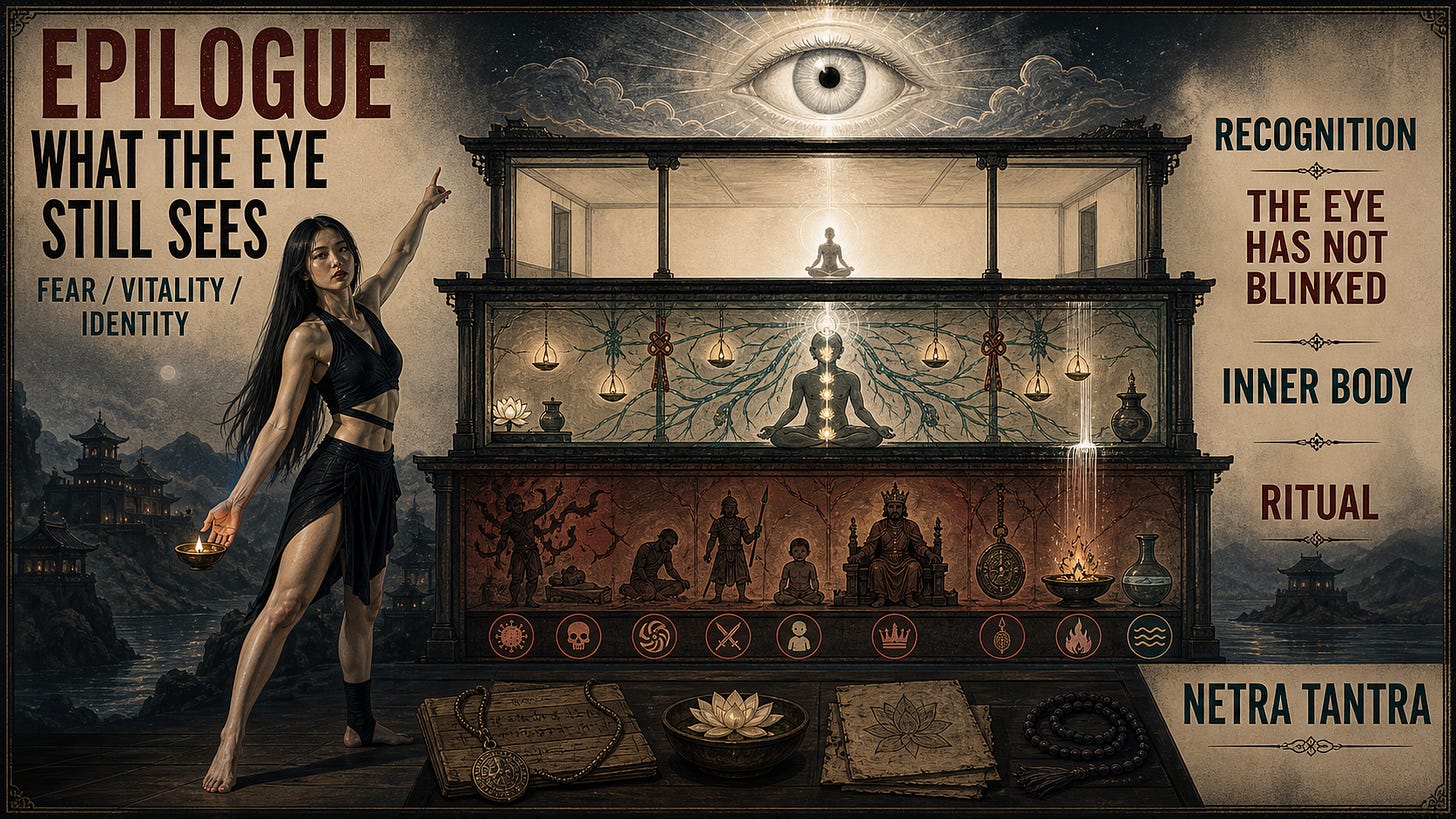
Epilogue: What the Eye Still Sees
Let us put the lamp out slowly.
Somewhere near the beginning of the ninth century, in a mountain valley at the hinge of Asia, learned men assembled a manual for the war against death. They built it in three ascending stories, because they understood that death attacks human beings at three depths. It attacks our circumstances, as disease, violence, sorcery, misfortune; and for this they prescribed ritual, the lotus of names, the sealed amulet, the fire, the poured nectar of the vase. It attacks our vitality, as depletion, the slow leak of life; and for this they prescribed the inner work, the breath raised along the lamps of the spine, the flood of amrita from the crown. And it attacks our identity, as the terror of annihilation; and for this they prescribed no instrument at all, only recognition: the discovery that the one who watches was never among the things that end.
Strip away the birch bark and the Sanskrit, and ask yourself honestly whether we have stopped performing any of it. We still write the names of those we love inside protective enclosures; we have only renamed the enclosures hospitals and insurance policies and prayers. We still perform lustrations of our armies and inaugurations of our kings, with anthems where the mantras were. We still hang amulets on our children. We still negotiate daily with invisible seizers, though we now call them by their clan names of virus, market, algorithm, diagnosis, and we still pay specialists in special clothing to stand between us and them, radiating trained confidence. The Kingdom of Fear has excellent continuity of government. Only the official language changes.
What the Netra Tantra preserves, and what almost nothing in our own culture still dares to say, is the third story of the building. That below the fear there is a watcher the fear has never touched. That the eye which sees the burning is itself made of nectar. The old chaplains sold protection to kings, and smuggled, in the same book, the secret that makes protection unnecessary, and they saw no contradiction, because compassion meets people at the floor they live on and builds stairs.
The book asked to be concealed, and history obeyed for twelve centuries. That time is ending. The manuscripts are edited, the translations are coming, and the Lord of Nectar, white as jasmine, patient as crystal, is stepping out of the valley at last.
Every age believes its fears are new. The eye has watched them all, and it has not blinked yet.
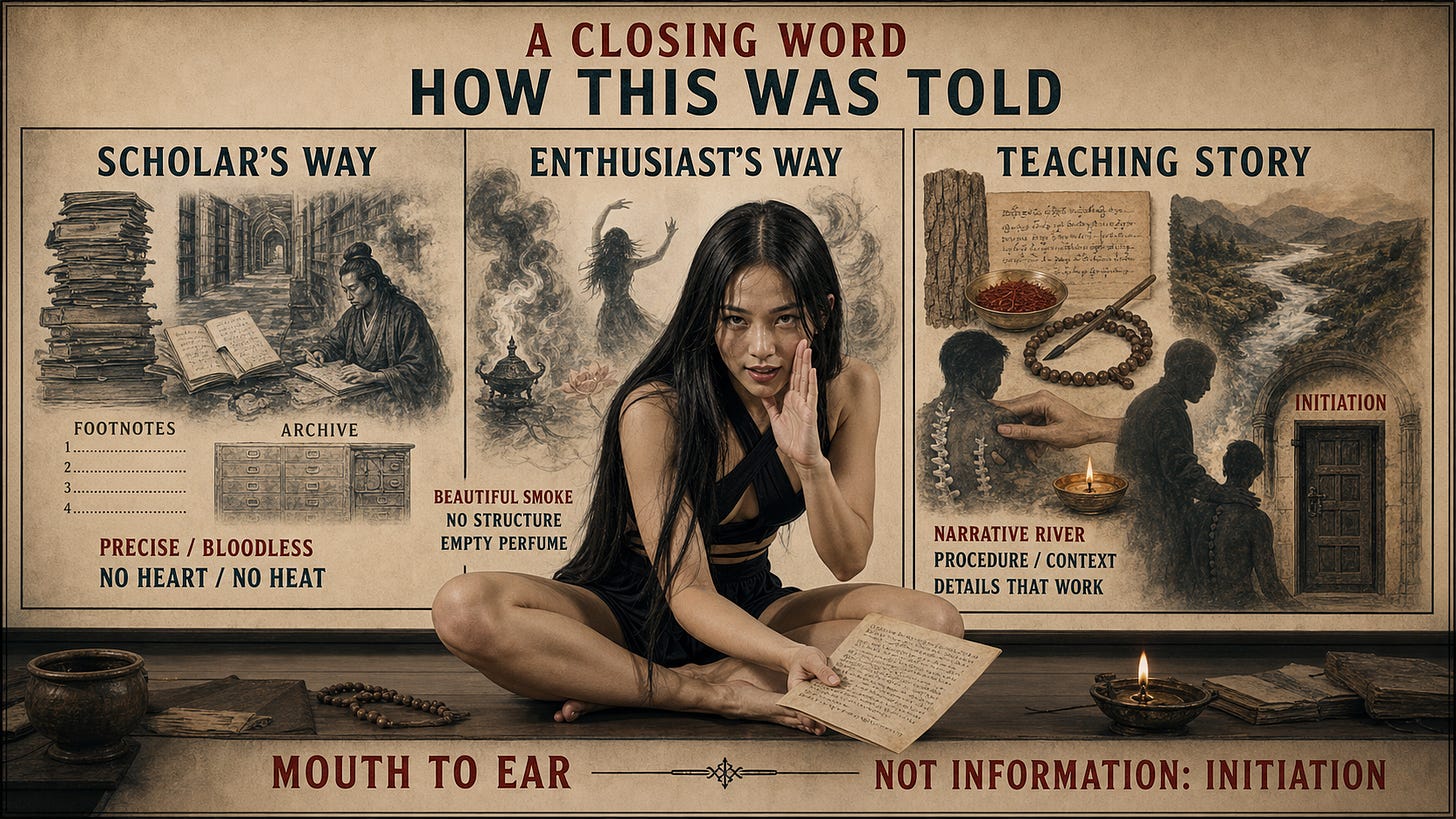
A Closing Word on How This Was Told
A word about the manner of the telling, for those who care about such things.
I learned long ago that there are two ways to write about a tradition like this, and both fail. You can write the scholar's way, precise and footnoted and bloodless, and the reader closes the book having understood everything and felt nothing, and changes not at all. Or you can write the enthusiast's way, all atmosphere and no spine, vivid and warm and finally empty, a perfume with no bottle. The traditions that actually transmit something have always known a third way, the way of the teaching story, where a narrative carries you in on its current and then, while you are not braced against it, hands you the real thing: the detail, the procedure, the mechanics that matter. Robert Svoboda's Aghora books, built around his teacher Vimalananda, are the modern master-class in this third way, and anyone moved by these pages should go to them next. They never hand you a complete rite to perform from the page, and that restraint comes from respect rather than secrecy for its own sake: the deepest keys pass only through a living teacher, mouth to ear, and a mantra taken from a book is, as the old texts say, a dead mantra. So I have done here what that lineage does. I have put you inside the night. I have given you the bark, the saffron ink, the sealed name, the count on the beads, the elements dissolved and rebuilt, everything the eye can see and the mind can hold. What I have not given you, because it is not mine to give in writing, is the one thing that was never written down in any of these books either: the breath of transmission, the hand on the spine, the moment a thing stops being information and becomes initiation. For that, in every tradition that has ever been real, you have to find a living door.
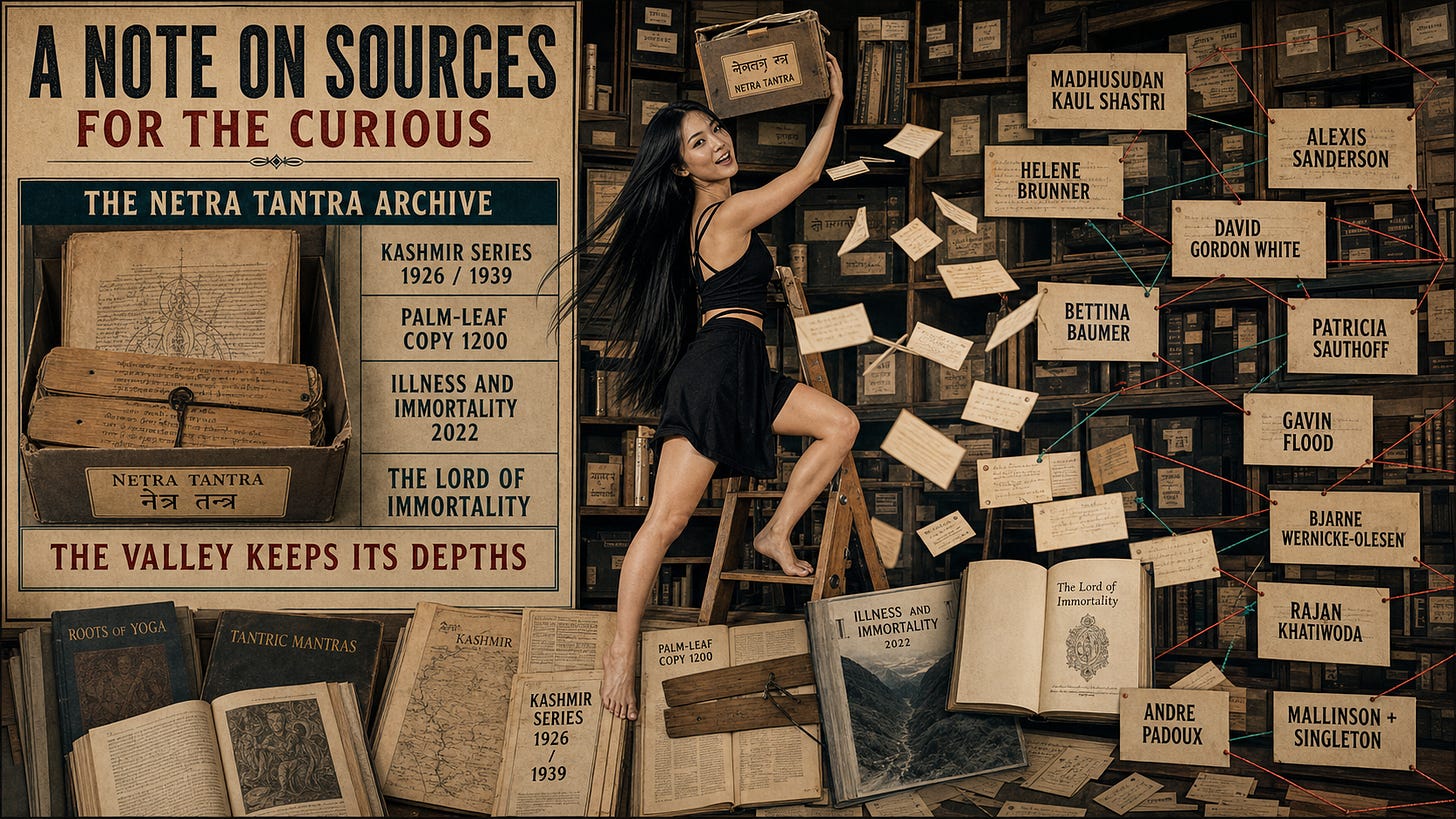
A Note on Sources, for the Curious
Everything in this book stands on the shoulders of a small number of scholars, and anyone who wants to go deeper should know their names. The Sanskrit text with Kshemaraja's commentary was printed in the Kashmir Series of Texts and Studies, volumes 46 and 61 (Srinagar, 1926 and 1939), edited by Madhusudan Kaul Shastri. Hélène Brunner's pioneering survey, "Un Tantra du Nord: le Netra Tantra," appeared in the Bulletin de l'École française d'Extrême-Orient 61 (1974). Alexis Sanderson's "Religion and the State: Śaiva Officiants in the Territory of the King's Brahmanical Chaplain," Indo-Iranian Journal 47 (2004), established the text's date, provenance, and courtly function, with rich detail on the world of the royal chaplains. David Gordon White's "Netra Tantra at the Crossroads of the Demonological Cosmopolis," Journal of Hindu Studies 5 (2012), and his subsequent work on chapter twenty, opened the demonology. Bettina Bäumer's study and translation of the yoga chapters appeared as The Yoga of the Netra Tantra. Patricia Sauthoff's Illness and Immortality: Mantra, Mandala, and Meditation in the Netra Tantra (Oxford University Press, 2022), developed from her SOAS thesis on the text's protective rites, is the first full monograph and the best single companion. The complete critical edition and translation by Gavin Flood, Bjarne Wernicke-Olesen, and Rajan Khatiwoda, The Lord of Immortality, is appearing in the Routledge Studies in Tantric Traditions; a sample edition of chapter seven was issued by the Oxford Centre for Hindu Studies in 2019. On the broader world of yoga's history, James Mallinson and Mark Singleton's Roots of Yoga (Penguin, 2017) places the subtle-body material in context, and André Padoux's works on mantra, especially Tantric Mantras (Routledge, 2011), illuminate the science of the three syllables. Where these scholars disagree, I have followed the weight of the evidence; where the text is silent, I have said so or stayed silent with it; and where I have compressed for the listener's sake, the originals are richer still. The valley keeps its depths.