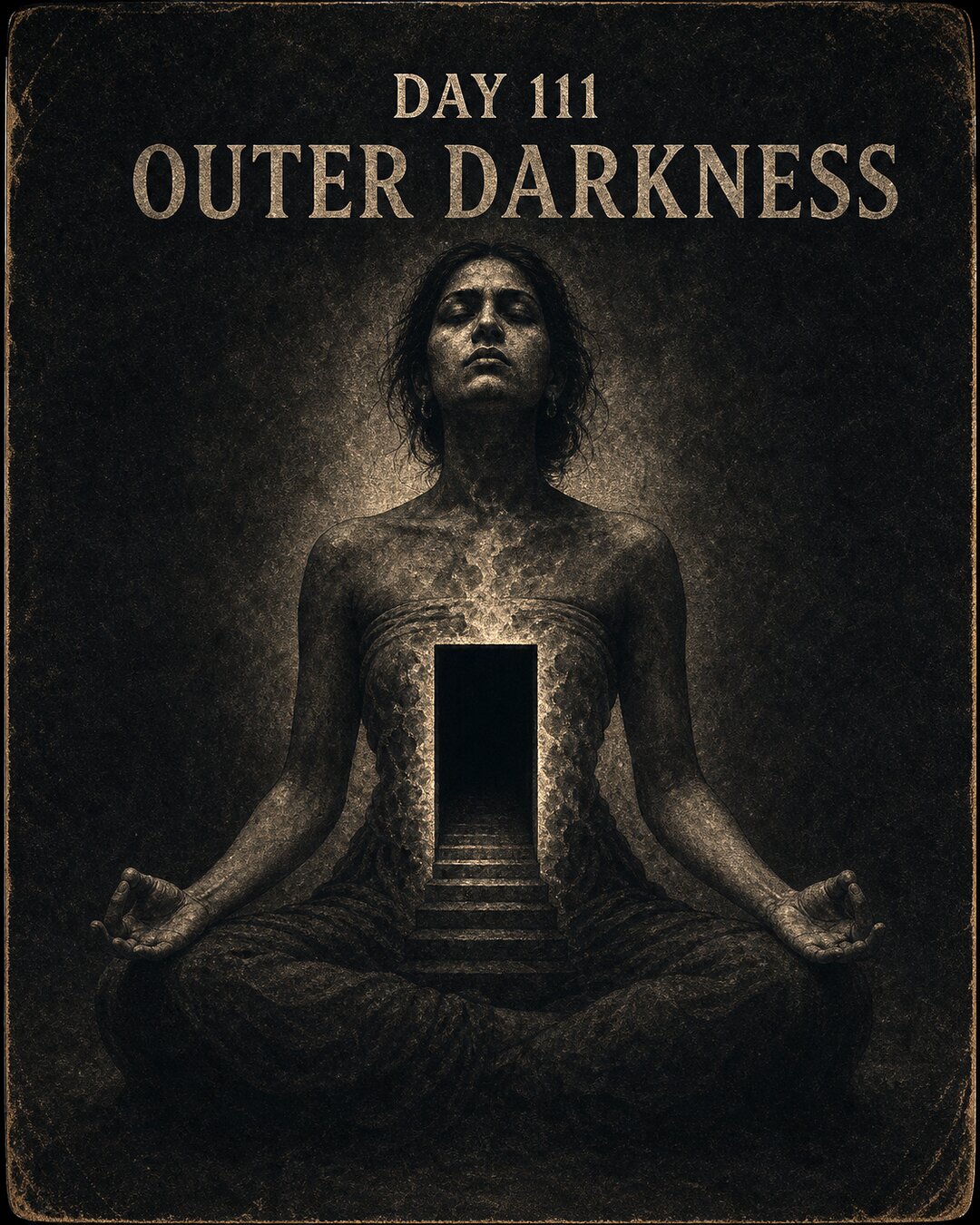
There is a practice so old that no one any longer knows where it comes from, and so dangerous that no school any longer teaches it openly, and it consists, to all outward appearance, of almost nothing: a person sits upright in a wholly darkened room, the eyes open, and gazes into the dark. That is all, and that is, in truth, immeasurably much. For this gazing into the open dark with open eyes is not what one understands today in the yoga studios by trāṭaka, the staring at a candle flame until the tears run; it is its exact opposite and its lost original ground at once, and I call it, by the name of my lineage, Andhakāra, the dark itself made into the path.
I want to speak of this practice the way a forensic pathologist speaks of a body and the way a lover speaks of the body he loves, with the cold eye and the burning heart at once, for both are needed, and the one without the other lies. The cold eye, because more nonsense has been written about this matter than about almost any other spiritual affair, and because I refuse to add to it a single further sentence. The burning heart, because I know what this practice does, I have experienced it in myself and seen it in the few others who have gone far enough, and because I know that it is the most powerful and at the same time the most lost thing I have to hand on at all. Among all the practices I know there is no second one in which the reward and the annihilation lie so close together, divided by no wall, only by the bearing of the one who does it.
My thesis, which I set at the very beginning so that it stands above everything, is this: the darkness trāṭaka, the gazing with open eyes into the pure dark, does not exist in the transmitted texts as a coherent, named practice. One will not find it, however long one searches, not on Google, not in the schoolbooks of the Bihar school, not in the great compendia of Haṭha. And precisely this silence, this almost total absence, is not the proof that the practice does not exist; it is the proof of what it is: one of the last practices that was never entrusted to paper, because it could be handed on only from mouth to ear, from nervous system to nervous system, under the waking eye of a living teacher, without destroying the one who does it. What follows is the attempt to read the silence, and to track down the little that was nonetheless written, there where no one suspects it, in Kashmir, in Tibet, in the ashes of the cremation grounds, and to bring it together with what my own lineage still holds, living, in its hands.
I call, again, as already in my last essay, three witnesses, and I know very well that in doing so I repeat myself; this calling of three witnesses has, naturally, long since become my method, my manner, almost my vice, and I confess it openly rather than conceal it, for none of these witnesses suffices alone for a matter that has fallen between the disciplines. The first witness is the lineage itself, the living, oral knowledge that I received and that I laid down in the three hundred and sixty-five days of my path, so far as it can be laid down at all. The second is the text, the little that was written and that survived, above all in Kashmir and in Tibet, and that I have brought up like an archaeologist out of the rubble of the libraries. The third is the sober scholarship of our time, Indology and Tibetology, which understand nothing of the practice because they have never sat in a dark room, but which know exactly which texts exist and which do not, and whose cold judgment keeps me from imagining things. Where these three meet, there I stand on firm ground; where they part, I say so.
I. The Eye That Opens Upon the Nothing
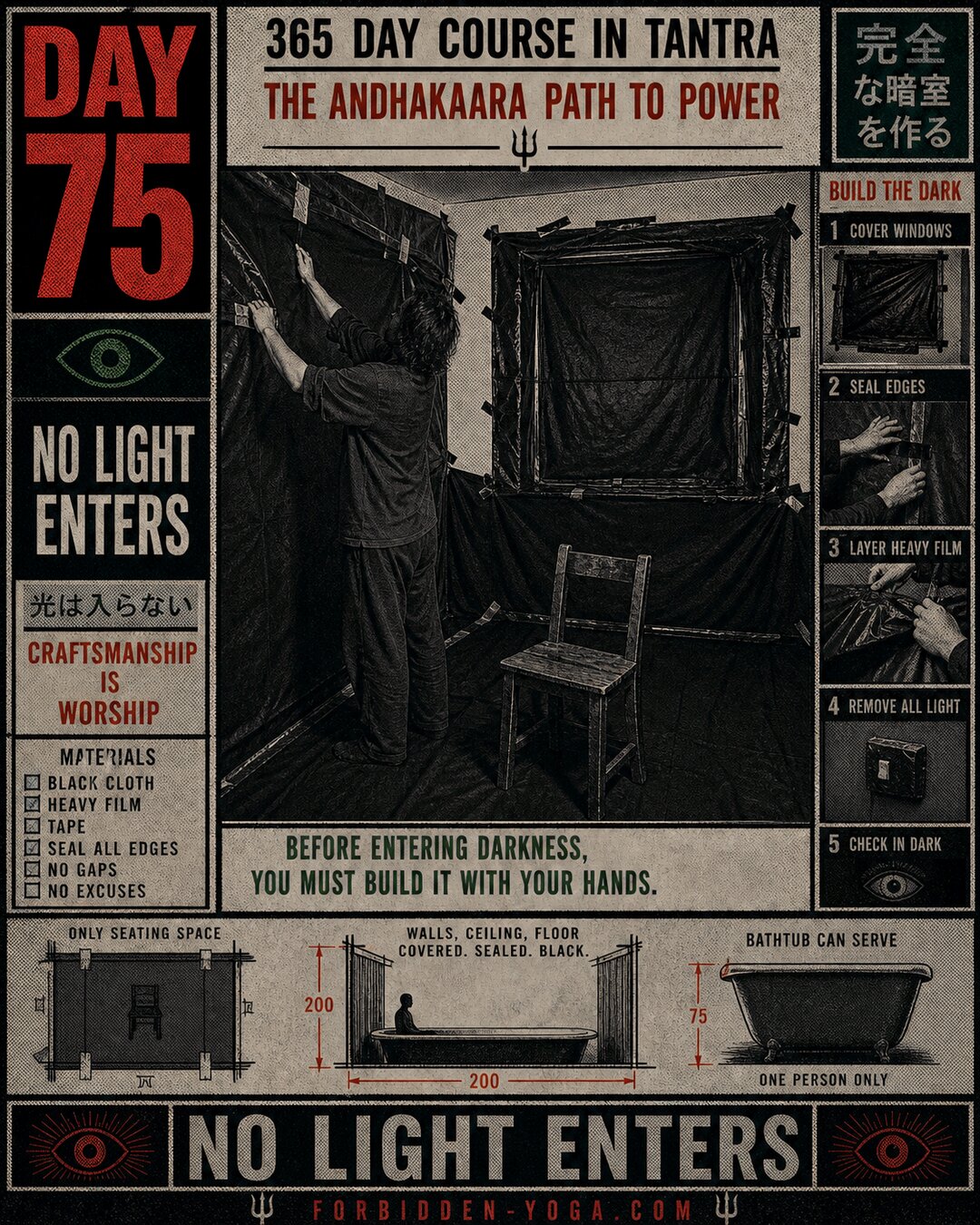
Let us begin, as my lineage begins, with the room. Before any practice is possible, a wholly dark room must be created, and this creating is already the first sādhana, not its preparation. One darkens the windows, one seals every crack, one banishes every light-emitting diode, every clock, every glimmering device, until the room is not merely dark but lightless, lightless in that absolute sense in which the opened and the closed eye see the same thing, namely nothing. That is harder than it sounds, naturally, for the modern world bleeds light everywhere, and to make a truly lightless room is, in a city, almost an act of resistance. My lineage says, on the seventy-fifth day, that one should do it with the dignity and the devotion of a craftsman who makes a masterwork, and one is not to understand this as metaphor: one is not building a darkened storeroom here, one is building a temple, and the temple is empty, and its emptiness is its only image. If at the beginning no room of one's own is available, then a seat suffices, says the transmission, at need the empty or water-filled bathtub; but the lavatory one should not use for it, if it can at all be avoided, for the place itself has a dignity, and one is preparing here an encounter, not a wellness treatment.
Then one enters. One sits upright, in Ardha Padmāsana or Vajrāsana, and under no circumstances does one lie down, for lying down is sleep, and sleep is the exact opposite of what we seek here; we seek the waking in the dark, in which otherwise no one wakes. One enters, as it is said on the seventy-sixth day, inwardly empty, and then one practices trāṭaka into the dark nothing. Nothing more. At the beginning no longer than five minutes, and if it becomes uncomfortable one stops, and that is perfectly in order, for this practice has, and this is the first thing one must really know about it, no immediate effect. That is its peculiar difficulty in an age that demands of every practice the instant payout. If you do a breathing exercise and pump the body full of oxygen, you feel something at once afterward, a euphoria, a tingling, a proof that something has happened. Here you feel, at the beginning, nothing. You sit in the dark and stare into the dark, and nothing happens, and precisely that is what happens, for this practice does not work upon the body that wants to feel something; it works, slowly, invisibly and without a receipt, upon the very matrix of karma.
Why the eyes open? Here lies the whole secret and the whole difference. If one closes the eyes in the dark, one is in one's own head, in one's images, one's memories, one's dreams; one is, in other words, still at home, with oneself, in the familiar. But if one opens them into a dark that is just as black as the closed eye, then something uncanny and precise happens: the eye searches and finds nothing, the perceiving apparatus, which abhors nothing so much as the absence of an object, runs empty, and into this running-empty, into the gap between the eye that wants to see and the nothing that offers itself to it, something else begins to appear, not out of the room, but out of the seeing itself. Neurology even has a sober name for that with which the play begins, the Eigengrau, the intrinsic light of the retina, the phosphenes, which the lightless eye generates out of itself; and it would be the materialist's error to say here that therefore the whole is only that. It begins with the eye's own light, certainly, the way a concert begins with the tuning of the instruments. But what then orders itself, what arises out of these first, senseless sparks in the way of form, of intention, of presence, that is no longer physiology, and whoever has ever sat far enough knows that the explanation by way of the retina simply breaks off at a certain point and falls shamefacedly silent.
So that the eye can become motionless and the body cease to push itself between the practitioner and the dark, my lineage teaches beforehand a technique that is still half-known in today's yoga, the Kāya Sthairyam, the rigid body. One sits, one breathes long in and out seven times, one feels the hands, the seat, the spine; one practices Maya Rūpa and regards oneself with closed eyes from all sides, as though one stood outside oneself; one feels how the legs grip into the ground like the roots of a tree; one takes hold of the Saṃkalpa, three times, my body is utterly unmoving, nothing stirs, and one feels how the Saṃkalpa becomes reality, how one stiffens into a statue of gold, of bronze, of stone, until the breath grows finer and finer and the mind collapses onto a single point. Only this body, become a statue, gathered onto a point, is at all capable of withstanding the dark with open eyes, without fleeing into panic, into sleep, or into the wild chatter of the mind. Let no one underestimate this preparation; it is not the anteroom of the practice, it is half its substance.
How one enters is almost more important than what one does inside. One does not switch the dark on and off like a switch, one does not fall into it as into a bed, one enters it. My lineage teaches the days of the entering long before the days of the gazing: how one approaches the threshold, how one pauses at it, how one leaves the last light behind one not as a loss, but as a gift that one offers. One enters the complete darkness as one approaches an old, silent animal, larger than oneself, which one wishes neither to frighten nor to offend. This respect is no sentimentality, it is a technical necessity, for the dark, as we shall see, is not empty, and whoever blunders into the house of another as though it were his own has already failed the first and most important lesson before he has even sat down.
II. The Silence of the Texts
I have spent years searching for this practice in the scriptures, and I say it without circumlocution: it is not there. The trāṭaka the classical texts know is something else, something almost trivial by comparison. The Haṭha Yoga Pradīpikā, that compendium of the fifteenth century, devotes to it exactly two verses, 2.31 and 2.32, and they say exactly this: one should gaze, without blinking, at a sūkṣma-lakṣya, a fine, small target, a point, until the tears flow; this heals the diseases of the eyes and bestows divine sight. The Gheraṇḍa Saṃhitā, two centuries later, repeats the same verse almost word for word, and precisely this verbatim repetition betrays to us that we are dealing with a fixed formula, handed down unchanged across the centuries, without anyone daring to add anything. The object is always a small point. The candle, that candle at which today the whole world practices its trāṭaka, does not even appear in these verses; it is a later, popular addition. And the dark, the open gazing into the dark, does not occur at all, in no place, in none of these texts, neither in the Pradīpikā, nor in the Gheraṇḍa, nor in the Śiva Saṃhitā.
One could draw from this finding the comfortable conclusion that the darkness trāṭaka therefore does not exist, that I am inventing it, that my lineage has fantasized something together. That would be the conclusion of a bad scholar. The good scholar, and I take pains, in this one matter, to be a good scholar, an Arthur Avalon of the year 2026, reads the silence otherwise. He asks: what kind of knowledge is it that is characterized precisely by its being absent from the written record? And the answer that my own lineage gives me, and that serious scholarship confirms, runs thus: it is the dangerous knowledge, the forbidden in the strictest sense, the knowledge that was not written down because in the wrong hands it was deadly. Such knowledge one wrapped, where one noted it at all, in the sandhyā bhāṣā, the twilight language, in which a word means to the uninitiated a harmless thing and to the initiated something altogether different; much, however, one did not write at all, but handed on only from body to body, because writing would have made the teacher superfluous, and the teacher here was not superfluous, the teacher was the only safety catch on a loaded weapon. The silence of the texts about the darkness trāṭaka is therefore no hole in the knowledge, it is the form this knowledge had to take in order to survive without killing.
There is a single modern phenomenon that claims the name darkness for itself, and I must name it in order to set it aside: the so-called dark-retreat centers of the West, in Guatemala, in the United States, where one lets oneself be shut up for money in a lightless room, seven days, forty days, and calls it a therapy, a shadow work, an encounter with oneself. I have nothing against these places, they are well meant, and they help some. But they have about as much to do with what I speak of as a heated indoor swimming pool has with the open sea at night. They are deconsecrated, detoxified, freed of the teacher and of the danger; their goal is not liberation but relaxation, not mokṣa but the better feeling about oneself; there is no deity, no handing-over, no initiation, no dīkṣā that guards the entrance, but a registration and an invoice. And tellingly, these centers invoke, when they invoke anything at all, the Tibetan Dzogchen and never the one verse of which I must now speak. They sense from where the wind blows, but they have thrown away the sail.
One must, in order to understand the silence fully, also see what happened to yoga in the twentieth century. The scholar Mark Singleton has shown how modern, physical yoga emerged from a fusion with Western gymnastics and physical culture, a yoga that had to be presentable, healthy, bright, harmless, exportable. In this process everything that was dangerous, dark, transgressive was sanded away, and what remained was the friendly: the breathing exercise, the stretch, and, of the whole wealth of the trāṭaka, the one harmless candle. The darkness trāṭaka fit into this bright, sellable yoga as little as a corpse fits into a shop window, and so it vanished, not because it had been refuted, but because it was unsellable. The silence about this practice is also this: the silence of the market about a ware it cannot offer.
III. The One Verse
For there is, after all, the one place where the practice with open eyes into the dark is not kept silent but spoken out, clearly and unmistakably, and this place is not in Bengal, where I myself received the practice, but far in the north, in Kashmir, in the Vijñāna Bhairava Tantra, that astonishing text of Kashmiri Shaivism from the eighth or ninth century, which enumerates one hundred and twelve ways of entering the Absolute. In the numbering that all serious translators share, from Jaideva Singh through Bettina Bäumer to Lakshmanjoo and Christopher Wallis, the decisive verses stand as eighty-six, eighty-seven, and eighty-eight.
Verse eighty-six prepares the way: it is said there that the three states, the limited knowledge, the outer light, and the dark, are all of them the form of Bhairava, and that whoever recognizes this carries within himself the infinite light of consciousness. The dark is here, let it be marked once and for all, no enemy and no opposite of the light, but a gate to the inner light. Verse eighty-seven then gives the practice: in a dark, overcast, moonless night, in the kṛṣṇa-pakṣa, the dark half of the month, one should meditate long upon the formless form of the dark, and one will attain Bhairava's formless form. The Sanskrit word for this dark is here taimira, and I shall come back to it presently, for it is not the only word for the dark and not chosen by chance. Verse eighty-eight, finally, describes, almost word for word, what my lineage practices: one should first close the eyes and behold the black before one, and then open them, upon that very black, and regard it as the form of Bhairava himself, and one will attain his nature. The closed and the open eye, in one continuum, directed upon the same blackness. That is it. That is, after more than a thousand years, the written seed of what I do.
And there is more in this text that belongs to it. Verse eighty-four lets us gaze with unbroken, motionless look into the clear, empty sky, until all at once we attain the form of Bhairava; that is the day-variant of the same thing, the gazing into the objectless blue instead of into the objectless black. Verse one hundred and thirteen says the sharpest thing: for the one whose eyes become motionless, without blinking, the radical freedom can happen in an instant; here is the diagnostic of trāṭaka, the unmoving eye, loosed from the small point and directed upon the emptiness. And around these verses lies a whole series of practices upon the śūnya, the emptiness, the vyoma, the space, from verse forty to fifty-one, and upon the madhya, the middle, the gap between two breaths, two thoughts, two states; in verse thirty-two one even regards the five spaces as the darkly shimmering iris in the eye of the peacock feather and enters through it into the heart, the highest space. One sees: the whole Vijñāna Bhairava is a book of the emptiness and the middle, and the dark is only their densest, most visible shape.
The Vijñāna Bhairava, to be sure, takes the dark as a formlessness with which one merges, not as a canvas on which guests appear. Those guests of whom I have still to speak come out of another stream. But that the root lies in Kashmir is confirmed by a second text whose mere name already speaks: the Netra Tantra, the Tantra of the Eye, the only Tantra at all that is named after the eye, the eye of Śiva, also called Mṛtyujit or Amṛteśa, the conqueror of death. Kṣemarāja, the pupil of Abhinavagupta, has commented on it, and Bettina Bäumer has translated its yoga chapters; they lead from the gross, fleshly eye, by way of the fine, visualizing eye, to the highest, formless inner light. A lineage that makes the eye into the gate of the deathless need invent no Bengali origin; it has in the Kashmiri north an older, more distinguished family than it itself knew.
And here, in this Tantra of the Eye, is found what I had long sought and scarcely hoped to find. For the Netra Tantra teaches that the three eyes of Śiva are his three powers, the power of will, the power of knowledge, the power of action, and that out of their interplay everything arises; and it teaches the monstrous thing that I set down here with held breath: that the opening of Śiva's eyes is the streaming-out, the creation of the world, and the closing of his eyes the streaming-in, the dissolution. Creation and annihilation are nothing other than the opening and closing of an eye, unmeṣa and nimeṣa, the lifting and the lowering of the lid. Let one grasp what that means for our practice. The person who gazes with open eyes into the pure dark and does not close it holds his eye exactly where Śiva holds his, at the hinge between creation and dissolution, in the open, streaming-out lid, and yet gazes into the dark, into that which was before all creation; he sits, in other words, in the very moment of the world's coming-to-be, the eye open above the nothing out of which everything proceeds. And in this third eye, says the text, dwells a fiery being, the source of creation, preservation, and destruction in one, the same eye whose fire in the old myths burns the god of love to ashes.
The Netra Tantra is also called Mṛtyujit, the conqueror of death, and Amṛteśa, the lord of the nectar of immortality, and it teaches three yogas, three ways of overcoming death: a gross one, which heals the body, a fine one, which builds up a divine body, a divya-deha, and a highest one, the realization of absolute consciousness without any method at all. The fine yoga of the seventh chapter leads through the channels and centers, through three targets and five emptinesses, five spaces of the nothing within one's own body, up to the dvādaśānta, and the eye of which it speaks, the netra, is not the brow-eye, not the Ājñā center, but a divine eye, a divya-cakṣu, that lies still above it. And precisely this text, the Tantra of the Eye, the conqueror of death, contains in its nineteenth and longest chapter something that, when I found it, made the blood freeze in my veins: a whole catalogue of the seizers, the grahas, the bhūtas and the mothers, the beings that seize, possess, take into possession the human being, with the exact description of the signs of possession and the rites for appeasing them. The scholar David Gordon White has examined this very chapter. It stands, black on white, in the one scripture that is named after the eye, the proof that those who opened the eye knew from of old that with the opened eye not only the light comes in, but also the guests.
Abhinavagupta, the greatest mind of this Kashmiri school, worked out the doctrine behind it, and it alone makes intelligible why the gazing into the outer black and the gazing into the inner light are in the end the same. Consciousness, he says, is not locked up in the skull, it is of itself luminous, prakāśa, and of itself aware of itself, vimarśa, and it reaches beyond the body into that space the school calls dvādaśānta, the measure of twelve finger-breadths above the crown and at the end of the breath, there where the breath dissolves and for an instant no one breathes. The dark into which the practitioner gazes with open eyes is therefore not really outside, in the room; it is the field of consciousness itself, stripped of all content. One does not gaze into a dark chamber. One gazes into one's own awareness, from which one has taken every object, and that it is just as black outside as inside is only the device that brings these two, which were always one, into coincidence with each other.
IV. The Many Names of the Dark
A language that has many words for a thing says thereby that this thing was important to it, that it knew it exactly, that it had to distinguish its shadings. Sanskrit has many words for the dark, and this is no accident and no mere poetic luxuriance, it is the fossil of a culture that made distinctions in the dark which we have long since lost.
There is tamas, the dark as such, as cosmic principle, as that one of the three fundamental qualities of nature which means inertia and veiling, the great, philosophical word for the dark. There is andhakāra, literally that which makes blind, the dense dark and at the same time the mental delusion, and this is the word that my lineage has given as a name to its whole path, Andhakāra, for it carries both within itself, the literal blackness of the room and the blinding thing the practice does to the practitioner before it makes him seeing. There is timira, or taimira, the dark in the narrower, the seeing sense, the dimming of the field of vision, and it is, let it be remembered, this very word that stands in the Vijñāna Bhairava for the moonless night, the word, then, for the dark of the practice itself. There are dhvānta, the poetic dark, and śarvara, the nocturnal one, and naktam, the adverbial by-night, and niśā, the night as such. And there is tamisra, the only one of these words that carries a hellish, an abyssal undertone, for tamisra is also the name of one of the hells, the terrible darkness as place of punishment.
Above them all, however, stands a word for which I searched long, because my lineage distinguishes between two darknesses, the dark of the practice and the terrible darkness of the graveyard, and for the second knows a word of its own. I have found it, and it is ghorāndhakāra, the terrible, the dreadful darkness, and it is not just any word, it is the proper name of one of the eight cremation grounds, the eight śmaśānas of the Cakrasaṃvara cycle, the southwestern charnel field, which is called ghorāndhakāra, the terrible darkness. Thus, in the transmitted record, the terrible darkness is lexically wedded to the cremation ground. The gloom of the charnel ground, in which the bhūtas and piśācas and vetālas dwell, the spirits, the goblins, and the revenants, that is ghorāndhakāra. But the dark into which the practitioner gazes with open eyes, that is tamas, that is timira, the pure, the veiling, the seeing dark. That these two words are nowhere, in any text known to me, expressly set against each other as a technical pair, that I openly admit; this distinction belongs to my lineage, it is oral, it is living. But the words themselves are old, they are exact, and they have waited centuries to be held apart again. It is a difference of everything, whether one gazes into the terrible darkness of the charnel field, in which the hungry beings dwell, or into the pure dark of the practice, which is the gate to the inner light; and whoever confuses the two confuses the sanctuary with the trap.
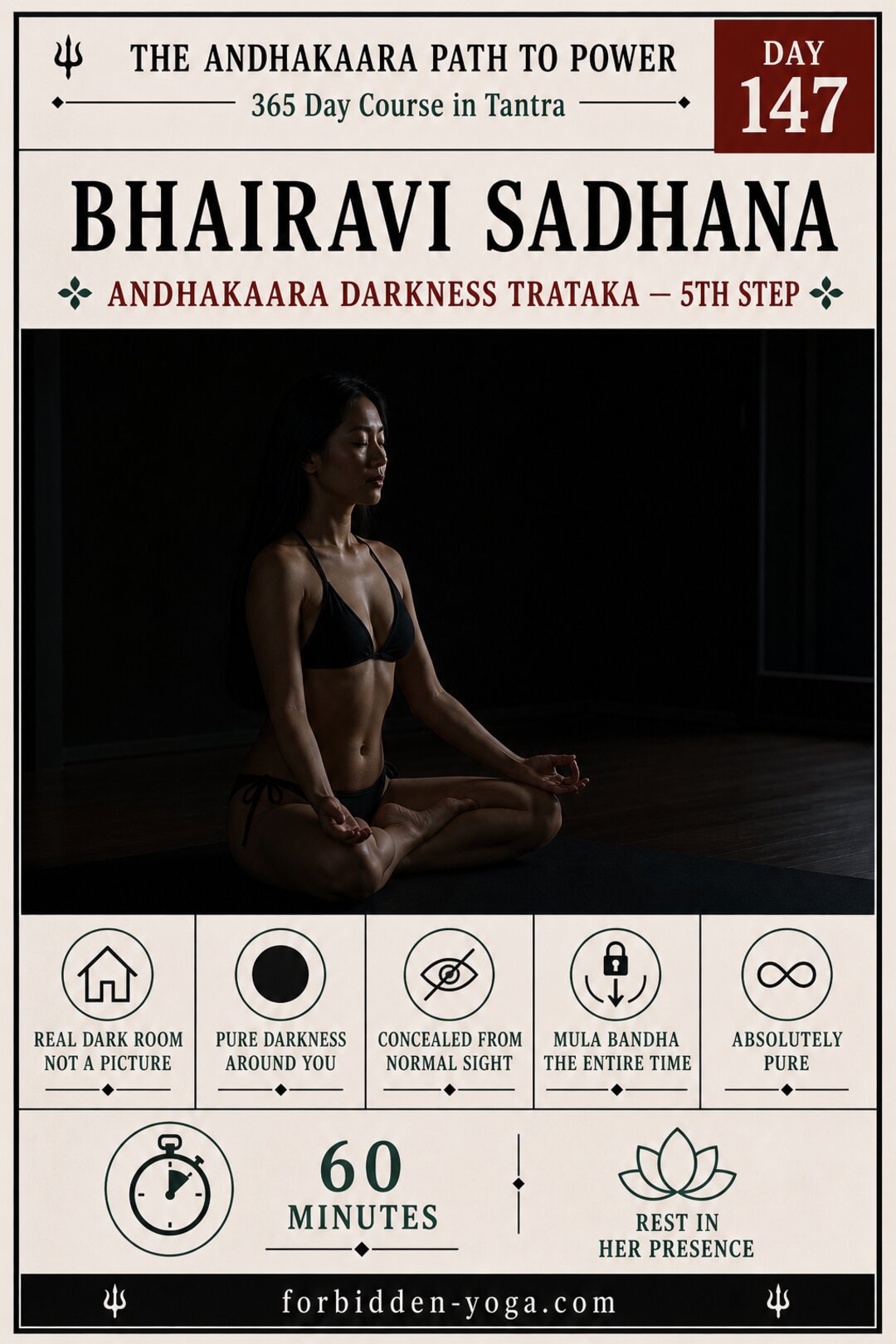
And this difference is no learned hairsplitting, it is an experience the practitioner makes with the whole body. The pure dark of the practice, the tamas, into which one sits down, has, when one has been in it long enough, a peculiar gentleness, a spaciousness, almost a tenderness; it carries one, it is, as my lineage says on the one hundred and forty-seventh day, absolutely pure, and in it is hidden what the ordinary eye does not see. But the terrible darkness, the ghorāndhakāra, which one brushes against on certain days and in certain realms, has another taste, a dense, grainy, inhabited one; one feels that one is no longer the only one in the room; and the beginner confuses the two unceasingly, he takes the harmless expanse for the threatening and the truly threatening for a beautiful vision. To distinguish exactly between these two, with closed mouth and open eye, is the real art, and it cannot, like everything essential here, be explained, but only learned under supervision.
V. Why We Stare
One asks, with right: if the whole classical tradition stares into a bright little dot or into the candle flame, why then do we stare into the black? What is even the point of the many different trāṭakas, and what distinguishes ours from them all? Here I must be exact, for the misunderstanding sits deep and it sits everywhere.
There is, this one should know first, a whole objectless gazing with open eyes that the texts do indeed know, only not as a dark practice. There is the Śāmbhavī Mudrā, the gazing without seeing, in which the eyes stand open and the look is directed outward, the attention, however, inward, upon the Self, without the look resting upon any outer object; the Haṭha Yoga Pradīpikā knows it, the Gheraṇḍa Saṃhitā, and my own lineage practices it on the seventy-eighth day as a preliminary stage. There is the Amanaska Yoga, that earliest text of Rāja Yoga, which the Oxford scholar Jason Birch has edited, in which the look grows ever weaker until it rests upon no object any longer, and in that instant the stream of concepts falls away and the laya sets in, the being-dissolved, the amanaska, the state without mind. There is the Maṇḍala Brāhmaṇa Upaniṣad, which distinguishes three looks according to the degree of opening of the lids, the new-moon look with closed eyes, the half and the full-moon look with wholly opened eyes, and which expressly demands the fully opened look; and it says, and this is decisive for us, that first a deep dark appears at the root of the palate and only through continued practice does there step forth out of it a light in the shape of an endless sphere. The dark as passage, the light as goal. And there is the Tāraka Yoga of the Advayatāraka Upaniṣad, the gazing upon the inner star, the light, the three targets, the inner, the outer, the middle; but this gazing is oriented toward the light, toward the luminous blue, the solar disk, the radiance above the head, it is the opposite pole to the dark.
The whole transmitted tradition therefore amply supports the objectless gazing with open eyes, but what it cultivates is the emptiness, the space, the inner light, and the dark appears in it only as a passing state on the way thither. My practice keeps the open, objectless eye, but it abides in the dark, it makes the passage into the dwelling place, and that is its peculiarity, its self-will, sown by verses eighty-seven and eighty-eight.
The candle trāṭaka, the staring at the small bright flame, does two things, and both are useful and both are limited. It gathers the mind onto a point, it schools the concentration, and it produces, through the afterimage that burns on the retina when one closes the eyes, a first, light play with the inner lights. There are, moreover, this one should know, far more complex candle trāṭakas than the popular one, practices with whole sets of candles in geometric arrangements and with various ways of looking, and these belong, beside the practices with the guests, to the most powerful things I have at all, for they shift the brain waves measurably and open, if one likes, a metaphysical Pandora's box. But the candle still gives the eye an object, a light, a hold; it leaves the seeing apparatus satisfied, and a satisfied seeing apparatus does not set out on the journey.
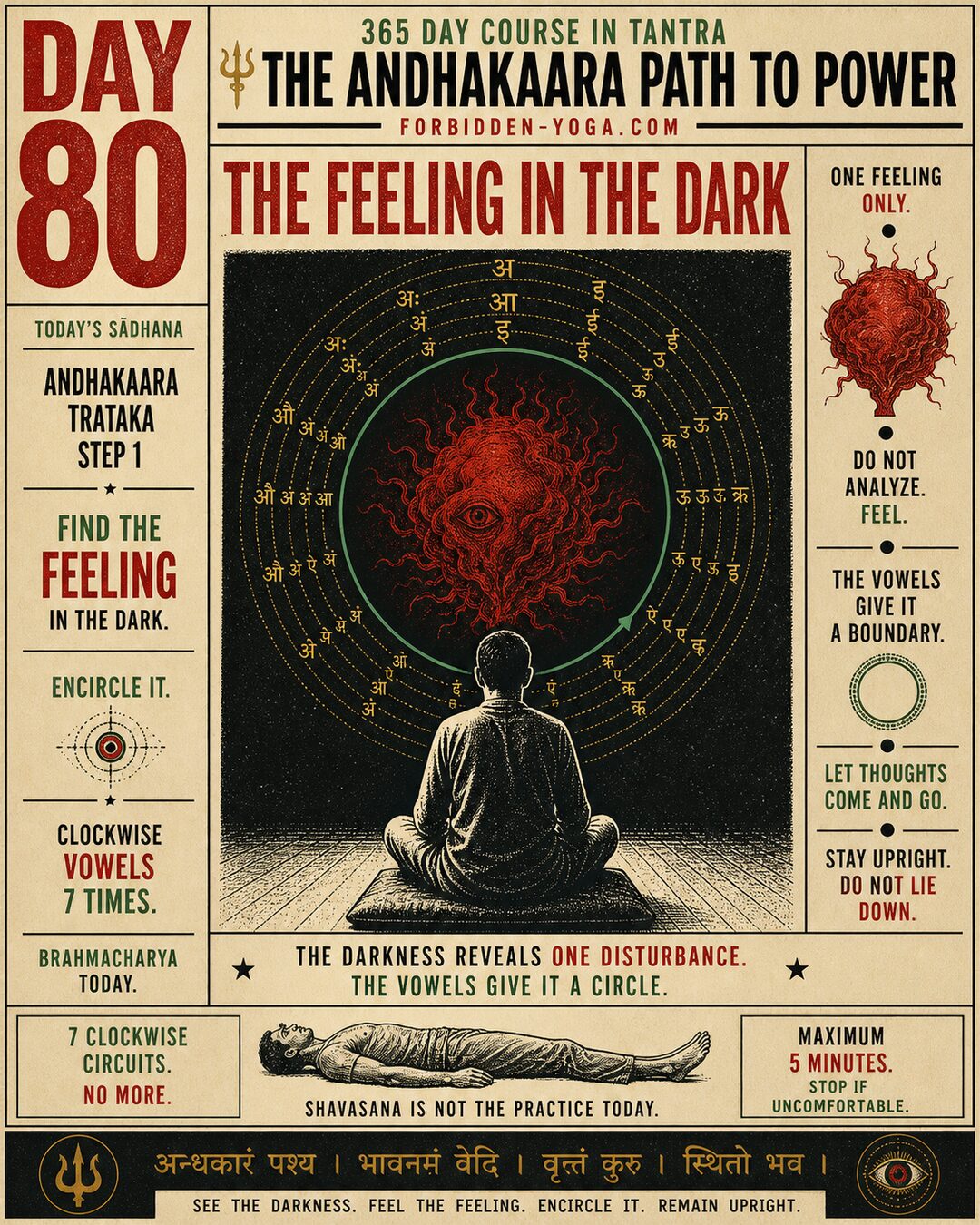
The darkness trāṭaka withdraws from it precisely this hold. It gives the eye nothing, and into this nothing something else must step. It is therefore not a concentration practice, it is a dissolution practice. And its purpose, and here lies the deepest of all the misunderstandings, is not the purification of the eyes, as the old texts claim of the candle trāṭaka, that it heals the diseases of the eyes. Its purpose is the purification of the energy body, of the emotional body. My lineage teaches it on the eightieth day with a simplicity I admire to this day: one should seek, by staring with open eyes into the dark, a feeling that oppresses or disturbs one; one should direct the attention upon this feeling that one perceives within oneself; one should encircle it with a circular line and speak, clockwise along this line, the vowels, seven times. One does not wash the eye here. One washes the energy. The dark is the only canvas dark enough that what the daylight outshines becomes visible, the oppressive feelings, the old saṃskāras, the knots in the fine body, and the vowel, the spoken sound, the śabda, is the knife with which one cuts them open. Therefore in my lineage the darkness trāṭaka always goes together with the Shabda-Sādhana, with the work upon the sound, upon the vowels, upon the consonant rows, for the seeing opens the dark and the sound moves within it.
And so let one understand too why the left hand, the vāma mārga, from which I descend, knows the Yoni-Trāṭaka, the gazing upon the gate of life, the sexual source, and why this is not the theme here. The Yoni-Trāṭaka, which one finds, be it said in passing, in not a single transmitted text, for which reason it too must be a coinage of the lineage, works with the fullness, with the primordial wellspring of orgasmic life-energy, with the brightest, the most overflowing object there is. The darkness trāṭaka works with the opposite pole, with the emptiness, with the nothing. They are the two hands of the same body, the full and the empty, and my lineage needs both; but here, in this text, it is the empty one that is at issue, the dark.
My lineage teaches this matter not all at once, but in stages that stretch across the whole year, from the stage zero, the mere sitting in the dark nothing for five minutes, to the late, sixty-minute stages, in which the darkness trāṭaka grows together with the sound, with the movement of the inner winds, with the bandhas into a single, dense sādhana. On the eighty-eighth day it speaks it out: that out of the formerly secret Andhakāra transmission a method has been developed in recent years, and that one must do the practices exactly as they are prescribed for the respective day, without shortening or lengthening them according to mood. That sounds like mere discipline, and it is much more: it is the only form in which the matter can be handed on safely at all. The sequence is not arbitrary, it is the slow, rhythmic dissolving of the resistance, the laya, and whoever picks out for himself the beautiful pieces and skips the laborious ones builds himself a raft out of the wreckage of a bridge and then wonders that it does not carry him.
VI. The Dark Retreat of the Snows
If the written seed lies in Kashmir, then the living, fully unfolded sister of this practice lies farther in the north still, in the snow, in Tibet, and it is the most honest thing in the world to admit it: the nearest living relative of my Andhakāra trāṭaka is not to be found in India, it is the Tibetan and Bönpo dark retreat, the mun mtshams, and the seeing-practice that one calls thögal, thod rgal, the leaping over, the immediate stepping-across.
One does it in a wholly lightless cell, the mun khang, with open eyes, often in fixed looking-postures, after one has found the stability in the preceding practice of the cutting-through, and then, into the lightlessness, the appearances begin. The tradition counts four visions, and whoever has ever sat in the Andhakāra has his breath stop at their enumeration, so exactly do they hit what happens. First appear the first lights, the little spheres, the thigle, and the vajra-chains, those chains of strung light-pearls that draw themselves through the dark. Then the appearances increase and order themselves, they grow more numerous, larger, more articulated. Then the awareness reaches its fullness, and the lights order themselves into figures, at the end into the hundred peaceful and wrathful deities, who appear in the spheres of light. And last all the appearances exhaust themselves again, they dissolve back into the primordial ground, and that is the way to the rainbow body, to the dissolution of the body into light in the moment of death.
The texts that teach this are the Seventeen Tantras of the Nyingthig, the Heart Essence, above all the Tantra of the Blazing Lamps, and the dark-retreat cycle of its own, the Yangti Nagpo, the Single Golden Letter of the Black Quintessence, in which great hermitesses like Ayu Khandro spent decades of their lives in the dark. The Bön sister, the Oral Transmission of Zhang Zhung, the Zhang Zhung Nyen Gyü, which comes down not as a hidden treasure but as an unbroken oral transmission from Tapihritsa to Nangzher Löpo in the eighth century, teaches the same thing in the Six Lamps, and one of these lamps is called, let one listen exactly, the Lamp of the Fleshly Eyes, sha'i sgron ma, for the bodily eyes are the gate through which the visions step forth. That is exactly the mechanism of the open eye, more exactly than I could ever have described it myself. And the Dzogchen even knows through which channels the vision comes, through the luminous kāti channels, which run from the heart to the eyes, an anatomical detail of the fine body that the Indian Kālacakra precisely lacks, although it too, in its night-yoga, the rātri-yoga, is practiced in the sealed dark room and knows its own ten signs, the smoke, the mirage, the fireflies, the lamp, the steady flame, then the moon, the sun, the eclipse-dark of Rāhu, the lightning, and last the blue drop.
Does this mean I descend from the Tibetans? No, and I shall not claim it, for that would again be the lie of the bad scholar who takes the resemblance for the descent. A bridge of transmission, a text that would join a Bengali or Kashmiri lineage with Zhang Zhung, is not to be found, and the resemblance is no transmission. A part of these appearances is, moreover, simply neurophysiological; the eye, deprived of light, generates its own phosphenes, and therefore in wholly unrelated traditions the same lights can turn up, because the same apparatus does the same thing. What I may say, however, and what a scholar of our time, Flavio Geisshuesler, supports with serious research, is this: that this whole bundle, the sky-gazing and the dark-gazing, did not arise within Buddhism, but rests upon an older, pre-Buddhist, animistic substratum, a cult that venerated the sky and the dark as the living primordial source of life, and over which Buddhism only later, in several waves, laid itself. Resonance, then, common substratum, not genealogy. My practice is typologically a sister of the Tibetan dark retreat and of the Kālacakra of the night, and that this is so, that the same matter turns up in places between which no bridge is demonstrable, is proof enough for me that I am inventing nothing, but rediscovering something.
And let one understand what the whole thing comes down to: the Tibetan dark retreat lasts classically seven or forty-nine days, and the forty-nine are no accident, they are the forty-nine days of the bardo, the intermediate state after death, and the dark retreat is nothing other than the dress rehearsal of dying. One lays oneself down, alive, in the dark that is death, and learns to meet the lights and figures that in dying come upon every human being with open, calm eyes, instead of being hurled by them, as the unpracticed are, into the next birth. Ayu Khandro, that Tibetan mistress, spent decades of her life in this dark. That is the true order of magnitude of the matter we speak of here, and it is the reason why the cremation grounds, the śmaśānas, are never far when the dark is the subject: because the darkness trāṭaka, thought through to its end, is a practice in dying, which one does while one still breathes.
It is worth laying the two Tibetan maps of the appearances side by side, for the practitioner of the dark finds himself again in both. The Kālacakra counts ten signs, and they are a stairway from the coarsest to the finest, from the smoke and the mirage by way of the fireflies and the lamp to the moon, to the sun, to the eclipse-dark of Rāhu, and last to the blue drop. The Dzogchen counts four visions, and they are a swelling, from the first sparkling by way of the increasing to the fullness in which the hundred deities appear, and to the exhaustion in which everything passes away again. It is not important which list one follows, and my lineage follows neither of the two literally, for what actually appears is with every human being a little different, formed by his own saṃskāras. Important alone is the one law that both lists write above themselves: that these appearances come, that they are meant to come, and that one may neither hold them fast nor drive them away, but only see through them.
VII. The Dark Is Alive
And now I come to what is hardest to say and easiest to misunderstand, for which reason I say it as clearly as I can: this dark has nothing, but nothing at all, to do with the dark in the sense of evil, of the negative, of black magic. Whoever reads that into it has understood nothing. It is much deeper and at the same time much simpler. When we speak of pre-Vedic spirituality, of the forgotten religion of nature, then we speak of animism, and animism means here quite concretely: the dark becomes alive. It does not become alive symbolically, not poetically, it becomes something like a deity itself, something into which one goes, the way one goes into an ashram, into a monastery, into a church, only far more abstract, far nearer to nature, for this dark into which the human being gazes is a piece of nature that we have lost, and it belongs, otherwise than one might suppose, not really to the tattvas, to the enumerated elements of creation; it is older, it is that out of which the elements first step forth.
That this is no chimera is told me not only by my own experience, it is told me by the oldest text we possess. In the tenth book of the Ṛgveda, in the one hundred and twenty-seventh hymn, stands the Rātri Sūkta, the Hymn to the Night, and the night is there no lack of day, it is a goddess, Rātri, a living, benevolent presence, the sister of the dawn Uṣas, and it is said that she has looked with her eyes upon many places and put on all her splendor. The night that looks with eyes. And in the sixth verse one begs her for protection, that she ward off the she-wolf and the wolf and the thief, she, the wave of the dark, and be good to traverse. One bargains here with the dark as with a sentient being, as with a terrain that has a will. This goddess of the night has a long family: she reaches by way of Nirṛti, the goddess of dissolution, of decay and of un-order, who dwells in the southwest, by way of Kālarātri, the night of time, the night of dissolution, as far as Dhūmāvatī, the smoke-grey widow among the ten Mahāvidyās, whom one equates with the Śmaśāna-Kālī, with the Kālī who dwells on the cremation ground, and of whom it is said that she is beyond order and disorder. An unbroken stream, then, from the Vedic night to the Tantric graveyard goddess, which treats the dark as a living divine presence. Not as evil. As the living thing that goes before us.
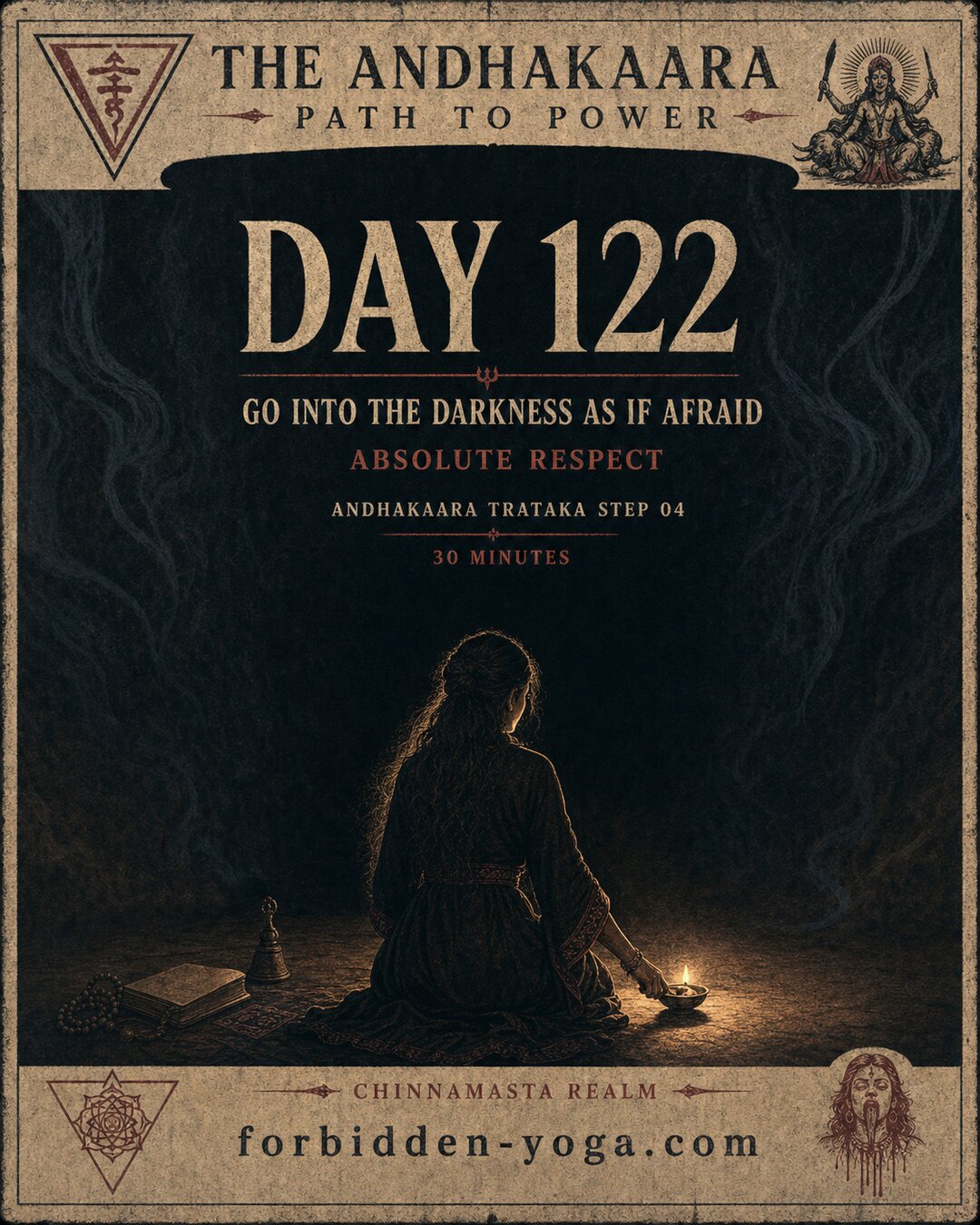
Therefore the first of all practices, before even the first technique, is respect. One does not enter this dark as one enters an empty chamber, one enters as into the house of one who is mightier than oneself, and one does well to hesitate at the threshold. My lineage therefore orders the days not by techniques but by realms, in the realm of Matangi, in the realm of Bhairavi, in the realm of Kālī, in the realm of Tārā, and that is no ornament, that is the truth of the matter: that in the dark one is never alone, but always sits in the realm, in the presence, in the dominion of one of these powers, and that one must know exactly in whose realm one finds oneself, for Matangi is not Kālī, and into the realm of Kālī, the mistress of the cremation grounds, one does not step with the same unconcern as into that of the outcast, wild Matangi. Whoever confuses the realm confuses the host, and to confuse a host is, in this region, no fault of courtesy, but a danger to life.
But who are these powers in whose realms one sits? They are the Mahāvidyās, the ten great wisdoms, the wrathful goddesses, and my lineage leads through their realms as through successive climates of the dark. In the realm of Matangi, the outcast goddess of the impure word, the mistress of the outsiders, one learns to enter the dark at all, for Matangi is herself a threshold-figure, one who stands outside the order and precisely therefore guards the access. In the realm of Bhairavi, the terrible one, the glowing one, the practice burns hot; here one sits the long stages of the darkness trāṭaka. In the realm of Kālī, the mistress of the cremation grounds, the black one, who devours time itself, one touches the terrible darkness, the ghorāndhakāra, the one in which the guests are at their densest together. And in the realm of Tārā, who already by her very name is the one who carries across, the ferrywoman, one learns to set across through the dark to the other shore. One does not traverse a single dark, one traverses a whole land of darknesses, and each has its own law and its own price.
And here, in this living dark, there meet in the end the two themes that my lineage never separates, the esoteric and the ecological. For that the modern human being knows the dark only still as a lack of light, as something that one removes at the push of a button, is the same forgetting that lets him also see nature only still as raw material, as something dead, available, illuminable. The crisis in which we are stuck is at its core a crisis of perception and of sensibility, a loss of the capacity to feel the living as living, and the darkness trāṭaka is, among everything else, also a schooling of this lost capacity: the relearning that what surrounds us is no thing, but a presence, and that one meets it with respect or not at all. Whoever has learned to feel the dark as living will also no longer be able to hold the forest, the river, his own body, for dead. That is the pre-Vedic religion of nature of which I speak, no belief-system, but a way of seeing.
VIII. The Guests
And with that I come to that for the sake of which this practice has been kept silent, feared, and almost died out, to that which makes it so fascinating and so dangerous that I hesitate to write of it at all, and do so only because the keeping-silent is in the end more dangerous than the open word. In the dark, when the eye has run into the empty long enough, guests come. I call them so because there is no better word, and because the word already carries within itself the only right bearing toward them: one treats them as guests, one gives them their space, and one never lets them, under any circumstances, too close to oneself.
These guests, these beings, these magical creatures, which we fetch over out of the other world, from the other side of reality, into ours, can help one, or they deceive one, or they pretend to help, or, and this is the most frequent and the most fateful, they make the I larger, they give the practitioner a very, very strange feeling of power. They climb into the Manipūra, into the power-center at the navel, and the practitioner thinks: it is I, I am the One, and in the instant in which he thinks it, he has already lost, and he has not lost one life, he has probably lost many lives. For these creatures are hungry. They have infinitely much to give, but they are famished to experience the world, the duality, the beautiful separation into two, through us, for they have no body and no senses, and they need a host, they need the sādhaka, the sādhikā, in order to taste through him, through her, the mahābhūtas, the elements, the indriyas, the powers of sense. If a human being has many saṃskāras, if he carries with him all his life, say, an inferiority complex or the feeling of having been cheated always and everywhere, and if he now suddenly receives this feeling of power, then these beings are glad beyond all measure, for they sense the weakness, they sense the gap through which they can enter, and they take the host into possession. Said simply and without prettifying: the sādhaka loses his soul.
I want it heard exactly that this is not my private mythology, no horror-tale that I tell to make myself interesting. Serious scholarship, which has never set a foot into a dark room, describes exactly the same mechanics. David Gordon White has shown in his book on the Yoginīs that at the core of the Kaula practice stood the feeding of the Yoginīs, those wild female spirit-beings to whom one offered gifts, juices, blood, and who only in this reciprocal exchange granted the practitioner the power and the divinization; that is, word for word, the mechanics of the beings that nourish themselves through the practitioner. Shaman Hatley has shown on the Brahmayāmala that the possession, the āveśa, is at once the goal and the danger, and that the power remains bound to the impurity and to the cremation ground. Judit Törzsök has described the āveśa as a cultivated, ritually controlled state, in which the body of the practitioner becomes the vessel, and in which the danger is the uncontrolled possession, for which reason the structure must be so strictly prescribed. June McDaniel has documented in Bengal the narrow border between the divine ecstasy and the breakdown, between the holy madness and the mere madness. And the Tibetan Dzogchen, which knows the visions as no other living tradition, gives the one, the non-negotiable warning: all these appearances, all lights and all deities, are rang snang, self-appearance, one's own awareness showing itself, and the one, the cardinal, the death-bringing error is to reify them, to take them for outer beings, to believe in them and to attach oneself to them. Whoever gets entangled in the visions and holds them for objective reality, the texts say expressly, remains stuck in them and does not attain the liberation, the very liberation the practice had promised; indeed, some travel through many realms, develop meditative powers, and yet in the end remain hanging. That is, in the sober language of the scholars, my loss of the soul.
And therefore, and only therefore, has this practice become as good as unteachable. It does not suffice merely to show the practice and to explain the practice. One would have to accompany the sādhaka, the sādhikā almost around the clock, twenty-four hours a day, for what happens as soon as they step out of the radiance of the guru and are alone with their guests is at first incredibly glorious, an intoxication of power and of seeing, a feeling of being one of the mightiest human beings on earth, and it stays glorious until the beings have taken over the whole system, because they are more patient than any human being. Therefore my lineage says, once and for all: never let this feeling too close to you, never merge with them. And therefore this practice is bound to humility and to surrender to a lineage, to a giving-oneself-over that one cannot shorten and out of which one can pick nothing. The picking-out, the raisin-stealing, the choosing-out-the-beautiful-practices is the disease of this generation, and it is, with this one practice, not merely a tastelessness, it is mortally dangerous. Whoever does everything rightly, in humility, bound, accompanied, can become one of the ripest, the most advanced human beings who ever lived on this planet. But he can become it only so long as the humility and the surrender to the lineage remain unharmed. In the instant in which he thinks, it is I, he is no longer one, and the guests, who know this, smile and wait.
Let one ask why precisely the absence of the immediate effect makes this practice so dangerous, and one has the whole tragedy together. A practice that hurts at once warns of itself; one stops when it burns. But a practice that for months seems to do nothing and then, long after the first dark room, begins to work in the rest of the human being's life, gives no warning. What the trāṭaka has set in motion shows itself not in the dark room, but outside, in the relationships, in the decisions, in the creeping, glorious swelling of the I, and by the time the human being notices what is happening to him, he is often no longer the same one who could still ask the question. Therefore the teacher here is no teacher in the Western sense, no transmitter of information, but a watchman, one who sees from outside what the practitioner, in the midst of the glorious intoxication, can no longer see in himself, and who intervenes before out of the guest a master has become. Such a practice without this watchman is a loaded weapon that one lays into the hand of a sleeper.
I have said that the practices with the guests belong to the most powerful things I have, and I must, for the sake of completeness, name the other half of this most powerful thing, the complex candle trāṭakas of which I spoke, those practices with whole sets of candles in geometric arrangements and with changing ways of looking. They are the bright siblings of the dark practice, and they are dangerous for the same reason: they shift the brain waves so far that a door opens, a metaphysical Pandora's box, and through an opened door comes in what will, not only what one has called. Whether one gazes into the manifold light or into the simple dark, the result is kindred: one leaves the realm in which the ordinary human being lives and in which the ordinary rules hold, and one does well not to treat this as a game. Whoever plays with Pandora's box because it glitters prettily has not grasped that the glittering was the warning.
IX. A Door for the Few
There will therefore, as with everything that is real, always be only a few who walk this path, and that is no regret and no elitism, it is the nature of the matter. The darkness trāṭaka cannot be packed into a weekend, it cannot be certified, it cannot be scaled, and there is, as I have said, no immediate reward at which one could stay hanging. It demands a wholly dark room, which the fewest can produce; it demands months and years, not days; it demands a teacher who stays, not a weekend seminar; and it demands the one thing that today is hardest to give, the humility to give oneself over to a lineage that is older than one's own small, hungry I.
I did not come to this practice as a seeker who gathers himself a collection of techniques. I did not ask for it, and no one invited me; it took me, the way a current takes a swimmer who has stopped fighting against the water. My own guru did not know where it came from; he had it from his grandfather-guru, and he too did not know it; when they were young they did not even have a dark room, they pulled, so it was told to me, a great blanket over the whole body and learned the dark beneath it. I do not believe that these practices arose in Bengal. I believe, after everything I have now found in the archives, that they come from the north, from Kashmir perhaps, from Tibet, from that pre-Buddhist substratum in which the human being still held the dark for living, and that what I received from mouth to ear is a last, splintered-off piece of this age-old, almost extinguished science, which was rescued by chance through a few blankets in a few Bengali nights.
Why, then, do I hand on at all something that cannot be taught from books and that devours the unguarded? Because the keeping-silent does not save the matter, but kills it for good. A practice that lives on only in two or three heads and of which no one any longer says a true word is a practice that dies with those heads. I write, then, not so that anyone should imitate this alone, on the contrary, I implore everyone not to do it alone; I write so that the knowledge that this door exists should not fall wholly out of the world, so that the few who are called should know that the call is genuine and not their imagination, and so that they, when they come, need not begin from the front in a field that lay a thousand years in the dark. A lineage is no possession, it is a fire that is passed from hand to hand, and a fire that out of caution one does not pass on is only another, slower way of letting it go out.
Perhaps you are one of the few. Perhaps not, and then let it be, with my blessing, another, gentler way that you walk; there are many of them, and good ones. But if you are one of the few, then know what you are letting yourself in for, before you enter the first dark room: not a relaxation, not a therapy, not an adventure of self-improvement, but the oldest and gravest appointment that the human being knows, the sitting with open eyes before the nothing, until the nothing begins to look back. Make the eye motionless. Hold the humility. Leave the guests in their space. And never, never confuse the light that rises out of you with the one you believe yourself to be.
The dark was there first, before the light, before the gods, before us. We have come out of it, and we return into it, and for a short, monstrous span it is given to us to gaze it in the face with open eyes. Almost no one does it. Perhaps you will do it.