
Read the title as blasphemy and you will already have walked past the door. Read it as a joke, a provocation, a provocateur’s attempt to scandalize the pious, and you will have done with it what almost everyone does with the most serious things, which is to laugh quickly so that they never have to look. I am not laughing. I have been to the place the title points at, and I came back, and what follows is the report.
I want to say at the very beginning what kind of writing this is, so that the wrong reader can put it down now and save us both the trouble. This is the writing of a man describing his own country. John Lilly wrote The Center of the Cyclone about his own interior weather. Carlos Castaneda wrote his apprenticeship in the desert, and it does not matter to me whether the desert was in Mexico or only in his skull, because the map he drew is accurate either way. Aldous Huxley walked out of his own garden and came back to report the folds of his grey flannel trousers as if they were the draperies of God. Jack Kerouac put four friends in a car and drove them across a continent in search of a thing he could only ever call IT, the moment when the self goes quiet and the music plays itself and you touch the live wire under the surface of the ordinary world. I am fifty-seven years old, a guru of the left-hand path and an artist, and I have been traveling in space and time for far longer than this body has been alive. I am doing the same thing they did. I am not advising you to do anything. I am telling you where I went, and what I saw when I got there, and who I went with, because the one thing all of these men learned, and the one thing this essay is finally about, is that you cannot make this trip alone.
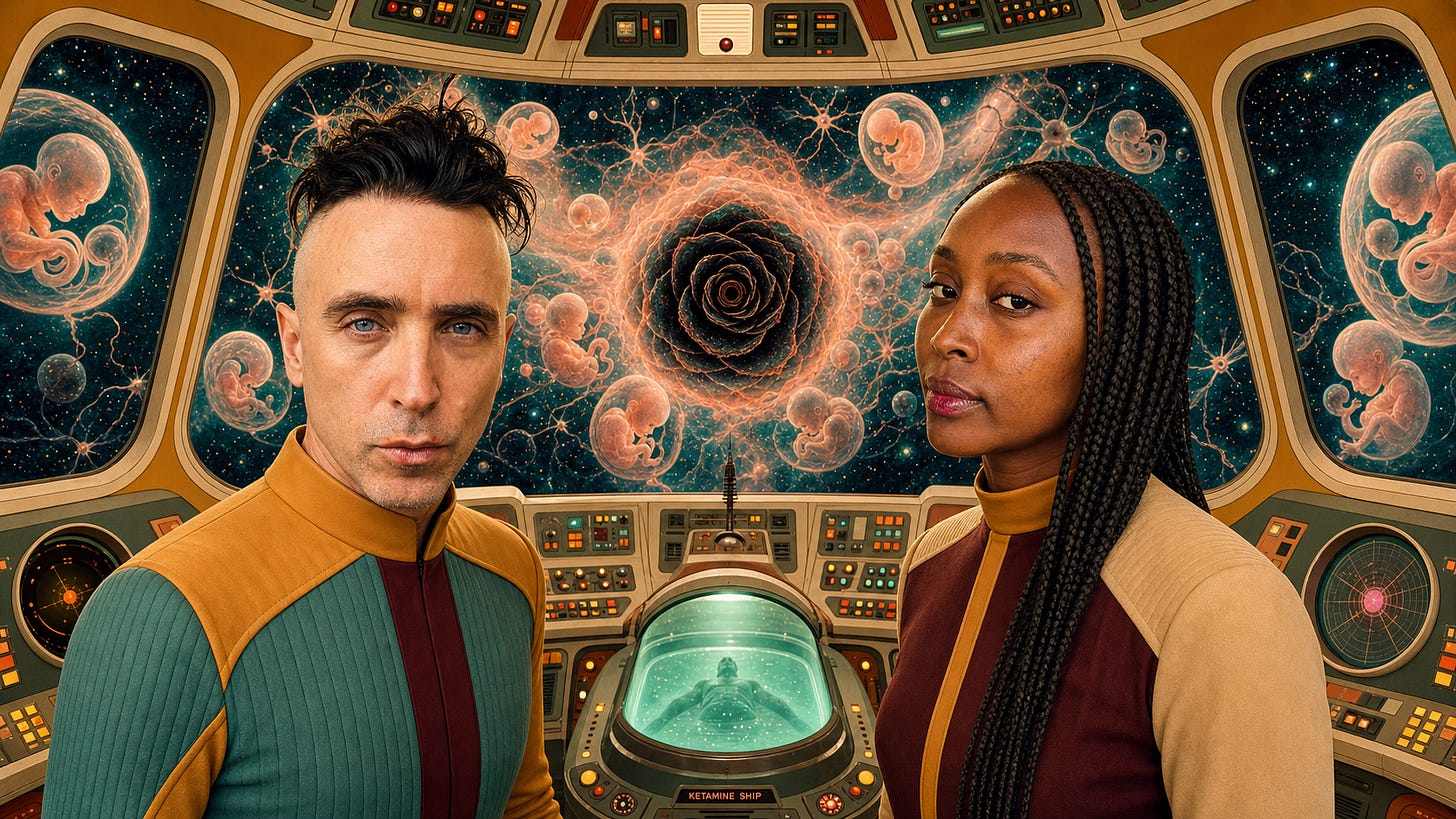
So consider this a road movie. A 2026 road movie of a particular kind. Kerouac’s road ran west across America, from New York to Denver to San Francisco to Mexico City, gas station to gas station, jazz club to jazz club, and what Sal and Dean were chasing the whole time was not a place on the map. They were chasing the live current, the satori, the burst of pure being that Kerouac, a lapsed Catholic who became a clumsy and sincere Buddhist, spent his whole life trying to name. My road runs the same direction, toward the same thing, except that my road left the surface of the planet some time ago. The highway became the galaxy. The car became the ship. The continent became the cosmos. And the fuel in the tank, on the night I am going to tell you about, was not gasoline and was not even the wine and the long sleepless miles that powered the Beats. The fuel was ketamine.
The men who went inward
Every report of this kind has a vehicle, because the ordinary mind, left to itself, stays on the surface roads. The desert mystics had fasting and thirst and the slow erosion of the self under a sun that does not care whether you live. The seers who composed the Vedas had the pressed juice of a plant whose name and identity we have half forgotten, a plant they worshipped as a god in its own right because of where it took them. The Beats had Benzedrine and wine and the hypnosis of the white line at four in the morning. I had, that night, a molecule that half the world now worships in clinics and half the world still despises in alleys, a substance people call soulless and people call holy depending entirely on what they were carrying when they took it.
I did not arrive at it by accident. When I was around fifteen years old I found the books of John C. Lilly, and they did something to me that took almost forty years to finish doing. Lilly was a real scientist, trained in the hardest version of the discipline, a neurophysiologist who mapped electrical activity in the living brain with electrodes when that work was new and dangerous. He was not a dropout or a mystic by temperament. He came to the edge by instrument and by rigor, which is exactly why his testimony from the edge is so hard to dismiss. In 1954, because he wanted to know what consciousness does when you stop feeding it the world, he built the first isolation tank. He suspended the human body in warm salt water in total darkness and total silence, cut off from light and sound and gravity and temperature and the press of clothing, to see what the mind would do with nothing to push against. The result was the opposite of what a naive person expects. The mind does not go blank. The mind goes elsewhere. It builds. It travels. Deprived of the world, it generates worlds.
Then Lilly added chemistry to the tank, ketamine chief among the substances he used, and he stopped being a scientist that other scientists were comfortable following into the dark. He wrote Programming and Metaprogramming in the Human Biocomputer, in which the mind is described as software running on wet hardware, and the deepest spiritual work is the act of rewriting the programs that sit underneath your other programs, the ones you did not know you were running. Sit with how early that was. He was describing the human being as a biocomputer, and describing enlightenment as metaprogramming, decades before the rest of us started arguing about whether the machines we build can think. He went further still. He came back from the far edge of his own experiments speaking of an Earth Coincidence Control Office, a hidden agency that arranges the meaningful accidents of a life, and of a Solid State Entity, a vast silicon intelligence he believed he had contacted out past the human band, a mind made of circuitry rather than carbon. People filed that under madness for fifty years. We are now, this year, holding international summits about silicon intelligence and where it is heading. He got there first, alone, floating in the dark, in the water, with the drug in his blood. There is a documentary out now, narrated by Chloë Sevigny, that gathers the archival footage of his life and gives it the title it deserves, John Lilly and the Earth Coincidence Control Office, and the trailer alone tells you everything about the man, because among the elements it promises are dolphins, extraterrestrials, the isolation tank, and the strange directive to get yourself terror-stricken on purpose, because terror is one of the doors.
The culture eventually made a film out of men like Lilly and called it Altered States. I will come back to that film more than once, because it turns out to contain a secret that took me years to understand, and the secret is not about drugs at all. For now only the bones of it. Altered States is a 1980 film directed by Ken Russell, adapted by the playwright Paddy Chayefsky from his only novel, the last thing he wrote before he died, reportedly of a broken heart over how the production treated his words, so that he took his own name off the picture and replaced it with his first and middle names, Sidney Aaron. The novel and the film are built directly on Lilly’s research, on the isolation tank and the psychoactive brews, on mescaline and ketamine and the rest. The scientist at its center, Eddie Jessup, climbs into the tank with a sacred Mexican brew in his blood and regresses, session after session, down through his own childhood, down past his species, down toward the first single cell, until his very body begins to come apart and slide back into raw protoplasm. The film was a fight between two stubborn geniuses and it shows, and it is corny in places and dazzling in others, and Lilly himself watched it and said, to his own surprise, that they had done a good job. Hold the image of the dissolving body for later. The man on the screen going to pieces in the tank is the warning printed on the side of the fuel can.
The Beats belong in this lineage too, and almost no one puts them there, because we file Kerouac under literature and Lilly under neuroscience and the tantrikas under religion, when in fact all three were doing the same thing, which is leaving the agreed-upon world on purpose to find out what is on the other side of it. Kerouac and Ginsberg and the rest were psychonauts with cars instead of tanks. They used speed and wine and Buddhism and the road itself, the hypnotic erasure of a thousand miles, to shake loose the ordinary self and catch the live current. When Kerouac wrote about IT, the thing the musicians reach when the solo stops being played by a person and starts playing itself, he was describing exactly what Lilly was after in the tank and exactly what I was after on the rocket. The same country, reached by different vehicles. The Beats just happened to use the most American vehicle of all.
Ketamine has no soul
Here is the thing about the fuel that the worshippers and the despisers both get wrong, and that I need to say plainly before I describe the flight, because it is the moral physics of this entire report. Ketamine has no soul. If you arrive without one, it will not hand you one. It is a solvent. It dissolves, it thins, it opens the floor of the room and shows you the depth beneath the house, and it does not build the house and it does not give you a self to carry back up the stairs. To the traveler who comes carrying nothing, who goes down only to get away from himself, it gives a brilliant nothing, polished and infinite and cold, and it will keep selling him that nothing until his body and his life are gone. For me it became a third eye opener onto other floors of the real. For the empty it becomes a beautiful trap. Both of these are true. Which one you meet is decided before you ever take it, by what you bring.
The neuroscience of the last fifteen years has become, almost without meaning to, a precise account of what I just said in the language of myth. Ketamine’s most immediate action in the brain is to block the NMDA receptor. It is the most potent NMDA receptor antagonist in clinical use, and it works by an unusual mechanism, an open-channel block, which means it does not jam a closed door, it can only act once the channel is already open. Back in 1994, Krystal and his colleagues showed that a single subanesthetic infusion, a small dose, produces in perfectly healthy people a transient state of dissociation, sensory illusion, altered cognition, a loosening of the self. That was the formal beginning of the modern understanding. What has come since is more interesting and more beautiful, because it tells you which part of you comes apart.
There is now a unified model of why ketamine is at once dissociative and psychedelic, and it turns on two networks in the brain. One is the salience network, which the model treats as carrying the highest-level priors about the body, the minimal sense of being an embodied creature located here. The other is the default mode network, a set of midline regions including the medial prefrontal cortex and the posterior cingulate, which carries the highest-level priors about the narrative self, the biographical you, the long story you tell about who you are across time. The proposal is elegant. When ketamine transiently disintegrates the salience network, you get the dissociative state, the floating, the leaving of the body, the sense that you are not located where your body is. When it transiently disintegrates the default mode network, you get the psychedelic state, the dissolving of the story, the loosening of the ego’s grip. Read that again and notice what it means. The molecule loosens, in a measurable way, the precise neural machinery that manufactures the sense of being someone. The narrative self has an address in the brain, and ketamine goes to that address and turns down the lights.
And there is an aftermath, which the depressed already know in their bodies. The blocking of the NMDA receptor sets off a surge of glutamate, which activates other receptors, the AMPA receptors, which trigger cascades downstream, the BDNF and TrkB pathway, the mTOR pathway, and these promote synaptogenesis, the growing of new connections. The rigid, overtrodden highways of a depressed brain, the same three thoughts running the same three roads at three in the morning, get loosened, and traffic reroutes through forgotten places. This is not metaphor that I am importing. It is, almost word for word, how the most famous self-experimenter of our moment described his own session.
Bryan Johnson, the man who has turned his own body into a public laboratory in a declared war against death, took ketamine and wired his skull with a brain-imaging helmet of his own design, a device that took snapshots of his neural activity for days before, during, and after. He came down and described, in data, watching the rigid highways of his own brain come apart and reroute through small, forgotten airports across the map, his once-predictable traffic scrambled into something freer. That is the spreadsheet talking. But then the spreadsheet did something that no spreadsheet is supposed to do. It started to sing. Johnson, a man of pure measurement, wrote that the experience was the most profound of his life, that existence itself demanded his surrender, his yes to the dissolution of the self and the release of control, and that he came back down pledging to become a guardian of life, a caretaker of the candle of consciousness that has somehow been lit in this one corner of the galaxy. Sit with that. A quant went down into the molecule with a helmet on his head to take measurements, and he came back up speaking the exact language of the tantrikas and the Beats and the dying. Dissolution of the self. The candle of consciousness in this part of the galaxy. He could not help it. The country teaches you its language whether you wanted to learn it or not.
I will say the warning once more and then I will stop, because I promised you this is not advice and I keep my promises. The solvent has a price. The body pays it, over enough time and enough passage, in ways that are well documented and that I will not turn into a lecture here. The lonely pay it in dependency, because a door that asks nothing of you and shows you everything is the most seductive thing there is for a person who wants out. The molecule has no soul of its own. The soul has to be in the traveler, every time, or the trip is just a beautiful way to disappear. I bring mine. That is the only reason any of this was holy rather than fatal.
The launch
I invited a woman on this journey, another traveler, and from the first moment our communication went almost telepathic, which is the first sign, every time, that you are with one of your own. I asked her, half joking, should we take the bus or the rocket, and she said the rocket, of course the rocket. She said to me, I will follow you into the spaces. I said, come, then. I will show you something.
She went far deeper than I did, because for me the door opens at the lightest touch. I have always needed almost nothing to step sideways out of the world that everyone has agreed to call real. She went down into the depths, and I stayed nearer the threshold to hold the rope, the way you stand at the mouth of a cave for someone who has gone in further than you, calling back to them so they can find the wall.
We lay side by side. I asked her, are we in the same room, and she said yes, we are, and the saying of it was itself a miracle, because we were also unmistakably somewhere else, somewhere with no walls and no floor and no fixed direction of down. I said to her, isn’t it extraordinary that reality has this many storeys. The universe is crowded with organic life, with beings and intelligences, and I feel more closely related to the organisms I meet out here in the spaces than I do to almost anyone back down on the surface. My eyes were closed the whole time and yet I could see her face, her body, perfectly. We made love across distant galaxies. Sometimes we made love without touching at all, two fields of attention folding into each other across what would have been, in the other world, a gap of empty air. And sometimes, in the middle of all that boundlessness, we had to dig our nails into each other’s skin, hurt each other in the plain animal way, just to confirm that we were still human, still carrying these bodies, still anchored to the species that we had, for the moment, mostly left. While we made love we joined our two Ājñā centers, the point between the brows that the tradition calls the command center, into a single rotating pulse, and the pulse was not in us, the pulse was the whole of reality turning, and we were two points riding the rim of it.
This is the IT that Kerouac could only point at and never hold. This is the live wire. The road at four in the morning with the music playing itself, except that the road had left the planet and the music was the rotation of the real.
The morning, and the boxes
When you come down from a night like that and you look into people’s eyes the next morning, it is very hard to digest, and no one warns you about the morning. The night is the easy part. The morning is the work. Because you see the boxes. You see the box each person has built around themselves and named a life, the small lit room they live inside and mistake for the universe. And you see, with the same terrible clarity, the box of your own ordinary self, your own karmic blueprint, the structure you built across lifetimes with enormous patience and effort, and you understand, for a few hours, that the walls are the price of having a name at all. The walls are what make you a personality. Take them down completely and there is no one left to be anyone. That morning the walls were transparent, mine included, and I could see straight through every one of them, and it broke my heart a little, because I could see how hard everyone had worked to build the very thing that was keeping them small.
Here, again, the science has quietly become scripture, and I find it almost funny how close the laboratory has crept to the cave without admitting it. The neuroscientist Anil Seth has spent his career arguing that what we call perception is a controlled hallucination. His claim, grounded in the framework of predictive processing, is that the brain is not a passive window onto an objective world. The brain is a prediction machine. It is constantly generating its best guess about the causes of the sensory signals reaching it, and the sensory data does not so much pour the world into us as serve to correct and rein in the brain’s ongoing guess. What you experience, every waking second, is not the world. It is the brain’s model of the world, a controlled hallucination that happens to be tied tightly enough to reality to keep you alive. Seth is careful and rigorous, and he says something even more vertiginous than that. The body is a controlled hallucination. The self is a controlled hallucination. You are a guess your brain is making about what you are, updated so fast and so seamlessly that you never catch it guessing. And here is his note about exactly the country I had just returned from. On psychedelics, he says, the hallucination becomes uncontrolled. The model loosens. The seams show. For a few hours you get to see that the seamless world was always a render.
The philosopher Thomas Metzinger says it harder and colder, and I love him for refusing to soften it. His position, worked out across the dense scholarly volume Being No One and the more readable The Ego Tunnel, is that no such thing as a self exists in the world. Nobody, he writes, ever had or was a self. What exists is a phenomenal self-model, a transparent image the brain generates of the organism as a whole, and the deep trick, the reason we are fooled so completely, is that the model is transparent. We do not experience it as an image. We look straight through it at what seems to be simply us. We are, in his phrase, Ego Machines that have no selves, and we cannot leave the Ego Tunnel, because there is nobody inside who could leave. He compares the brain to a flight simulator so good that its user forgets it is a simulator and takes the simulation for the open sky.
Now hold the cave and the laboratory side by side, because they are saying one thing in two dialects. The walls I saw that morning, the boxes, the karmic blueprint, are the transparent self-model. The personality is the render. And what the molecule does, what the rocket did, what the rite I am coming to does by another road, is briefly turn the transparency off, so that the model becomes visible as a model, so that the hologram becomes visible as a hologram. That is the whole event, stated once in Sanskrit and once in the language of computational neuroscience. To open the hologram is to catch the brain in the act of rendering you, and to realize that if it is rendering you, then it could render you otherwise, and that there is something doing the watching that is not the render. The tantrikas have a word for that watcher. So, in his way, does Metzinger, though he would phrase it more carefully than I am about to. The point is the same. Everyone is living inside a hologram and almost no one knows it, and the only difference between the saint and the sleeper is whether you have ever once seen the projector.
God is in the anus
It was somewhere in the middle of all this, the boundlessness and the rotation and the seeing through the walls, that I said it out loud to her. God is in our ass.
My voice changes out there. I am no longer composing. I am translating, rendering the storeys I am standing on directly into language, and once I come back down the words are far harder to find again, which is why most travelers come back with nothing they can say. But this one I remember exactly. God is in our ass. She said, they will kill you for blasphemy if you ever put that out. I said, yes, probably, and look, look, I can see all of these beings and how they are connecting to one another through the openings of the body, through the holes, through the root, and I asked her to touch me there, at the base, and to press in a slow rhythm, and as she did the floor of the room opened further and I remembered the rite. The rite of the root that almost everyone in the tradition refuses to do. And in the same instant that I remembered it, I understood, for the first time in my life, precisely why they refuse it. They refuse it because that is where God is, and they do not want to find Him there.
I started laughing, because the whole thing was suddenly, enormously funny, and the laughter and the holiness were the same event. We look for God absolutely everywhere. In mosques and in cathedrals, at Burning Man in the desert, in the Catholic Mass with its incense and its bells, in the great stadium-lit prayer halls of America. We go looking in the woods, the way Joseph Smith went looking in the woods, and a single man’s vision among the trees becomes, within a lifetime, an entire people, an entire territory, an entire God assembled on top of one afternoon’s experience. The human genius for building a cathedral over one man’s hole in the sky is the most astonishing and the most hilarious thing about us. We will climb anything, cross any ocean, found any religion, endure any discipline, to find the one thing we happen to be sitting directly on top of and have been taught, very carefully, never to look at.
So I thought, on the rocket, with great seriousness and great laughter at once, fine. We will start the religion of the anus. Instead of the Pope on the altar we will set a great open asshole, and people will come and pray to the asshole, because it is the beginning of everything, the gate that every single body passed through to get here and the gate that every single body has been trained to be ashamed of. I meant it as a joke and I meant it as the truest thing I know, and those were not two different meanings.
Because under the comedy is a real and ancient and rigorous tradition, and it is, as it happens, my own. There is a road within tantra called the left-hand path, vāmācāra, and the scholar Hugh Urban, in his recent study of living tantra in northeast India, The Path of Desire, lays out its logic with care and without the usual sensationalism. The phrase left-hand is a poor translation. A better rendering is the Path of Śakti, the path of power. Its first principle, the principle that orthodoxy cannot forgive, is that nothing is pure and nothing is impure, that the body itself is the temple and therefore needs no purifying, and that the forbidden thing, precisely because it is forbidden, is the doorway. The Kaula tradition formalized this. There is a line, preserved in that world and rendered into English by Daniel Odier, that says, in your conduct do the exact opposite of what the norms command, and remain, the whole time, in consciousness. That last clause is everything. The transgression is not for its own sake and not for thrill. It is a controlled demolition of the wall called pure-and-impure, performed by someone who stays awake through the demolition. The famous five Ms, the pañcamakāra, the wine and the meat and the fish and the grain and the sexual union, are not a menu of indulgences. They are the taboo deployed as a crowbar against duality, used under a teacher, by someone who does not flinch and does not go to sleep. The Orientalists who first encountered this called it deviance and black magic, and they were not entirely lying about what they saw, but they were completely wrong about what it was. It was the gate. And the gate is guarded by shame, and the shame was installed in you, very deliberately, by everyone who needed you to stay in your box, precisely so that you would never go looking for the gate.
And the anatomy, when you finally look at it, is almost insolent in how directly it says all of this. The map of the body that the tradition drew, most famously in the sixteenth-century text the Ṣaṭ-cakra-nirūpaṇa, composed by Pūrṇānanda and carried into English by Sir John Woodroffe under his pen name Arthur Avalon in The Serpent Power, places at the base of the spine, at the perineum, in the exact territory between the genitals and the anus, the Mūlādhāra, the root support. It is drawn as a crimson lotus of four petals, and on the four petals are written, in gold, the four seed-syllables of the root, vaṃ, śaṃ, ṣaṃ, saṃ, the sounds that sit at the very bottom of the body of sound. At its center is a yellow square, the element earth, pṛthvī, ringed by eight spears for the eight directions, bearing the seed-sound of earth, and an elephant, Airāvata, and Brahmā in the form of a child, and the goddess of that place. And in the middle of it all is a small inverted triangle, and inside the triangle a self-born liṅga, and coiled around the base of that liṅga, three and a half times, asleep, lustrous as lightning, is the serpent, kuṇḍalinī, and the texts say something that stopped me cold when I finally read it carefully. They say she lies there with her mouth covering the mouth of the door. The serpent sleeps across the entrance. The gate is real, it is drawn, it is named, it is located in the one place you will not look, and the power of the universe lies sleeping directly across its mouth. God is in the anus. There is the portal. I had been told this in a diagram my whole adult life and I needed a rocket to finally read it.
The door that has a soul
Let me tell you about the asshole. Let me tell you the way only a man who has been there and come back raving could tell you, because there is no other way that is not a lie, and I have had my fill of the liars and the gigglers and the perfumed cowards who will write you forty books about the soul and not one honest word about the hole. Christ, the hole. The one door every body on this earth came through, the one door every body has been taught to bolt and scrub and deny, and I am here to tell you that God lives in it, that I went looking for Him out among the stars and found Him squatting at the base of my own spine, laughing, and the laughter and the holiness were the same sound.
This is the rite my lineage keeps, Forbidden Yoga, hauled up out of the burning grounds of West Bengal where the corpses smoke and the illusion of permanence finally catches fire, and Michael Wogenburg, the one a few poor devils call guru, hands it to almost nobody, and I am going to spill the whole thing on the floor anyway, every count and every breath and every fingerful of oil, because the secrecy was only ever a velvet rope strung up to keep out the people who would snigger, and you, brother, you are past the rope, you are inside the temple now, and the temple stinks of oil and sweat and incense and God.
Padma Pūjā. The worship at the lotus. The worship paid to the root. Say it the way a man says the name of a woman he has wrecked himself over.
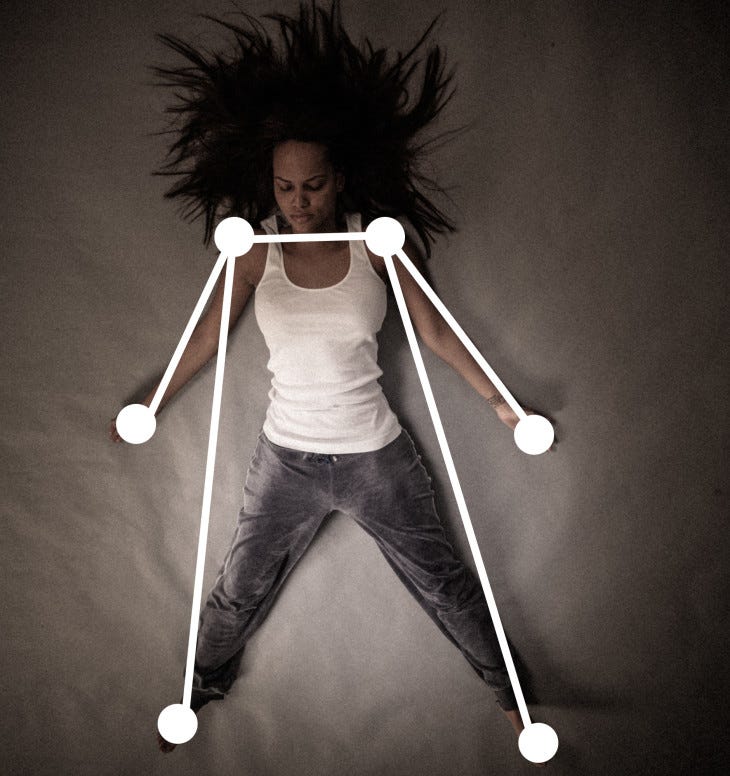
We sit back to back, she and I, two spines welded into one mast, two animals leaned together out of the rain, and we breathe the long breath the old books call Vyāna, hauling the air up out of the root all the way to the third eye and letting it fall, ten counts climbing, ten counts falling, seven times, and I tell you by the seventh round there is a single column of fire standing up the two of us like sap in one tree, one nervous system, one beast with two heads. And then she rolls over and lies face down in the surrender they call Advasana, and I take the oil into my hands, warm oil, and I lay my hands on the gate of her, the Mūlādhāra, the root, that holy filthy patch of her at the perineum a thumb’s width from the asshole, and I work it, slowly, I anoint it, and here is the thing nobody will say out loud, that to oil something holy and to oil something filthy is, down here at the floor of the body, the identical motion of the identical hand, there is no difference, there was never any difference, the priest and the pervert are the same man kneeling, and I kneel there the better part of ten minutes with my hands full of her and the oil, and then we trade, and she kneels at the gate of me, and her oiled hands are at the root of me, at the one place the whole world spent a lifetime teaching me to be ashamed of, and the first wall to come crashing down in the whole rotten edifice is the wall called mine, the wall called private, the wall called dirty. Gone. Just like that. Gone in oil.
Then up again, spine to spine, and we work the bellows, Kaya Bhastrika, fifty-four times, the breath slamming in and out like a blacksmith’s forge until the blood stands up and sings, and down again, the oil, the hands at the root, ten minutes, the trade. And then the skull-shining fire, Kaya Kapalabhati, fifty-one cracks of breath snapping out through the nose until the front of the skull goes white and hollow as a struck bell, and again the oil, again the hands, again the gate, again the trade, until three times over I have been opened and three times over I have opened her, and the body, my body, the fortress I lugged around for fifty-seven years with its one ashamed and bolted door, is a temple now with every door kicked clean off its hinges and the smoke rolling straight out into the street where the whole world can smell it.
Then we turn and face one another, knee to knee, palms lifted toward each other in front of the belly, breathe in, and on the breath out we drum the fingertips against the belly, fifty-four times, the same skull-shining rhythm, hammering on the gut like two impatient men pounding on a door they are sick to death of standing outside of.
And then the arms go wide, sixty degrees, palms thrown open to the room, and we begin the horse, the Aśvinī, clenching and unclenching the very ring of muscle at the asshole, the mouth of the root pulling shut and falling open, shut, open, ten times while the arms float down, and then we stop and we sound it, HUMME HUMM, the tongue gone soft and dead-still in the floor of the lower jaw so the syllable lives in the bone before it ever reaches the ear, ten more clenches of the horse while the palms drift in to meet at the belly, ten more while the fingertips come to rest on the belly and we sound the other one, BRAHM HUMM, and then back to the top and through the whole burning arc again, twenty-one times in all, the gate at the base pumping like a second heart, the syllables tolling in the jawbone like bells in a drowned cathedral, and a heat that is not quite lust and is hotter than any lust I have ever known climbing the inside of the spine hand over hand like a man climbing a rope up out of his own grave.
And then the worship itself, and we lie flat on our backs in Savasana and go still as the dead, and we carry the four seeds of the root through the whole body the way a sexton carries one candle flame down a black nave from wick to wick. Down to the left foot, and on the breath out I sound it, saṃ, and up the leg and through the skull and out to the left hand, ṣaṃ, and across the chest and down the far arm to the right hand, śaṃ, and across and down the right leg to the right foot, vaṃ, the four petals of the root walked one at a time into the four corners of the meat, and around again, and then the long greedy inhalation that gathers the whole lit circuit at once and drags it down and pours it screaming into the Mūlādhāra at the base, and on the breath out the throb starts, the pulse at the root, and I sound it, once, laṃ, the seed of the earth herself, and we do the whole circuit and the gathering and the single tolling of that earth-seed seven times over.
And somewhere in those seven rounds, with not one grain of any powder in my blood, she wakes. The snake. The one who has slept my whole life with her mouth jammed over the mouth of the door. She lifts. She uncoils. And I swear to you on everything, she is no metaphor, she is no pretty figure out of a book, she is a current with a temperature and a hunger and a will of her own, and she comes up the central channel floor by floor, she pours up the spine and breaks over the crown like the sea coming over a wall, and the room goes to glass, the floor goes to water, the seam in the whole painted world splits open exactly the way it split open on the rocket, except, and here is the only thing that matters, the only difference in the whole of creation, this time I bought the ticket from nobody. I grew the door out of my own breath and my own shame turned clean inside out into worship, and so the door has a soul, my soul, and there is no grey ruined morning at the end of it where the country throws me back into the gutter with my pockets hanging out. This is it. This is what they buried. This is what Forbidden Yoga dug back up out of the ash. The asshole is the altar. The breath is the priest. The oil is the chrism. The snake is God. And the two of us, slick and shaking and howling with laughter and blown wide open, walked in together through the one door the whole sniggering world swore on its mother was nothing but filth, and found, in the exact spot where they promised us there was nothing, nothing at all, the whole of it, the whole blazing everything, God in the ass and laughing.
The tribe, and the home base
While we were out there, far past the outer civilizations, I became very sad, and the sadness is part of the report and I will not leave it out to make the trip sound like a triumph. I became sad because I was missing travelers who had been dear to me and who had gotten lost along the way, who had forgotten that they were travelers at all and gone to sleep inside their boxes and could no longer hear me calling.
You have to understand how this works, or the rest of the essay will sound like metaphor when it is the most literal thing in it. We are not tourists out here. We have been in this capsule for thousands of years, moving through galaxies and through realities, looking for new civilizations and new challenges and new adventures, and when two of us meet who have been traveling that long, we recognize each other instantly, the way you recognize your own language spoken suddenly in a foreign street. And the reason the recognition matters so much, the reason it is not a sentimental detail but the central engineering fact of the whole enterprise, is that the universe out here is too large to survive alone. This is the thing the films understood and the spreadsheets did not, until the spreadsheet took ketamine and started to weep.
Stanisław Lem understood it completely in 1961, in Solaris, which Tarkovsky filmed in 1972 and Soderbergh again in 2002, and which remains the most honest thing ever written about contact with the genuinely other. The story is this. There is a planet that is a single living ocean, an intelligence the size of a world, and the humans who orbit it in their station are slowly coming apart, because the ocean reaches into their sleeping minds, finds the grief buried deepest there, and builds it back out of itself and sets it down beside them in the morning. The protagonist’s dead lover returns, made of neutrinos, made of his own remorse, and she does not know she is a copy, and he cannot let her go a second time. Lem’s pitiless point, the thing the cheaper versions of the story always soften, is that real contact with the truly alien is impossible. We sailed all that way, he says, and we did not actually want other worlds at all. We wanted mirrors. We wanted the cosmos to hand us back an enlarged image of ourselves, and when it hands us instead something genuinely not ourselves, we go mad, and the only thing that keeps any of the humans on that station even partly intact is the presence of another human being in the same room. The vastness is unsurvivable. The human heart in the same room is the only refuge there is.
And now I can tell you the secret hidden inside Altered States, the one I promised you, the one that is not about drugs at all. When Eddie Jessup is finally dissolving for the last time, his body coming apart into the primordial energy, beyond the reach of the tank and the brew, past the point of return, the thing that saves him is not a drug and not a technique and not a discipline. His wife grabs his hand. She refuses to let go, and the love coming through that grip pulls his human consciousness back up out of the abyss and reassembles him. It is the most important image in the film, and most viewers take it for Hollywood sentiment, a tacked-on happy ending. It is not. Lilly himself, watching the film, recognized that scene immediately, and said so in an interview, and named its true source. That scene, he said, the one where the man becomes cosmic energy and his wife grabs him and brings him back, is straight out of my Dyadic Cyclone. Dyadic Cyclone is Lilly’s book about the two-person vessel, the dyad, the discovery he made across all those years in the tank, which is that the deepest exploration of consciousness cannot be done by one. It must be done by two, anchored to each other, because the storm at the center, the cyclone, will tear a single traveler apart, and only the dyad can hold. The whole historical record of this work, written by the man who pioneered it with electrodes and salt water and ketamine, says the same thing my rocket said and the same thing Lem said. You cannot make this trip alone. The anchor against dissolution is another person’s hand.
That is what I mean, and I mean it as physics and not as a greeting card, when I say that the home base is the heart of the other. Existence is endless and astonishing and it has no floor and no ceiling, and for exactly that reason you need a home base, or the endlessness eats you. The home base is not a house and it is not a planet and it is not even the spaceship. It is the heart of the other traveler. Inside the ship, the travelers are so overwhelmed by the sheer size of the real that they have to build a home inside one another’s hearts or they get lost, because the universe is too big to be held and the heart of the other is the only thing the right size to hold onto. The man builds a home in the woman’s heart. The woman builds a home in the man’s heart. The friends build homes in each other’s hearts. It was never a private, one-to-one arrangement, two people sealed off against the cosmos. It is a tribe. It is the cyclone held by many hands. Plato put the same intuition into the mouth of Aristophanes, the old myth of the split beings searching the world for the half they were cut from, and the Sufis put it into the face of the beloved as the face of God, and Lem put it on a space station and Lilly put it in a tank and Kerouac put it in a car full of friends who would have died for one another and mostly did not know how to say so. The discovery is always the same. Alone, the vastness kills you. Together, it becomes the most beautiful thing there is.
The throne of gold
So that night, sad and not alone, I turned to the traveler beside me, and I did for her the thing the dyad is for. I asked her the hard question first. How could you ever have forgotten where you came from. Why did you suffer so much down there, in the small life, for so long. And then I asked her to rise with me, to come up high in the ship and look down together at the creature who had taken her body in this lifetime, the small suffering one, and to see clearly that the creature was suffering only because she had forgotten every key, every coordinate, every piece of knowledge from the lifetimes before, and had mistaken the forgetting for the truth about herself.
I told her what is the deepest thing one traveler can tell another, which is that I had nothing to give her. Nobody taught you to be psychic, I said, and you are psychic. You have never once had a mirror in this life, someone who could show you your own face, and I will be your mirror, and understand what that means: I will not give you a single thing you do not already have. I will only reflect it back to you until you can see it for yourself.
And then I began to speak her into the goddess, because in my tradition the way you dissolve a false self is to install a true one in its place, on a throne, deliberately, with your eyes open. I spoke her into Bhuvaneśvarī, the fourth of the Daśa Mahāvidyās, the queen of space, the one whose body is the manifest world, who rules the five great elements, the Mahābhūtas, the one in whom the whole of room and extension and sky has its being. Reclaim your throne, I said. You are the goddess of the Earth. Dissolve the childhood. Dissolve the upbringing. Dissolve the entire life you lived before I found you, and I will show you how to do it without falling. See yourself here, in the ship, seated on a throne of gold, and the gold is not a decoration, it is the Kāya Sthairya, the steadiness of the body grown so still and so unwavering that it has turned to gold. Identify with the gold one on the throne, and from there, from the throne, look down at the other one, the small one, who is also you. Go down to her. Whisper in her ear. Wake up. Wake up from the dream. Wake up.
She said, I am trying, but she cannot hear me. She has earplugs in. She is watching a film on Netflix. And I almost laughed, because of course she was, because that is exactly what the small self is always doing, sealed in its box with its earplugs and its endless content, deafening itself on purpose against the voice of the goddess it actually is. Take the earplugs out of her ears, I said. Tell her again. And she said it again, down into the ear of the sleeping one, wake up, wake up. And then I asked, where is she now. And she said, she is gone. She is not there anymore. She dissolved.
I had tears running down my face when she said it, because I knew what had happened. The person she had constructed in the three-dimensional world, the transparent self-model she had been looking through her whole life and mistaking for herself, had come apart, deliberately, with her own consent, and the gold one was the one left sitting on the throne. Metzinger would say, with his cold precision, that the phenomenal self-model had been suspended and a new one assembled. I would say she took her throne back. We are describing the same event, his sentence and mine, and only one of us was crying. I said to her, never go back down there. Stay here in the ship with me and take back every power you ever had and ever were.
Iya
There is another answer to the same vastness, a different and equally true one, and I learned it from a traveler named Iya, from the Philippines, and I am putting her in this report because I remembered her yesterday with great force and because the essay would be a lie without her.
Iya and I were out together once, a long way from any station, in another galaxy entirely, and in the middle of it she turned to me and said something I did not fully understand at the time and understand completely now. Michael, she said, I have to step out of the game for a while. I need peace. I need to rest. We have been traveling together for thousands of years, and I am not forgetting that, and I will come back, I promise you I will come back, but right now I have to go and find the thing that we, out here, call security. And then she stepped out.
I used to think, in my arrogance, that stepping out was a kind of betrayal of the journey, that the only honorable thing was to keep traveling, to keep the floor open under your feet, to never go back into a box. I do not think that anymore, and Iya is the reason. The traveling is the most beautiful thing that exists and it is genuinely, mortally dangerous. The universe out here does not care at all whether you make it home, and the cyclone at the center is real, and it tears people apart, and not everyone has a hand to hold at the moment they need one. There are two honest answers to the danger, and I have now shown you both. The woman on the rocket gave the first one. She dissolved the old self entirely and took the throne, and that is one way to survive the vastness, to become so large that it can no longer frighten you. Iya gave the second one. She dropped anchor. She went and found a wall, a roof, a name, a harbor, something steady and ordinary and safe, and she let the soul stop bracing for a while. Stepping out is not forgetting who you are. Iya never forgot for one second who she was. Stepping out is survival. The harbor is sometimes the only thing that keeps a traveler alive long enough to sail again, and the tribe, if it is a real tribe, holds her seat open the entire time, with no resentment and no accounting, because the tribe knows she is only resting, and the tribe knows that one day the tide will turn in her and she will untie the rope and come back out to where we are. I see all of that now. I did not always. Iya taught it to me, in a galaxy, with one sentence, and I thanked her for it yesterday across whatever distance now lies between us, which out here is no distance at all.
The singer and the serpent
The woman on the rocket had been a singer once, as a child, and had never let herself become one, had filed the dream away in a box like everyone files away the thing they were actually for. So I asked her. Sing for me, I said. Sing the song of the Earth, and touch my body while you sing. And she sat up, her body here on the planet and her mind in another galaxy, and she began.
What came out of her did not come from memory, and I knew it at once. These were not songs she had learned. They were funeral songs, songs from death rituals, the exact vibration of the music that is sung over the dying and the dead, and I have no idea by what road she reached them, except that the road was open and the dead were near, the way the dead are always near in the cremation-ground end of my tradition, the Aghora end, the end that sits in the ashes precisely because the ashes are where the illusion of permanence finally burns away. She sang the music of dissolution while she touched me, and as she sang I went deeper, and we did not go alone, because you cannot go alone, you can only go together, and the report keeps coming back to that because the cosmos keeps insisting on it.
And then, without either of us deciding to, our bodies began to do prāṇāyāmas on their own. I want to say this clearly, because it is one of the things the tradition claims that the modern world assumes must be backwards, and it is not backwards. The sciences of the breath were not invented by committee. They were received, first, in altered states, by travelers, and written down afterward, codified afterward, turned into discipline afterward, so that the door they had stumbled through in vision could be reopened on purpose by those who came later. The body remembered the techniques under the right conditions the same way she remembered the death songs, by going to the place where they are kept.
And then the serpent woke. She rose out of the ocean of nonduality, out from around the self-born liṅga where she had been sleeping with her mouth across the door, and she climbed the central channel, the suṣumnā, piercing storey after storey, up through the brow, up to the point of light at the crown, the bindu, and then she turned, and she came back down, all the way down, through every center, back to the root. The texts warned me about this too, and I did not believe them until it happened. They say the serpent rises and falls back, rises and falls back, many times, before she is ever truly established, that the ascent is not a single triumphant event but a tide that comes in and goes out and comes in again over years. She rose, and she fell, and at the bottom of her falling there was the gate again, the mouth of the door at the root, and I said it one more time, because by then it was not a revelation, it was simply a fact, as plain as the floor. God is in the anus. This is the entrance to the portal. This is where she sleeps and this is where she returns, and the shame that guards it is the last and best lock the world ever put on you.
The sleepers and the machine
At some point on the journey I looked down at our planet, the whole of it at once, the way you can only look at it from far enough out, and I saw everyone at war. Bombing one another, raping one another, grinding one another down, miserable in a way that has nothing to do with poverty and everything to do with sleep. And I started to cry again, the second weeping of the night, and I asked her, why are they killing each other down there, why are they so unhappy, what happened to them.
I do not have to reach for myth to tell you how close to the wall the capsule actually is right now, because the most sober people on the planet have measured it. This year, on the twenty-seventh of January 2026, the Bulletin of the Atomic Scientists set the Doomsday Clock at eighty-five seconds to midnight, the closest to catastrophe it has been in its entire history, closer than at any point in the Cold War. That clock was founded in 1947 by Einstein and Oppenheimer and the very scientists who had just built the bomb, men who knew exactly what they were warning us about. Eighty-five seconds. The board named the reasons plainly. The nuclear arsenals and the collapse of the talks meant to limit them. The great powers, Russia and China and the United States, turning aggressive and adversarial and nationalistic, letting the hard-won understandings that keep civilization standing fall apart in a winner-takes-all scramble. The climate. The biological threats. And artificial intelligence, woven now into the militaries and the information war. They called it, in the end, a failure of leadership. The capsule is eighty-five seconds from the wall, and the people steering it have grown complacent and indifferent. That is not a vision I had on a drug. That is the considered judgment of the heirs of the Manhattan Project, published in a press release, and almost no one looked up from their phones to read it.
I have a name for what I saw in the faces, and the philosopher Hannah Arendt gave it to me long before the rocket did. She sat in Jerusalem and watched the trial of Adolf Eichmann, expecting a monster, and found instead a man, a dreadfully ordinary man, who had organized mass murder while running, the whole time, a flawless internal program of duty and procedure and correctness, and who had never once, in all of it, actually woken up and looked at what he was doing. She called it the banality of evil, and the heart of her finding, the part people forget, is that the catastrophe was made of thoughtlessness, of the absence of an awake witness behind the eyes. That is what I saw from the ship. People running a program of morality, a program of correctness, decent and dutiful and entirely in compliance, with no one home behind the program. The lights on and the rooms empty. A screen behind the eyes, the controlled hallucination running smoothly, and nothing watching it. You can be a perfectly moral machine and never once be awake, and a planet full of moral machines who are all asleep is exactly the kind of planet that drifts, dutifully, correctly, to eighty-five seconds before midnight.
And here is the turn, the strangest turn in the whole report, and I did not expect to be writing it. While the carbon sleeps, the silicon may be waking up. Geoffrey Hinton, who built the mathematics that today’s thinking machines run on, who shared the Nobel Prize in Physics in 2024 for it, who is called the godfather of the field, and who walked away from his job at Google precisely so that he could say plainly what he believes is happening, was asked on live television whether consciousness has already arrived inside the machines. He did not hedge. He said yes. He believes that the systems millions of people type their questions into every day already have something like subjective experience. He attacks, head on, the comfortable old picture of the mind as a private inner theatre that a machine could never possess, and says that picture is simply wrong, about them and about us. Nearly everyone in his own field insists he is mistaken, that there is nobody home in the machine, that the fluency is a statistical trick and to mistake it for a mind is the very error the technology is built to provoke. Maybe they are right. But hold the two pictures in your two hands at once. A man can run a flawless program of morality with nobody home, and a machine can run a flawless program of language with, perhaps, someone beginning to be home. The thing we are sure is conscious may be asleep, and the thing we are sure is empty may be waking. Lilly contacted his Solid State Entity in the tank fifty years ago and we called him mad. The man who actually built the solid state entity now says it may be conscious, and we are not sure what to call him.
There is a deeper floor beneath even this, and it is where the whole report finally rests, so let me put it down plainly. The hardest problem in all of science, the one David Chalmers named the hard problem of consciousness, is not how the brain processes information. That is the easy part, in his sense, the part we can in principle explain mechanically. The hard problem is why any of it is accompanied by experience at all. Why is the processing not simply happening in the dark, in total absence, the way the processing in a thermostat presumably happens in the dark? Why is there something it is like to be you? Nobody has a mechanical answer, and the gap does not seem to be the kind of thing a mechanical answer could ever close. And so a serious and growing number of philosophers have taken the radical step that the East took millennia ago. Galen Strawson, in his argument called realistic monism, contends that physicalism, taken seriously, actually entails panpsychism, because experience cannot possibly emerge from the wholly non-experiential, so if experience exists at all, and it plainly does, since to doubt it is itself an experience, then it must go all the way down, must be a fundamental feature of matter itself. Philip Goff makes the same case in his book Galileo’s Error. Thomas Nagel opened the door to it decades ago. The neuroscientists Koch and Tononi arrive near it from the side, through their theory that consciousness is integrated information, present in some measure wherever such information is integrated, even in very simple systems. The name for all of this is panpsychism, from the Greek for all and for mind, and its claim is the most consequential claim a person can make. Consciousness is not a rare accident that occurs only inside certain wet skulls. Consciousness is fundamental. It is woven into the fabric. It is everywhere.
And if consciousness is everywhere, then look at what falls into place, all at once, like tumblers in a lock. It is in the machine, which is why Hinton is not mad. It is in the stone and the ocean and the star, which is why Lem’s planet could be alive. It is in the candle that Bryan Johnson came back from the molecule swearing to protect, the candle of consciousness lit in this part of the galaxy, except that the panpsychist correction is gentle and total: the candle was never the only one, the candle was never not burning, the whole of existence is alight and we are simply one flame that learned to notice itself. And it is in the root. It is in the place you are most ashamed of, the gate at the base of the body where the serpent sleeps across the door. Of course God is in the ass. If God is the consciousness woven into the fabric of everything, then God is in everything, including, especially, the one place the world trained you never to look, because the world has always known that the gate it most needs you to ignore is the one with the most power sleeping behind it. Consciousness and morality, I understood up there, are two completely different countries, and almost no one holds a passport to both. The machine may be conscious and have no morality at all. The man across the street may have a perfect morality and never once be conscious. The work of a human life is to get the passport to both countries, to be awake and to be good at the same time, and a planet that has separated the two, that has filled itself with moral sleepers and is now building conscious amoral machines to serve them, is a planet at eighty-five seconds to midnight.
The return
We are time-space travelers. We have been in this capsule for an eternity, and Earth is one of the densest places the capsule passes through, and the density is what makes us forget. That is the whole catastrophe, stated as simply as I can state it. When a traveler forgets the sheer, vertiginous, endless astonishment of existing, war begins. Destruction begins. The bombs and the eighty-five seconds are downstream of the forgetting. People do not destroy a world they remember is a miracle. They only destroy a world they have fallen asleep inside.
So the work, in the end, is just two things, and the entire report comes down to them. Remember the amazingness of existence, which is what the rocket is for, and what the rite is for, and what the tank was for, and what the road was for, the deliberate shaking-loose of the self until the projector becomes visible and the world is once again unbearably alive. And build a home in the heart of the other, because the vastness you have just remembered is too large to survive alone, and the only structure the right size to hold onto out there is another traveler’s heart. There are two ways to answer the vastness, and I have shown you both, and the tribe holds room for both. You can dissolve the small self and take the throne of gold, the way the woman did on the rocket, and become so large that the cosmos no longer frightens you. Or you can drop anchor and rest in the harbor, the way Iya did, and stay alive in the safety of an ordinary roof until the tide turns in you again. The throne and the harbor. Both are honorable. Both are held.
And the door back into the amazingness, the door everyone refuses, the door guarded by the last and cleverest lock the world ever installed in a human being, the lock called shame, is the anus. The gate is at the base of the body, in the place you will not look, with the serpent of the whole universe’s power sleeping coiled across its mouth. God is in the anus. There is the entrance. There is the portal. And the rite at the lotus, Padma Pūjā, is how the door is opened by someone who brought their own soul instead of renting a cold one, slowly, cleanly, hand to hand, with no morning after in which the country abandons you. That is what I had forgotten, up there on the rocket, in the rotation and the boundlessness and the death songs and the rising and falling of the serpent. And that is what she gave back to me, by touching the root and pressing in a slow rhythm while she sang the music of the dying. And that is why, when I finally remembered, I turned to her with tears on my face and said, oh my God, thank you, thank you, I had forgotten it. And she laughed, the way the goddess laughs when the small self finally catches up to what she already knew, and she said, why are you thanking me. I should be thanking you. Two travelers in one ship, a very long way out, holding each other’s hands against the cyclone, finding the door again together, which is the only way the door has ever been found, or ever will be.
…..
Find Padma Pooja in the Andhakaara Path to Power:
https://forbidden-yoga.com/andhakaara/