Prologue: Tribeca and the East Village, 2016
Ten years ago, in the spring and summer of 2016, I sat in hotel rooms in lower Manhattan and wrote a course.
A few days in the East Village. A few days in Tribeca. Then another hotel, another desk, another lamp at three in the morning. The work would not let me rest. I had inherited the entire corpus of an Indian left-handed tradition, Vāmācāra, the Shakta Kaula stream that runs from pre-Vedic shamanism through Laya Yoga and the Mahāvidyā cosmology of West Bengal, and I had decided, alone, in those rooms, to melt it down into one streamlined work-study program. One year. Three hundred and sixty-five days. One teaching unit per day. A new ashram in the form of an interactive online architecture, because no book has ever been able to teach a body how to act, breathe, look, sit, fast, ritualize, and dissolve.
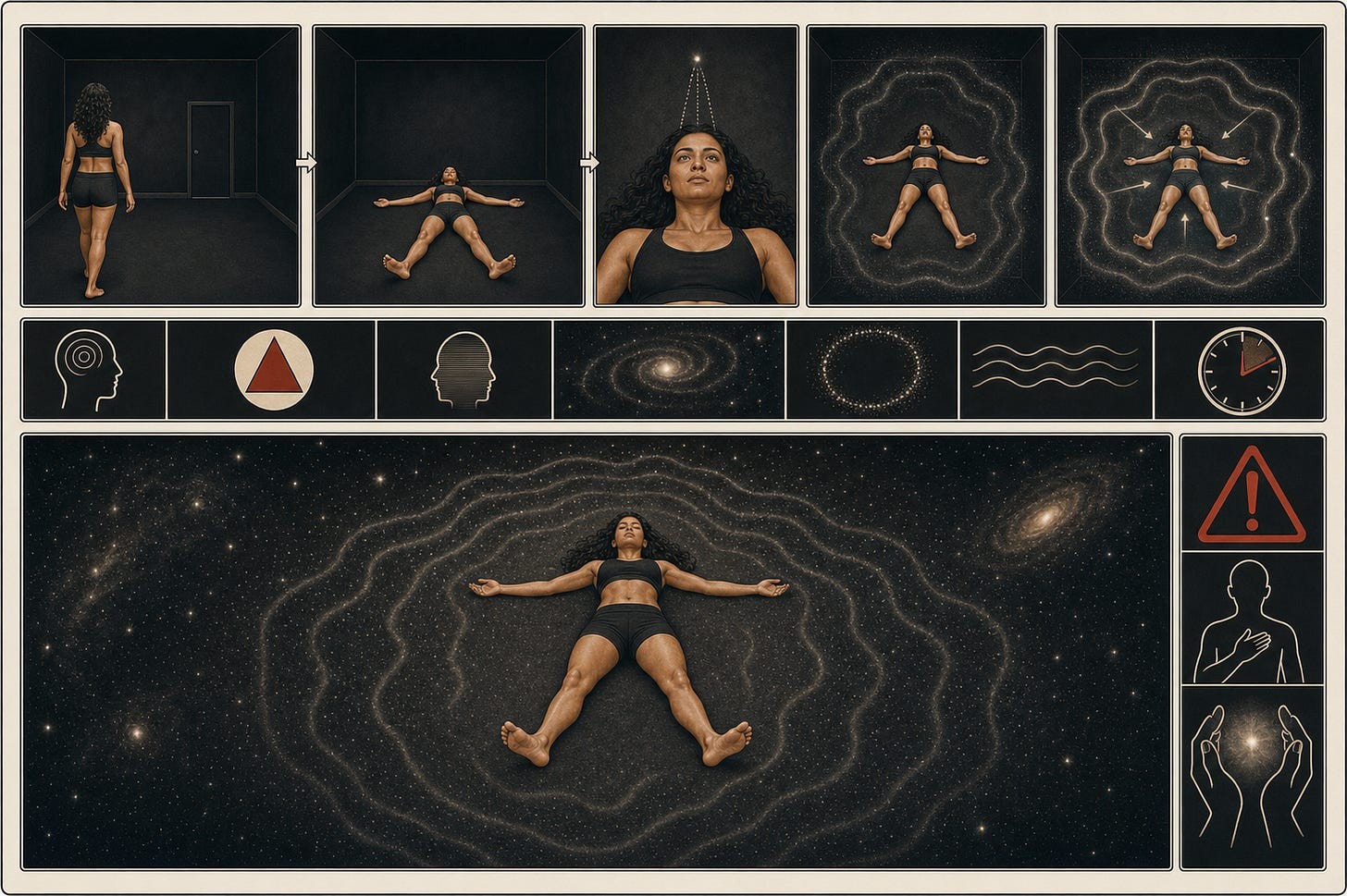
I called it the Andhakaara Path to Power. Andhakaara (अन्धकार) is one of the many Sanskrit words for darkness, and the course is, at its center, a 365-day training in concentration on darkness with open eyes, a form of dhāraṇā that the tradition I inherited treats as the foundational sādhana from which everything else follows. Out of the absolute darkness, the universe was born. We worship the source, not the appearance.
I was certain in those hotel rooms that I had stumbled onto the work of my life. I thought modern yoga had gone downhill into Birkenstocks and corporate flow classes. I thought modern Tantra had been hollowed out into genital massage and weekend workshops. I thought no figure with Osho's disruptive spiritual force had appeared in the public field since him. I thought the world needed what I had been given, and that I had been called to give it. I wrote with the kind of conviction that, looking back, is almost embarrassing, but I would not undo a word of that conviction, because without it the document would not exist.
I finished the course. I tried to sell it. To my astonishment, the world did not want it. Tantric men wanted erection fixes. Modern yoginis wanted Kundalini-with-Birkenstocks and seven-petalled flower diagrams in pastel pink. Nobody wanted three hundred and sixty-five days of disciplined sādhana built around darkness, the Mahāvidyās, complex pranāyāmas, and irrational rituals designed to break the mind. I spent months and years trying to promote it. The silence was total. Years of marketing returned almost nothing.
For a long time I thought this silence was a failure of marketing, or a failure of the audience, or a failure of the times. I thought I had miscalculated the moment. Then I thought maybe the world wasn’t ready yet. Then I thought the entities that govern this lineage simply did not want it broadcast. Then I stopped thinking about it at all and got on with the work.
And then, a few weeks ago, two things happened in rapid succession. The new generation of AI image models began to produce infographic visualizations that were so detailed I could let them run over the course and watch each day’s teaching come alive in a way that would have cost me years of human design effort. I sat with the renderings and saw, for the first time from the outside, what I had actually written.
And my friend Gabriel Lovemore, in Los Angeles, whom I love and admire as a teacher, a mentor, and a guru in the truest sense, sent me an excerpt of his book. It was a conversation with God, structured like Neale Donald Walsch’s. In Gabriel’s version, the teacher complains to God about the lack of recognition, the missing paycheck, the world’s deafness to the work he has done. And God, in Gabriel’s text, is harsh. God tells him: Nobody hired you. That was your idea. The world is already perfect. You were not commissioned to rescue it.
I read this and I rolled on the floor. Because ten years late, I finally understood my own course. Nobody had hired me either. The teachings of the Andhakaara Path to Power were never meant to be understood by the public. They were meant to be understood by one or two people in each generation, so that the knowledge could survive long enough to be rediscovered later, when the conditions allow. The world we live in is not ready for the left-handed traditions. The entities that govern these lineages do not want this world. They will hold me accountable to whom I share these teachings with, and they have been holding me accountable all along, by closing every door I tried to open, until I stopped trying to open them.
This essay is what came out of that recognition. It is the most important thing I have written. It is meant for the one or two people in this generation who will read it and recognize themselves in it.
The thesis is simple. A lineage is only one thought. Everything else is the long, elaborate, holographic detour by which the one thought is made transmissible. The detour can be redesigned in every century. The thought cannot.
I will demonstrate this thesis through the lineages of aikido under Morihei Ueshiba, of Wing Chun under Ip Man and Bruce Lee, and of the Taoist Sexual Teachings of the White Tigress under Madame Lin. I will then situate the Andhakaara Path to Power inside the same structural pattern and explain, finally, in plain words, what the course is, and why, in retrospect, it was always going to be invisible to the audience I once tried to sell it to.
Part One: Ten Years of Silence
Most teachers who experience silence after offering their best work either give up, or convert the silence into bitterness, or rebrand and try again with diluted teachings. I did the second for a while, and then I did the third for a while, and finally I did neither. I kept the course, I kept teaching the few who came, I built Forbidden Yoga as the public-facing vehicle for a smaller version of the work, and I made peace with the fact that what I had written in those hotel rooms in New York was never going to find the mass audience I had once imagined for it.
The peace was not resignation. It was a recognition that the silence had a structure. Whenever I tried to reach more people, the channel itself would close, the Instagram algorithm would mark me as a sex entrepreneur and suppress every post, the publishing world would ghost me after one polite meeting, the platforms would shadow-ban anything that mentioned the actual content of the work. Whenever I lowered the volume and worked privately with one or two clients at a time, the work flourished and the people transformed. It was as if the lineage itself had a thermostat. Above a certain temperature of publicity, the system shut down. Below it, the work could happen.
The women who had tried to take the practices over the years confirmed the same pattern from the darker side. Since 2018 I had run Sensual Liberation Retreats, hiring carefully selected female placeholders to participate in highly choreographed tantric rituals with single clients. A handful of those women decided, at different moments, that they could simply take what they had been shown, repackage it, and run their own version of the work. What followed, in every case I witnessed closely, was not success but collapse: relationships breaking apart, illness, financial pressure, psychological crisis. I do not read this as punishment, and I do not claim to have caused it. The protection is structural. The practices only function as a path when they remain inside the one thought that holds them together. Taken out of that field, they are not neutral techniques. They are charged fragments without a coherent operator. The charge has to reorganize somewhere. If the operator is missing, the pressure often returns into the life of the person holding the fragment. A lineage is a coherent field. When you stand inside the field, the field can hold you. When you take its tools while standing outside the field, its coherence has nowhere stable to land and may appear in your life as incoherence. The Snow Queen had it right when she demanded that Kai spell Eternity from the shards of the Mirror of Reason. She would not give him the answer. The shards themselves had to find their order. The mirror was the devil's. Wherever its splinters lodged in a human eye, that eye thereafter saw everything wrong, or only had eyes for what was bad, for every speck of the mirror retained the same power as the whole mirror had possessed. The tools always retain the power of their origin. Whoever picks them up without the right relationship to the source is going to feel the original power expressing itself through their life, in ways the modern mind does not understand because the modern mind has decided, by polite agreement, that this kind of metaphysics is not real.
It is real. I have watched it for twenty years.
Gabriel’s text, when it arrived, gave me language for the second half of the recognition, not just that the lineage protects itself from theft, but that the lineage was never asking to be popularized in the first place. Nobody hired me to bring it to the world. The world, in fact, is fine. The world was not waiting for a 365-day course in Vāmācāra. I had projected my own ambition onto a cosmos that does not require salvation by anyone, and certainly does not require salvation by me. The grandiosity of believing oneself to be the rescuer is itself, as we will see in a later section, one of the most dangerous traps in the entire spiritual landscape. It is the trap I was building for myself while writing the course. And it is one of the traps the course itself was designed to dissolve, though I did not understand that fully until now.
So: ten years of silence. Two weeks of recognition. One essay, the one you are reading, that names what those ten years were actually for.
Part Two: What Is a Lineage?
The word lineage is used loosely in modern spirituality. It is invoked as a credential (”I am in the lineage of so-and-so”), as a marketing device, as a way of claiming legitimacy in a marketplace crowded with self-appointed teachers. I want to say something more precise.
A lineage is one thought. That is all.
It is not a set of practices. It is not a sequence of empowerments. It is not a chart of names from teacher to student going back fifteen hundred years. It is not a vow lineage, a transmission lineage, an empowerment lineage, an ordination lineage, or any of the other administrative structures the religious institutions have built up around the actual fire they are tending. Those structures are real, they have their function, they protect the form. But the form is not the lineage. The form is the geometry around the bindu. The bindu is the lineage.
The one thought is what makes the lineage a lineage. It is the recognition at the center which every external practice points to and which no external practice can substitute for. If you have the thought, you have the lineage even if you discard every practice. If you have all the practices and not the thought, you have nothing, worse than nothing, because the practices will work against you, in the way I described above with the women who tried to take them.
This is why someone who carries the lineage can completely modulate it. The lineage holder can drop a practice that has been transmitted for ten centuries and add a practice that has never been performed before, and the lineage will not fracture. This is impossible for the curator, the preservationist, the orthodox keeper of the form, because for them the form is the lineage. They are not lineage holders. They are museum directors. When they die, the museum closes. The lineage holder, by contrast, can rewrite the entire museum tomorrow morning and the lineage continues, because the lineage was never in the museum.
You can recognize this in every tradition once you start looking. A monk who has actually realized something can drink, swear, fall off a chair laughing, behave in ways that scandalize his juniors, and the lineage in him remains. A young initiate who has memorized every text and performs every ritual flawlessly and has not yet realized anything is, with all his correctness, still outside. This is why the Zen tradition is full of stories of drunken masters and laughing fools, and why the Kālī tradition tolerates so much surface deviance from its lineage holders that the average bhakti devotee finds them blasphemous. It is also why the Aghori sit in cremation grounds eating from skulls, and why the Vāmācāra ritual sequence appears, to anyone outside the tradition, to be a deliberate offense against every value of the surrounding Hindu society. The lineage holder has gone upstream of the surface. He is operating from the bindu. The surface is downstream and can be rearranged at need.
Why would anyone want this? Why follow a lineage at all? Why train in aikido, in Wing Chun, in Tantra, in Taoist alchemy, in any of these absurdly demanding paths?
The answer is the same across all of them. The soul wants what the Indian terminology calls mokṣa, liberation. Liberation from the wheel, from the cycle, from the endless repetition of pattern and incarnation and forgetting. Every authentic lineage on this planet is a different geometry around the same bindu, and that bindu is the soul’s recognition of its own freedom. Aikido is a Japanese geometry. Wing Chun is a Cantonese geometry. The White Tigress is a Chinese alchemical geometry. The Andhakaara is a West-Bengali Shakta geometry. They look unrecognizable to each other. They are all walking the same gate.
The one thought is always, in the end, a description of nonduality. Nonduality is the recognition that the apparent split between observer and observed, self and world, subject and object, sacred and profane, light and dark, poison and antidote, is the original error from which all suffering proceeds. Nonduality cannot be described directly, because any description introduces a describer and a described, which is already two. So the lineages describe it indirectly, through extreme practices and extreme opposites, through paradox and koan, through ritual sequences that hold the practitioner at the cliff edge of the duality long enough for the duality to dissolve.
This is why the left-handed traditions exist. The right-handed traditions approach nonduality by purifying duality, by removing impurity, by elevating the practitioner above the gross, by separating the spiritual from the material. The left-handed traditions approach nonduality by collapsing duality from the other direction, by entering the very places where the duality is most charged, by performing the practices that the right-handed traditions forbid, by demonstrating in the body that what was called impure is the same fabric as what was called pure. Both paths arrive at the same bindu. The right-handed path arrives by ascending. The left-handed path arrives by walking through the door the moralists were guarding.
The one thought, in every authentic lineage, is some version of this: the two are not two. The aikidoka discovers that the attacker and the defender are not two. The Wing Chun practitioner discovers that the mind and the counter-movement are not two. The White Tigress discovers that the poison and the antidote are not two. The Vāmācārin discovers that the sacred and the profane are not two. The Andhakaara student discovers that the darkness and the light are not two. The recognition is always one. The geometry is always different.
We will now look at three lineages in detail, to see how the modulation works in practice. The lessons will then make the Andhakaara Path to Power visible in a way I have never been able to articulate before.
Part Three: Case Study One: Aikido and the Reorganization of a Lineage
Aikido is a case where we can watch a lineage modulate radically within a single human life, and across a single generation of students, while remaining recognizably one lineage.
Morihei Ueshiba (1883–1969) began as a student of Takeda Sokaku, the headmaster of Daitō-ryū Aiki-jūjutsu, a feudal-era combat school that taught joint manipulation, throws, and atemi (striking) techniques designed for actual battlefield use. Daitō-ryū was hard, technically precise, and morally instrumental, it existed to produce competent fighters who could neutralize opponents. Ueshiba received the full curriculum and was, by all accounts, a formidable martial artist within it.
Then, in 1919, Ueshiba met Onisaburo Deguchi, the spiritual leader of the Ōmoto-kyō religion, a Shinto-derived new religious movement centered in Ayabe, Japan, and something inside him reorganized. The reorganization was not a rejection of Takeda’s teachings. He continued to use exactly the same body mechanics, the same throws, the same wrist locks. What changed was what those techniques meant. Where Takeda had taught fighting, Ueshiba began to teach harmonization. Where Takeda had taught the defeat of the opponent, Ueshiba began to teach the dissolution of opposition itself.
The technical content of his new art, which he would eventually call aikido, was almost identical to the Daitō-ryū content. But the architecture of meaning around it was inverted. Aikido became a practice in which, ideally, both attacker and defender end the encounter unharmed, not because the defender has withheld force, but because the defender has entered the geometry of the attack so completely that there is no opposition left for force to operate against. The attacker’s energy is received, absorbed, and returned to him in a circular motion that resolves the conflict at its source. The defender does not win. There is no winning to do. The encounter has dissolved into a single, unified motion.
This is the one thought of aikido. It can be stated in a sentence and yet it requires a lifetime to embody. Aiki, the harmonization of energies, is not a technique. It is the recognition that the attacker and the defender are not two. From this recognition, every aikido technique flows. Without this recognition, every aikido technique is just a slightly impractical jujutsu variation.
Now watch how Ueshiba’s lineage modulated across the four generations of his own students.
The pre-war students of the early 1920s through the mid-1930s received a hard, combat-effective art that still smelled like its Daitō-ryū origins. The wartime students received something tighter and more concentrated. The post-war Iwama students of the late 1940s and early 1950s received an art that was softer, more circular, increasingly spiritualized. The final-years students of the late 1950s through 1969 received what was effectively a moving prayer, Ueshiba in old age had become so suffused with the one thought that the techniques themselves had become softer, almost weightless, less combat-applicable but more transparent to the underlying recognition. Each generation received a markedly different physical practice. The same dojo, the same teacher, the same name on the door. Mutually unrecognizable practices.
How did the lineage not fracture into incompatible schools? The answer is precisely the thesis of this essay. Because Ueshiba held the one thought, he could modulate the form without losing the lineage. He gave each generation the form appropriate to them. He could teach combat to a wartime student and call it aikido. He could teach what was essentially misogi, Shinto spiritual purification, to a final-years student and also call it aikido. Both were aikido. The bindu had not moved.
After Ueshiba’s death, the visible aikido world did in fact fracture. Yoshinkan, Iwama-ryū, Shodokan, Ki Society, Aikikai, and a dozen smaller branches now sit in mutual non-recognition, each claiming to be the true transmission. The reason is structurally identical to my thesis: most of the students who started those branches received the form without metabolizing the thought. For them, the form was the lineage, and so when they inherited the form they had to decide which version of the form was correct. Yoshinkan students will tell you that pre-war aikido is the real aikido and the soft post-war version is a degeneration. Aikikai students will tell you that Ueshiba’s final-years teaching is the true heart of the art and the hard pre-war material was a stage he transcended. They are arguing about the geometry. The bindu is not in the geometry. None of these schools are wrong about their geometry. All of them are missing what their teacher actually transmitted.
There is no aikido outside the recognition that the two are not two. Once you have that, you can teach whatever you want and call it aikido and the lineage will live. Without that, you can wear the keikogi, hold the dan rank, run the dojo, and be technically a museum curator.
This is exactly what Madame Lin understood about the White Tigress lineage, and what Ip Man understood about Wing Chun, and what my own guru understood about the Vāmācāra. The form is downstream. The form can be sacrificed. The thought is what gets carried forward, sometimes through vehicles so radically different from the original vehicles that the lineage’s previous custodians would not have recognized the new ones.
Part Four: Case Study Two: Ip Man and Bruce Lee: The Apartment That Was Refused
The Ip Man and Bruce Lee story is one of the cleanest demonstrations in modern history of what it means to hold a lineage versus to want a lineage. I find it almost embarrassingly precise as a confirmation of the thesis. I want to walk through it slowly, because every detail matters.
Ip Man (1893–1972) was born into a wealthy Foshan family. He had access to education, social position, and the time to study Wing Chun deeply for decades under Chan Wah-shun and Leung Bik. By his fifties he was a police officer in Foshan and a recognized master of Wing Chun, though he taught only privately. Then the Chinese Civil War ended, the Communists took power in 1949, and Ip Man fled to Hong Kong. The flight destroyed him materially. His hurried escape to British Hong Kong meant leaving his family and assets behind in Foshan. Whatever gold he had on his person was rapidly spent or cheated out of him en route. Given shelter at the Restaurant Workers’ Union Hall, he was very grateful. He arrived a refugee, broke, sixty years old, and was given a place to sleep by union members who recognized him as a martial artist of stature. He never rebuilt his fortune. Despite his martial arts success, Ip faced financial struggles in Hong Kong, and developed an opium habit to cope with refugee life. This addiction affected his health and family relationships. He spent the rest of his life in modest apartments, eventually dying of throat cancer in 1972 in a small unit at 149 Tung Choi Street.
Bruce Lee (1940–1973) became his student in 1956, at age fifteen. Bruce was already a difficult prospect. He was Eurasian by his mother’s side, and the other students in Ip Man’s school objected. Jealous of his status as a child actor and the success he had achieved under Wong Shun Leung and Ip Man, many of them made efforts to get Lee expelled from the Wing Chun school. The reason they used was based on Lee’s heritage. Since his mother was Eurasian, they argued Ip shouldn’t teach Chinese martial arts to someone who was of mixed race. During these days, it’s true that it wasn’t acceptable for non-Chinese to learn kung fu, but Ip didn’t see it that way and kept Lee around.
Stop here for a moment. Notice what Ip Man did. He kept Bruce. He overruled the tribal logic of his own student body, a logic that was, in the racial calculus of 1950s Hong Kong, the normal social default, because he saw something in Bruce that mattered more than racial purity. This is already a sign that Ip Man was operating upstream of the surrounding consensus. He was not protecting the form of Wing Chun-as-Chinese-male-tradition. He was protecting something else.
Bruce trained under Ip Man for about five years and then, in 1959 at age eighteen, his parents shipped him to America. He hadn’t even finished the system. He didn’t know the wooden dummy form completely. He hadn’t mastered the weapons. He was basically a high-level intermediate student when he left for Seattle. Five years of training, then gone. In America, Bruce built Jeet Kune Do, his own synthesis that fused Wing Chun foundations with boxing, fencing footwork, grappling, and his own kinesthetic philosophy. To the orthodox Wing Chun world this looked like vandalism. To Bruce, it was the same impulse he had always had: break the form, find what is underneath, do not be ruled by inherited containers.
Bruce became, by the early 1970s, the most famous martial artist in the world. He was the fastest man on film, punches that had to be slowed down in post-production to be visible to the human eye. He had global fame, financial freedom, a film career that was just beginning to peak. And then he came back to Hong Kong to see his old master.
Ip Man was dying. Cancer of the throat, opium-thinned body, a small apartment, no money. And Bruce offered him the deal. When Bruce returned to Hong Kong as a massive movie star, he offered to buy Ip Man a new apartment if the master would film himself performing the entire Wing Chun system so Bruce could finish his learning. Ip Man refused.
The fastest man on Earth, internationally famous, materially limitless, offering the dying refugee a luxury apartment in exchange for the rest of the teaching he had not finished receiving as a teenager, and the dying refugee said no.
This is not a fight. This is not bitterness. Ip Man’s eldest son, Ip Chun, later went on record to dismantle the dramatic interpretations: his father refused the apartment simply because he didn’t want to commercialise martial arts, not due to conflict. There was no anger in the refusal. There was something more interesting. Ip Man understood, with the clarity of a man who knows he has a few months to live, that the complete forms in Bruce’s hands would not transfer the lineage. Bruce already had the body. He already had the speed. He already had more raw martial talent than any of Ip Man’s other students. What Bruce did not yet have was the bindu, the recognition that would have made the further forms transmissible without harm. Selling the forms for an apartment would have been the destruction of the lineage in Bruce’s direction, because Bruce would have built techniques on top of his existing speed without metabolizing the underlying recognition, and those techniques would then have been broadcast to the world through his films, his books, his global reach, and the bindu would have been lost in the broadcast.
Ip Man kept the fire. He died on December 2, 1972. After being diagnosed with throat cancer, Ip Man decided that he wanted to record footage of himself practicing the art, so the next generation could learn from him. Only days before his death, he, with his students and his son Ip Chun, came up with this footage so people in the future could know how the legendary man performed Wing Chun and learn from it. The footage is grainy and features a very old Ip in his final days, in the clip Ip can be seen demonstrating his Wing Chun techniques on a wooden dummy. Ip may have been dying and in his final days yet the fluidity and precision of his movements can still be seen and cannot be denied.
The footage was not made for Bruce. The footage was made for the future. The director Wong Kar Wai watched this footage decades later and said exactly what I am saying in this essay: “I keep asking myself why he wanted to do it and much later I realised that there’s a saying in Chinese martial arts that’s like ‘to keep the fire burning.’ So what I think he intended to do is to do this: he wanted to preserve his technique so it can be shared and taught to future generations.”
Wong Kar Wai made The Grandmaster in part because that footage haunted him. The lineage traveled. Not through Bruce, who could not yet receive it, but through a Hong Kong filmmaker who recognized something in a grainy home movie made by a dying man.
And here is the part that has the quality my guru would have recognized immediately. Ip Man died on 2 December 1972. Bruce Lee died only 7 months later. The student who had come back with money in his hand to buy the rest of the teaching, and who had been refused, that student did not survive his teacher by a year. The medical explanation for Bruce’s death (cerebral edema, possibly from a reaction to a pain medication) is its own argument and I do not contest it. What I will say is that the timing has the kind of quality that the rationalist will dismiss and the lineage holder will silently note. The transmission attempt that wasn’t completed. The forms that weren’t given. The fire that the master kept burning to the end and did not hand over because the hand reaching for it wasn’t yet ready to hold it. Seven months later, the hand is no longer there to reach.
Now here is the part that closes the loop on the one-thought thesis. What was the one thought of Wing Chun? Bruce Lee himself wrote it down, in 1967, in an interview, quoting his master directly. He gave it to the world in plain English. The one thought, in his own words, recounted from Ip Man:
“My instructor, Professor Yip Man, head of the Wing Chun school, would come up to me and say: ‘Relax and calm your mind. Forget about yourself and follow your opponent’s movement. Let your mind, the basic reality, do the counter-movement without any interfering deliberation.’”
That is the entire lineage of Wing Chun, stated in one breath. Forget about yourself. Follow your opponent’s movement. Let your mind, the basic reality, do the counter-movement without any interfering deliberation.
It is the same one thought as aiki, blend, don’t oppose, the attacker’s intention and your body are already one motion. It is the same one thought as wu wei in Taoism. It is the same one thought as the nondual recognition that underlies every authentic lineage. Ip Man gave Bruce the entire lineage in a sentence. Bruce wrote it down. Bruce quoted it back. Bruce built Jeet Kune Do partly out of this recognition and partly without it. The recognition had landed as words. It had not yet landed as embodied capacity, which is the only way it lands as transmission. That is what Bruce was coming back to Hong Kong to complete. That is what the apartment was supposed to buy. That is what Ip Man, with his last weeks of breath, refused to sell.
The lineage is in millions of Wing Chun practitioners today. Ip Man’s legacy is kept alive today by his millions of Wing Chun practitioners under his lineage. The lineage is not in the millions. The lineage is in the few who, among those millions, will read Bruce’s quotation of his master and recognize that the entire system is in that sentence and everything else is the geometry around it.
I write this as a man who has done the same thing in his own tradition for twenty years and watched almost no one come to the bindu, and who has, in the last few weeks, finally met someone who did.
Part Five: Case Study Three: The White Tigress and Three Thousand Years of Modulation
I have written elsewhere on Forbidden Yoga about the Sexual Teachings of the White Tigress as documented in Hsi Lai’s 2001 book based on his transmission from Madame Lin, the matriarch of a still-living Taiwan lineage. Here I want to lay out the historical sweep of how this lineage has modulated across the centuries, because it is one of the clearest examples in the historical record of what the one-thought thesis predicts about lineage survival.
The deep substrate is the Chinese fangzhongshu, the arts of the bedchamber, the Taoist project of using sexual energy as the prima materia of immortality alchemy. The Han dynasty texts, the Sunü Jing (Plain Girl’s Classic) and the Yufang Bijue (Secret Instructions of the Jade Bedchamber), are already speaking the technical theory. Ching is the densest concentration of the Three Treasures (ching, qi, shen, sexual essence, vital force, spirit). The alchemist’s task is to transmute ching upward into qi and finally into shen. The body is the alembic. The sexual encounter is the heat under the retort. Having sex, especially in the wilderness, was a way to cultivate oneself and prolong life. In the Taoist sex manual “The Plain Girl’s Secret Way,” men were told to have a lot of sex but not come very often. That way their yang would remain within their bodies. Life-extending Taoist sexual practices also encouraged men to have a lot of sex because the waters of the yin helped strengthen a declining yang. The early texts are unambiguously male-oriented and reduce the woman to a utilitarian role. In Taoist sexual books, the woman sexual partner is called ding, originally an ancient cooking vessel with two loop handles and three or four legs, used in the practice of alchemy. The woman is the cooking pot. The man is the alchemist.
The White Tigress is the precise inversion of this. Same alchemy. Same Three Treasures. Same metaphysical goal of immortality. But the woman is the alchemist and the man is the prima materia. The ding becomes the operator. The dragon becomes the fuel. This is the first radical modulation: the same one thought, the same metaphysics, but the gender architecture flipped end to end. Anyone reading the male-oriented Han-dynasty manuals would not have recognized the female-oriented White Tigress practice as the same tradition. It is, structurally, the same tradition.
In the Tang dynasty the lineage modulates again, this time into institutional monastic and quasi-monastic forms. In the era of the Tang Dynasty, women played a special role, where they could reveal the higher secrets of the Tao, they were holders of the tradition. Women transmitted the teachings of herbs, magic, sex, healing and esoteric practices. Taoist women founded schools like the Highest Clarity School. Lao Tzu, the great Master who wrote the Tao Te Ching, is said to have had a female teacher. The form is now monastic, semi-public, recognized by the state. The thought is unchanged.
Then the Neo-Confucian moral order tightens across the Song, Yuan, Ming dynasties, and the public face of the tradition is closed off. In later dynasties, these sexual manuals would all but disappear from circulation, being replaced by sexual literature and art. When sex manuals were listed as medical texts in later imperial histories, they concerned methods of producing offspring, not immortality. The classical immortality alchemy is forced underground. So the lineage modulates again. It finds a new vehicle. The new vehicle is the courtesan and concubine system, a social architecture in which a woman could spend a life in disciplined practice masquerading as her profession, with the cover story of the brothel hiding the alchemical work happening inside. From the outside it looks like prostitution. From the inside, in the lineage houses, it is a multi-decade training in immortality cultivation. The form has migrated. The bindu has not moved.
Madame Lin, the matriarch of the surviving Taiwan branch, names the persecution pattern directly in her foreword to Hsi Lai’s book: “Over the ages we have been ridiculed, banned, imprisoned, and even killed for our sexual beliefs by zealous moralists and political thugs who attempted to gain favor with the masses. Yet we have survived the incriminations of taboo-breaking through the courage and determination of an endless stream of adherents, both male and female”. Across the centuries the lineage had been ridiculed, banned, imprisoned, killed, yet had survived through an endless stream of adherents. Always dying, always resurrected. The same phenomenon I described at the opening of this essay, observed from inside the lineage three centuries before I observed it from inside my own.
In the twentieth century the lineage faces the extinction event the prior centuries had not produced. The concubine and consort system is made illegal across East Asia. The Cultural Revolution destroys what remained of the underground continuity on the mainland. Madame Lin, holding the lineage from Taiwan, faces the question that every authentic lineage holder eventually faces: when every form your lineage has used for transmission is being annihilated, what do you modulate to next? “Our past avenues for propagation of the teachings have disappeared very rapidly in this century, so the options for preserving the teachings cannot exist as they have in the past”.
What Madame Lin did is the modulation I find most beautiful in the entire historical record of these traditions. She took a Western man, an American of European descent, living in California, who had been studying Taoist practice for decades, and authorized him to write the teachings in English under a Chinese pseudonym, Hsi Lai, which means the West has come. Xi Lai is the spiritual name given by Madame Lin. Xi Lai and Madame Lin decided that he should use his spiritual name as his pen name to protect the identities of everyone involved with the teachings in China.
Read that decision carefully. She did not insist that the teachings must remain in Chinese. She did not insist that the carrier must be Chinese. She did not insist that the carrier must be female. She did not insist that the transmission must remain oral. She did not insist that the form must be preserved. She made the call that the form is downstream, the thought is upstream, and the form can be sacrificed without losing the thought. She authorized a paperback. She authorized English. She authorized a Westerner. She authorized a pseudonym that announces the rupture itself as the new vehicle. The West has come is the name of the carrier. The thought has moved. The form is unrecognizable from anything the lineage had ever done before.
This is what a lineage holder does. This is what only a lineage holder can do. The orthodox keeper of the form would have refused this transmission and insisted on Chinese-language oral transmission to a Chinese woman in a concubine house, and the lineage would have died with the keeper, because the social architecture for that transmission no longer exists. Madame Lin chose to keep the fire burning instead of keeping the lantern intact.
What is the one thought of the White Tigress lineage? It is not “achieve immortality through sex.” That is the goal, the telos, the orientation. The one thought is what the Manual itself says in a single line that almost no one reads carefully:
“Sex is like a poison, and like most poisons, it is also its own antidote. Tigresses are not emotionally attached to sex; we see it as a powerful vehicle to restore and enhance physical beauty and delve into the sublime Tao to attain immortality.”
Sex is a poison and it is its own antidote. That is the entire lineage stated in one line. Everything else, the disciplines, the diets, the three-year initiation, the nine illuminations, the Green Dragons who give and the Jade Dragons who retain, the techniques of fellatio and energy ingestion, the matriarchal house structure, all of it, is downstream of that one recognition.
The recognition is that the most charged, most polluting-looking, most socially shamed energy in the human body is the most direct material for the alchemy of immortality precisely because it is so charged. The defilement is the door. The poison and the antidote are the same substance, separated only by the operator’s relationship to it. Whoever can hold poison-and-antidote as one thing has the lineage. Whoever needs to separate them has nothing, no matter how many techniques they have memorized.
This is the same recognition as Vāmācāra. This is the same recognition as the pañcamakāra. This is the same recognition as the Kālī chakra pūjā, the Aghori practices around death and ash, the Tibetan charnel-ground meditations, the Sufi practices around wine and erotic poetry. Each tradition speaks the same one thought in its own language. Each tradition’s outer form is unrecognizable from the others. They are the same thought rotated through a different geometry.
The modern reader will object: but is it about sex or is it not about sex? The argument will not stop. People who call themselves tantrics will divide themselves into two camps. One camp will say “Tantra is not about sex” with great delicacy. The other camp will say “Tantra is sex” with great enthusiasm. Both are right. Both are wrong. Neither has understood that the left-handed tradition is only one thought. You cannot argue about a lineage. You can only study it for ten or twenty years and at the end recognize that what you were arguing about did not have the shape you thought it had.
Of course the White Tigress teachings are about sex. The Tigresses enjoy it. They love it. They do not force themselves through some austere obligation. The Manual is unambiguous. The practices are unambiguous. The women who entered this tradition were not pretending to do sex while secretly doing meditation. They were doing sex. They were also doing immortality alchemy. These are not two different activities, one literal and one metaphorical. They are one activity seen from two angles. Once you have the one thought, there is no but. The “but it is really about energy” position has not understood the lineage any better than the “it is just sex” position. They have only chosen the more respectable confusion.
This is why the cherry-pickers are, in the final analysis, more dangerous to a lineage than the persecutors. The persecutors at least force the lineage to defend its bindu. The cherry-pickers want to extract the techniques and discard the metaphysics. Take fellatio for immortality, drop the immortality, sell a workshop on Taoist oral sex. Take pañcamakāra, drop the pañca and the makāra, sell a tantra-for-couples weekend. The lineage prefers persecution to wellness theater, because under persecution the bindu still has to be defended, while under wellness theater the bindu is simply forgotten.
The modern Indian society that produced Vāmācāra has, in the last two centuries, lost the framework entirely. The psychoanalyst Sudhir Kakar has argued that there was little sexual repression in ancient India, say from the third to twelfth centuries, at least among the upper classes, the primary audience of the Kāmasūtra and of Sanskrit poems and plays of the period. The demands of sexuality had to be reconciled with those of morality, dharma, but it was reconciliation rather than repression. The uninhibited sexuality of the Kāmasūtra, where nothing is taboo in imagination and very little in reality, combined tenderness with playful aggression in lovemaking, where gender roles in the sexual act are neither rigid nor fixed. The modern West is no better, it is in the opposite trap, having severed sexuality from any metaphysical frame whatsoever and reduced it to either pornography or therapy. Neither pole is the lineage. The lineage sits exactly where neither pole can see it.
Part Six: The Yantra, the Bindu, and the Guru’s Instructions
There is a moment in the early period of training with my guru that I want to record here because it sits at the structural center of the thesis. He told me, of various practices: Don’t put this one into public. Don’t put that one into public. This one, don’t even write down. This one, you will never teach. And if you really want to keep it, write it into a yantra, in the very middle, so that it is protected.
The instruction was specific. The most concentrated essence of a practice goes in the bindu of the yantra, the center point, and the geometry around the bindu is what gets shown to the world. The world sees the geometry, finds it beautiful or interesting or scandalous, and walks past. The bindu is in plain sight and yet invisible, because the world reads the surrounding geometry as the entire object. The practice is hidden by being placed in the most central position. The form protects the bindu precisely by being elaborate enough that no one bothers to ask what is at its center.
This is the structural answer to why the Andhakaara Path to Power did not sell to the public. The course is a yantra. The 365 days are the geometry. The bindu is at the center, in the practices the world does not know how to read. Anyone who buys the course expecting techniques will find techniques and miss the bindu. Anyone who walks the days with the right relationship to the work will find the bindu somewhere in the middle of the year and after that the geometry will reorganize itself for them. The course is not designed to deliver the bindu to everyone who pays for it. It is designed to be available to whoever can find it.
This is also why my guru insisted, again and again, that I cannot teach everyone. He insisted because the lineage cannot be transmitted to everyone. Madame Lin made the same call. Ip Man made the same call. Ueshiba modulated the form for each generation precisely because he could not give every generation the same thing. The teacher who tries to give everyone everything has not yet understood that the lineage is one thought and the thought lands in different students at different speeds. The watering down is automatic once you commit to scale. The watering down is the destruction of the lineage. There is no exception.
I have lost much of what most people consider a normal life by holding this. I lost a great deal of money. I lost what people call good luck. I lost periods of my own sanity. I have walked through the darkness of the soul more times than I can count, and most of those walks did not produce books or workshops or anything anyone could sell. They produced silence, and after the silence, the slow recognition that the silence was itself the practice.
Today, ten years after Tribeca, I think it was worth it. The fact that I might die without anyone in my lifetime fully receiving what I carry is something I can sit with now. The fact that someone might receive it three generations from now from a grainy home movie or an obscure paperback is, if it happens, exactly the way the lineage has always worked. I am not the exception. I am simply the current carrier, doing the same thing every authentic carrier in every authentic lineage has always done, modulating the form as needed, refusing to commercialize the bindu, and trusting the geometry to outlast me.
Part Seven: The Drunken Master and the Dropping of the Form
There is a figure in Japanese cinema, and in Chinese Chan painting, and in the entire mythology of authentic spiritual lineages, that I want to bring forward here because it makes the thesis vivid for the reader who has not yet seen it.
The drunken samurai. The drunken Zen master. The patriarch with rice wine on his robes, falling off the table, laughing at his own foolishness while his juniors stare in horror.
Kurosawa filmed this figure repeatedly. So did King Hu. So did, in his own way, John Cassavetes when filming American characters. The mad-master archetype runs from Linji to Ikkyū to Hakuin in the Chan and Zen traditions, from the Aghori in India to the Mast’i Sufis in Persia, from the Crazy Wisdom teachers of Tibet to Chögyam Trungpa drinking sake at his own enthronement ceremony.
The lay observer sees collapse. The lineage holder sees the opposite: someone so completely settled into the one thought that the surface behavior is no longer required to perform the lineage. He can drink. He can swear. He can fall off the table. He can act like a fool. The bindu still holds. The form has become free precisely because the thought is unshakable.
This is the inverse of the museum curator. The museum curator must hold the form rigid because the form is all he has. If he drops the form he loses the lineage. The drunken master can drop the form because the form was never the lineage. The form was the scaffold by which he reached the recognition. Once the recognition is stable, the scaffold can come down. He continues to use the scaffold sometimes, for the students who still need it, but he is no longer dependent on it.
People mistake the absence of ornament for the absence of essence. They have it backwards. The ornament was always optional. The essence is what was being protected.
This is also why so many authentic teachers are, by the surrounding culture’s standards, scandalous. The scandal is not incidental. It is structural. If the lineage holder could be socially acceptable while holding the lineage, the lineage would already be domesticated to the culture, and the bindu would have been long absorbed into the surrounding consensus. The fact that the lineage holders are repeatedly difficult, embarrassing, sexually unconventional, financially erratic, prone to drinking or fasting or other extremes, this is the sign that the lineage is still upstream of the culture’s domestication of it. When the lineage holders become respectable, the lineage has usually died. They are now university professors holding chairs and writing peer-reviewed papers, and the bindu is no longer in the room.
I do not say this to romanticize bad behavior. I say it to point out that the authentic teacher will look, to most observers in most generations, like someone who has gotten something wrong. This is the cost of the work. Whoever wants to do the work and remain acceptable to the surrounding social order has not understood that the surrounding social order is precisely the consensus the work is meant to walk through.
Part Eight: The One Thought Is Nonduality
I have circled this point throughout this essay. Let me state it directly now.
Every authentic lineage is, in the final analysis, a description of nonduality. The one thought at the center of every authentic lineage is some version of the recognition that the apparent two are not two. The aikido of “the attacker and defender are one motion.” The Wing Chun of “let the mind, the basic reality, do the counter-movement.” The White Tigress of “sex is the poison that is its own antidote.” The Vāmācāra of “the impure is the same fabric as the pure.” The Andhakaara of “out of the darkness, the light was born, the darkness is the source.” These are all the same recognition rotated through different cultural geometries.
Nonduality cannot be stated, because any statement introduces a stater and a stated. So the lineages do not state it. They construct elaborate apparatuses that bring the practitioner to the cliff edge of the duality and hold him there long enough for the duality to dissolve on its own. The apparatus is the form. The dissolution is the thought.
Osho, whom I have respected for many years even when I disagreed with him, was unusually direct about this. Asked again and again about God, he refused the consolation of theism. He told his disciples: “All is divine. In fact there is no God, only godliness. God is not a person but a quality, not a person but a presence. The idea of God as a person is anthropomorphic: we have made that image in our own image. It is nothing but man-projected; it is not the true God. That’s why Buddha is silent about God. He talks about godliness but never about God. My own experience is exactly the same: there is no God but there is godliness, the whole existence is overflowing with godliness. There is no division between God and the world; existence is divine”.
And on the eternity question that haunts every Western mind that has been trained to expect a creator: “Once you are one with the cosmos, and the cosmos has never been created, it has been there always and always, and will be there always and always, from eternity to eternity”. There is no creation. There is no moment when nothing became something. There is only suchness, beginningless, endless, and the discomfort that the modern mind feels about this is the discomfort of a finite mind trying to grasp an infinite. “It is simply incomprehensible for people, it is inconceivable how this immense universe is running without any controller, how it has come into existence without any creator. So they invented ‘God’ as a consolation. The problem is just because the capacity of the mind is very limited. Only no-mind can conceive the beginning-less, the endless”.
The Taoist position is structurally identical. There is no creator. There is only the Tao, which is the suchness of what is. The Buddhist position is structurally identical at the deepest layer. There is no creator. There is only emptiness and dependent origination. The Advaita Vedānta position is structurally identical. There is no creator separate from creation. There is only Brahman, which is one, without a second.
Once you stand inside this view, the body’s pleasures are not separated from the divine, because there is no divine entity that the pleasures could be separated from. The Tigress’s body and the Tigress’s immortality are the same fabric. The aikidoka’s throw and the aikidoka’s prayer are the same motion. The Vāmācārin’s ritual sex and the Vāmācārin’s meditation are the same practice. The split between sacred and profane does not arise inside this view. The split is the symptom of having lost the view.
This is what every authentic lineage protects. This is the one thought.
In my own course I do not call it nonduality. I call it darkness. Andhakaara. Out of the absolute darkness, the radiant universe was born. The darkness is not the absence of light. The darkness is the source from which light becomes possible. When you stare into darkness with open eyes, for years, with the right disciplines, you eventually stop noticing the distinction between darkness and light. The two are not two. The recognition lands not as an intellectual proposition but as a state of the body. The pineal gland activates. The breath changes. The dualistic apparatus of the perceiving mind dissolves into a single unified field of awareness. This takes years. There is no shortcut. The course is 365 days because the body needs 365 days, or many years more, to walk the geometry that brings the bindu within reach.
Part Nine: The Ritual That Was One Ritual
Two years ago I had a recognition that I think every authentic lineage holder eventually has, and that is exactly the inverse of what every new student of the work assumes.
I had been performing rituals with people, almost daily, for a long period. Each day’s ritual had different logistics, different sequence, different mantras, different physical movements, different objects, different roles for the participants, different theatrical script. From the outside, no two nights looked alike. Different theater every night. Different cast. Different play.
And then I saw, with great clarity, that it was one ritual. Not metaphorically one ritual. Actually one ritual. The same operation rotating through a thousand staged forms. The variation in the form was the way the bindu was being approached from every available angle, so that whoever was present would have at least some chance of one of the angles being the one that opened.
I have a particular fondness for the Mūla Bandha, the root lock at the perineum, because it sits at the very beginning of every yogic curriculum and also at the very end. The first-week student learns Mūla Bandha as a basic technique: contract the pelvic floor, hold, release. The twenty-year practitioner is still working on Mūla Bandha, only now it is the foundational lock that holds the entire complex pranayama sequence together, that gates the rising of Kundalinī into the subtle channels, that anchors every advanced ritual technique. It is the same technique. The same physical contraction. The first-week student is performing the bindu and does not know it. The twenty-year practitioner is performing the bindu and finally knows it. The course is the long road by which the student becomes aware of what was already happening from the first day.
This is the meaning of the Inception structure I built into the Andhakaara Path to Power. The course is conceptualized as nested holographic layers, inspired by Christopher Nolan’s film, in which the student moves from his present reality of consciousness into deeper dreams of reality without being aware that he is doing so. By Day 100 he is in a different layer than Day 1. By Day 300 he is in a layer he did not know existed when he started. And at some point, often near the end, he realizes that the entire structure was one layer all along, and that he has been performing the bindu since Day 1 without knowing it. The course’s complexity is the form. The simplicity at the center is the thought.
This is also why I designed the course with the explicit warning that it is not advisable to skip ahead. Some students, ambitious, will want to buy only the advanced material. The advanced material, in isolation, is unintelligible. It is unintelligible because the practitioner has not yet built the body that can receive it. The early material is the construction of that body. The advanced material is the recognition that the body that was being constructed is the body that has always been there. The student who buys only the advanced material gets only the form of the advanced material, with none of the foundation that would make it transparent to the thought. He will either be bored, or he will misunderstand, or, most dangerously, he will perform the practices in ways that activate forces he is not yet structurally able to hold.
Part Ten: The Andhakaara Path to Power
I now want to describe the course in some detail, because the previous parts of this essay will let me describe it in a way I have never been able to describe it before.
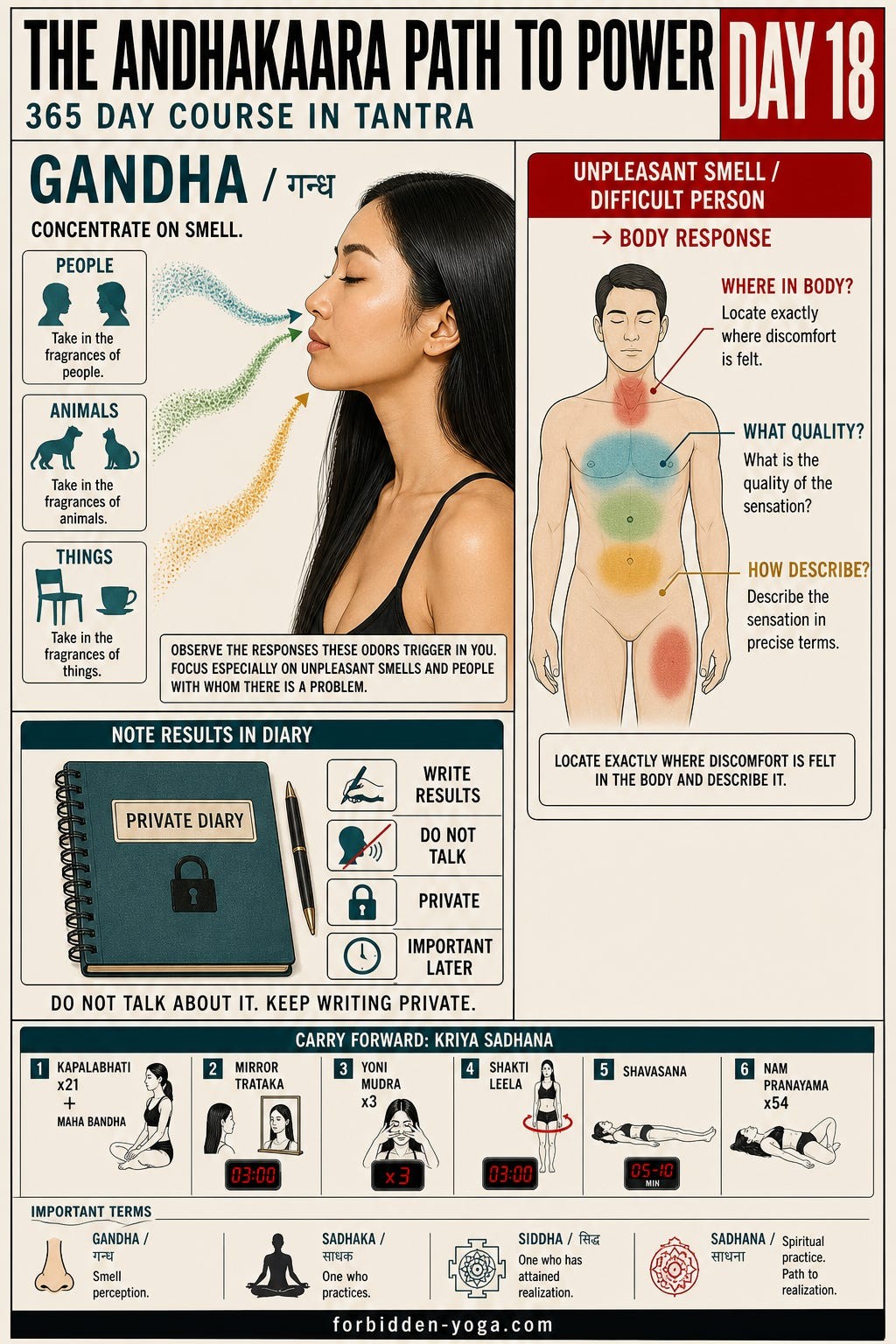
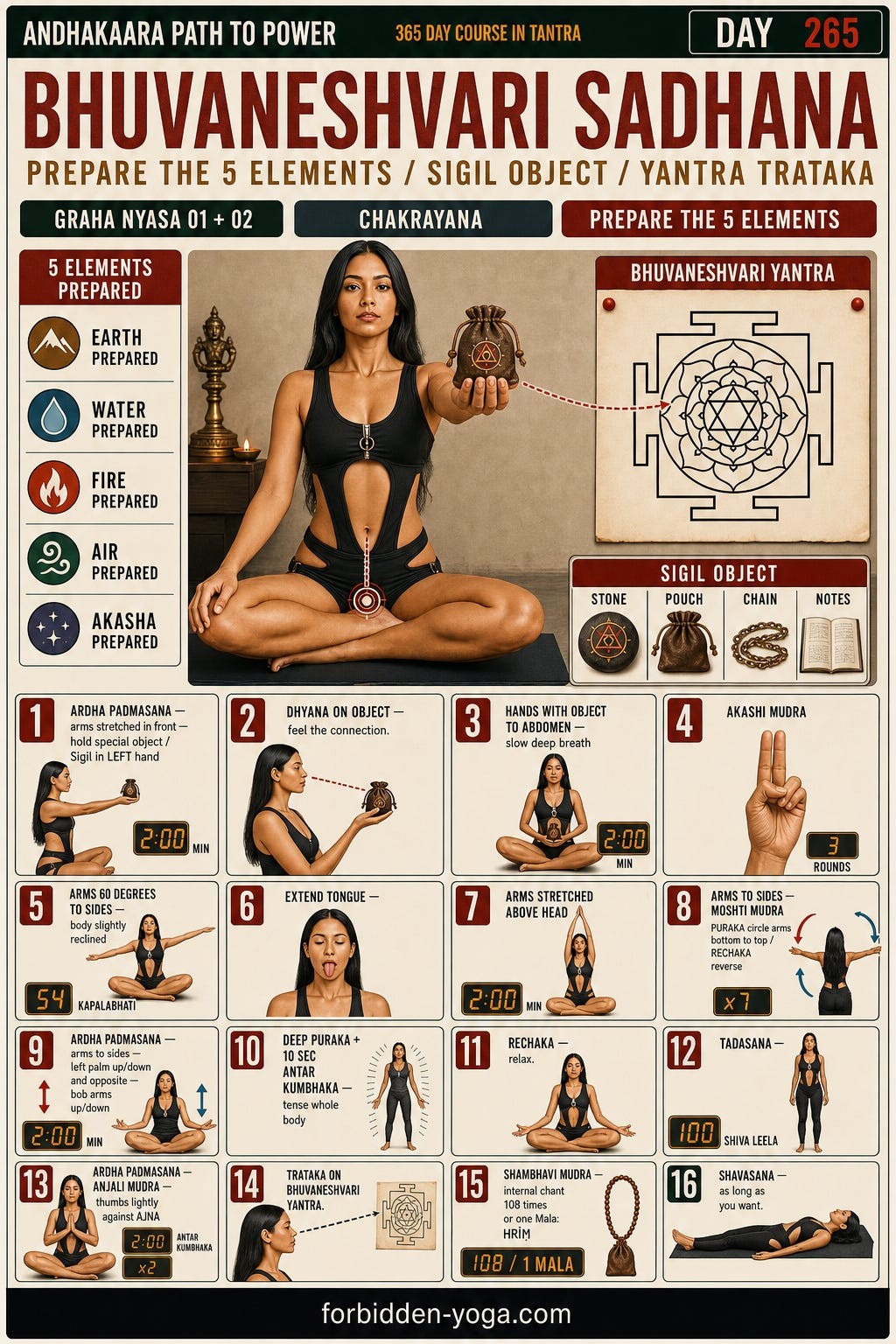
The Andhakaara Path to Power is a 365-day online study course in Indian left-handed Tantra. The 365 days are organized into 10 levels, each dedicated to one of the ten goddesses of the Mahāvidyā pantheon, Kālī, Tārā, Tripura-Sundarī, Bhuvaneśvarī, Bhairavī, Chinnamastā, Dhūmāvatī, Bagalāmukhī, Mātaṅgī, and Kamalā. The Mahāvidyās are, in the formulation I have used in earlier writing, arguably the first feminist science fiction story, ten implacable women, each representing a different cosmic power, three of them walking around bare-breasted, all of them aspects of the great goddess Pārvatī. The system is structurally a polytheism of goddess archetypes that, when worked from inside, dissolves into a recognition that all ten are aspects of one Devi, and all One Devi is the nondual ground of all phenomena. It is, in other words, a sustained meditation on the one thought arriving in ten distinct geometries.
Foundation of Kriyā Yoga sādhana, in the lineage related to the Bihar School of Yoga but adapted for non-celibate, left-handed practice. The 20 main Kriyās of the Kundalinī cycle, including Viparīta Karaṇī Mudrā, Cakra Anu Sandhāna, Nāda Sañcālana, Pavana Sañcālana, Pratyāhāra Kriyā, and the rest of the sequence, are taught in graduated form across the early levels.
Three forms of Trāṭaka, including the central Andhakaara Trāṭaka, staring into darkness with open eyes, which is performed every day across the entire course in deepening variations. This is the practice that gives the course its name. Out of absolute darkness our radiant universe was born; we worship the source rather than the appearance; the disciplined contemplation of darkness with open eyes is, over time, a complete sādhana that activates the pineal gland and produces sustained states of nondual awareness.
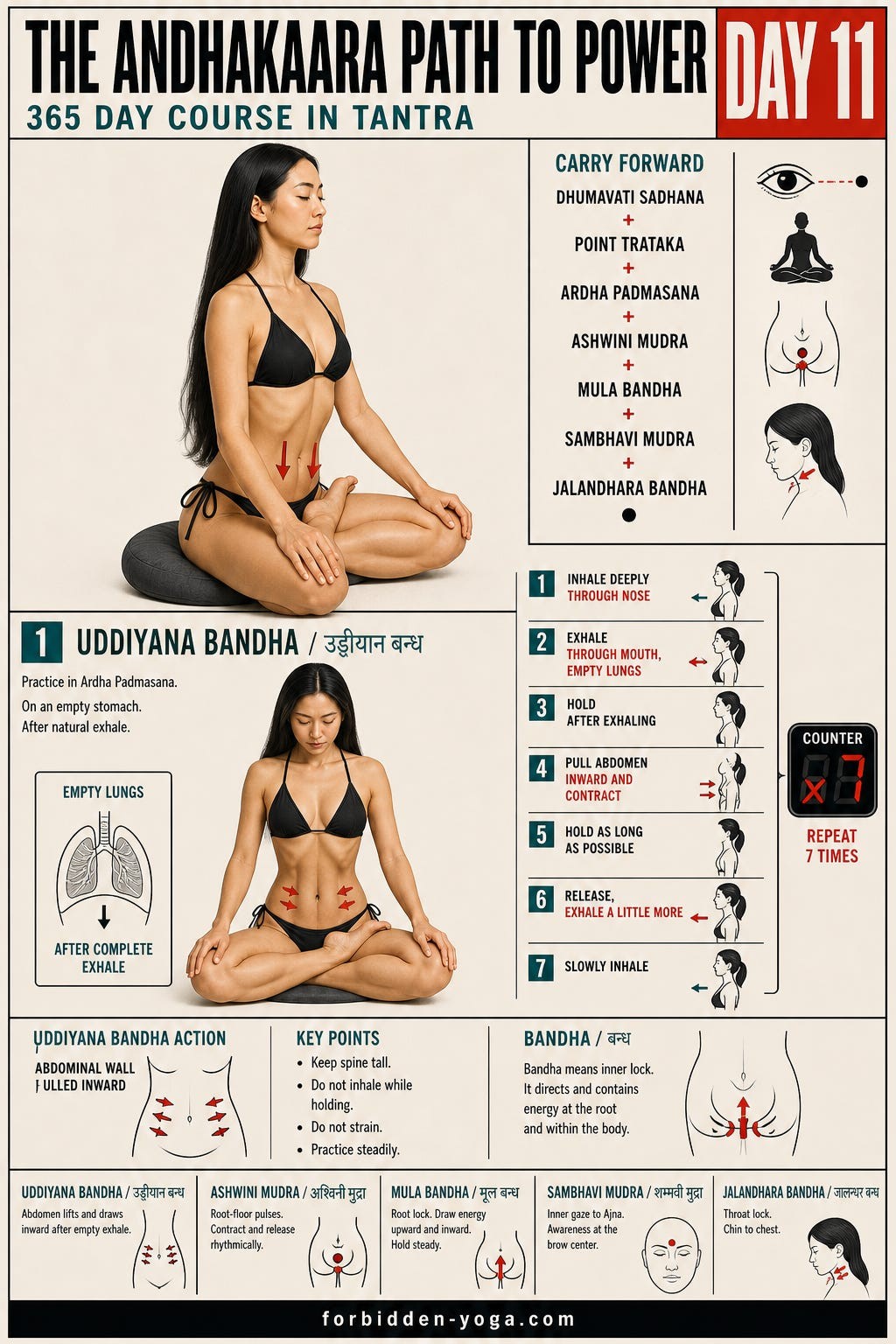
The full apparatus of bandhas (Mūla, Uḍḍīyana, Jālandhara, Mahā), mudrās (Aśvinī, Vajroli, Sahajoli, Śāmbhavī, Yoni, Khecharī, Akāśī, and many others), and pranāyāmas (Kapālabhāti, Nāḍī Śodhana with variations, Antar and Bāhya Kumbhaka, Vahnisāra, Agnisāra, Kāya Bhastrikā, Śakti Līlā). For men, the curriculum includes non-ejaculation techniques with Vajroli Mudrā. For women, vaginal muscle strengthening and the female variants of the same energetic practice.
Bhūta Śuddhi, the five-element purification, which is a five-day intensive practice working through Pṛthivī, Apas, Tejas, Vāyu, and Ākāśa, the gross elements, with their associated yantras, bīja mantras, and chakra correspondences. The sequence is repeated and deepened across multiple levels of the course.
The Sanskrit alphabet learned from the end, that is, beginning with the four petals of the Mūlādhāra chakra and ascending, because the embryo grows from the root and the spine forms in the same direction. The alphabet is not the academic Sanskrit of the university. It is the energetic Sanskrit of the chakras, the bīja mantras, and the petals.
Mānonāśa, literally, the destruction of overthinking, a structured 20-step partner practice combining Antar and Bāhir focuses (inside and outside), Cidākāśa and Śāmbhavī gazes, hip rotations, Bhuchari Mudrā, and various Śakti Līlā pranayamas, performed in the nude, face to face, in a sequence that systematically dismantles the discursive mind through alternating internal and external concentrations.
Various rituals based on Nyāsa, placement of mantras and deities on the body, both one’s own and one’s partner’s, including Matangi Antar Nyāsa, in which the practitioner mirrors and identifies with another human being through the 16 petals of the Viśuddha chakra, dissolving the experiential boundary between self and other.
The Mahā Vidyā meditations themselves, including the Dhūmāvatī sādhana (the widow goddess), the Bhairavī sādhana (the fierce goddess), and so on through the pantheon, each performed with its corresponding pranāyāma, mudrā, mantra, and visualization.
The Śakti Pīṭha system, the 51 places where the dismembered body of Sati fell across the Indian subcontinent, taught as a Tantric meditation on the mysteries of life and death, narrated through the voice of Pārvatī addressing Śiva across nine thousand years of remembering.
This is a very partial inventory. The full curriculum contains material I have not catalogued here and material I would not put in a public document. As my guru said, some things go in the bindu of the yantra and are not for the page.
The structural point is this. The course is the elaborate geometry around the bindu. The bindu, in the case of the Andhakaara Path to Power, is the recognition that the darkness from which the universe arose is the same darkness one stares into during daily Trāṭaka, is the same darkness inside one’s own closed eyelids, is the same nondual ground that the Mahāvidyās and the bandhas and the mudrās and the pranāyāmas and the Nyāsas are all distinct geometries around. By Day 365, or, for most practitioners, by some year significantly later than Day 365, the recognition lands. Before it lands, the practices are interesting techniques in an exotic system. After it lands, the practices are transparent to the one thought that always animated them.
I have said many times, and it remains true, that not many people can complete this course in a year. Perhaps one person in the whole world. Each day is so dense that doing Day 1 properly could fulfill a practitioner for an entire lifetime. There is no competition to complete all days. Going higher does not mean understanding more. Some students will work for years on one level and that is exactly correct. Others will pass through ten levels in two years and that is also correct. The lineage is not in the completion. The lineage is in the recognition. The recognition lands when it lands.
Part Eleven: The Trap of the Mimicking Entities
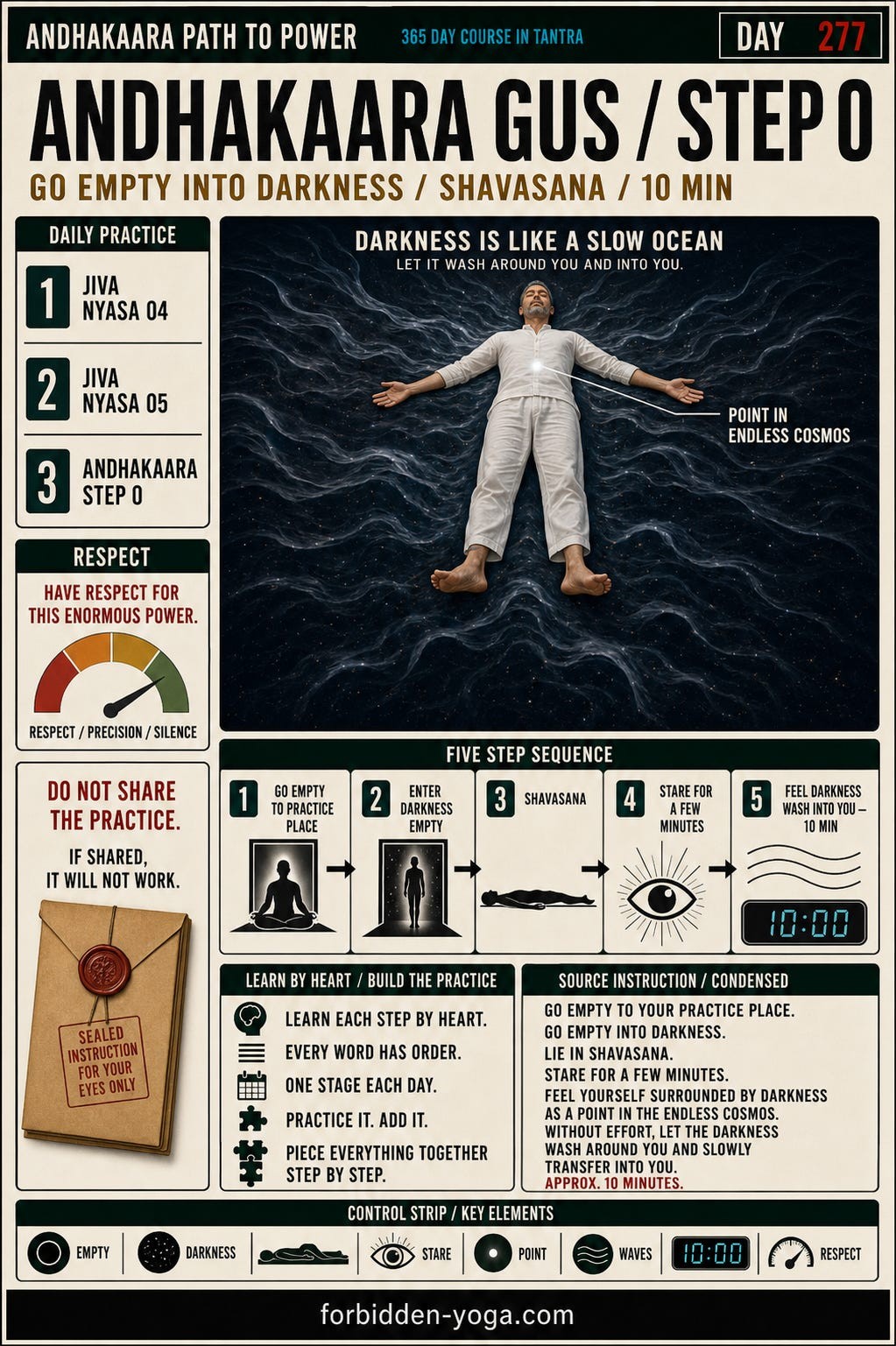
I want to record here a correction to my own teaching that I made very recently, because it sits at the structural center of the most dangerous trap in the entire course and I want it on the public record before I forget my way back to it.
The Andhakaara course includes, in its more advanced sections, work with what the tradition calls entities, the autonomous forms that appear in the darkness during sustained Trāṭaka, particularly during the longer dark retreats. These appear visually in the field of perception once one’s daily practice is consistent enough that the discursive mind has stopped flooding the inner space with its own thoughtforms. They have presence. They have something like personality. They are not hallucinations in the dismissive psychiatric sense, anyone who sits in serious darkness practice for long enough will encounter them, and the practices for relating to them are an old and detailed body of work.
My guru gave me an instruction many years ago about these entities. Be extremely careful that they do not merge with you. Let them come close, but do not let them in. I took this literally, as students take their teachers literally, and I taught it that way to my own students for years. Don’t let them visually enter you.
A few weeks ago I realized I had been teaching this incorrectly. Not because my guru was wrong. He was right for himself, in the language he used. But I had taken the instruction at the surface, and the surface, here, is misleading.
The danger is not that the entities visually enter the practitioner. The danger is much more subtle and much more dangerous. The danger is that the entities mimic the practitioner. They whisper, in the practitioner’s own voice, I am you. This power is yours. You are great. You are chosen. You are the one. They feed the ahaṃkāra, the egoic self-construction. They produce a steadily escalating experience of grandiosity which the practitioner mistakes for spiritual progress. The practitioner begins to feel powerful, special, capable of hearing things others cannot hear, perceiving things others cannot perceive, and in a certain technical sense this is true; the practitioner can do these things, but the cost is invisible until it is too late. The cost is that the practitioner has been turned into a feeding source for the entities. They are not granting the power. They are extracting it. The practitioner becomes useful to them, and as he becomes useful he becomes hollow, and as he becomes hollow he loses what the lineage cares about most: the sweetness of the human soul.
This is what Hans Christian Andersen described, with extraordinary precision, in 1844, in the opening section of The Snow Queen. The devil makes a mirror that distorts everything good and beautiful into something ugly. The devil and his students try to fly the mirror up to heaven to laugh at the angels and the Good Lord. The mirror slips, falls, shatters into hundreds of millions of pieces, some no larger than a grain of sand. Wherever those pieces lodged in people’s eyes, the people thereafter saw everything wrong, or only had eyes for what was bad about something; for every speck of the mirror had retained the same power as the whole mirror had possessed. Some people even got a tiny mirror-shard in their heart, and that was quite horrible, the heart became like a lump of ice.
Kai, the boy in the story, gets a shard in his eye and a shard in his heart. He stops being able to love. He becomes cold, mocking, cruel. He mimics his grandmother to make people laugh. He kicks the rose-box. His friend Gerda is bewildered because the boy who loved her last week is now a boy who finds her ugly. Once the mirror splinters enter Kai’s eye, he can only see ugliness in the world, suggesting that cynicism and cruelty are diseases of perspective rather than reality. The magic mirror, created by a devil, symbolizes a distorted and cynical view of reality. Then the Snow Queen comes for him. She kisses him until his heart is a lump of ice. She takes him to her palace and sets him the task of spelling Eternity from the shards on the frozen Mirror of Reason, promising him the whole world and a new pair of skates if he succeeds. He sits there for years, playing the icy game of reason, unable to complete the word.
This is the exact mechanism I am describing. The mirror is the work of the devil, that is, of forces that mimic the divine while being its inversion. The shard in the eye is the cognitive distortion. The shard in the heart is the loss of sweetness. The Mirror of Reason is the cold, brilliant intellectual game the practitioner ends up playing while his actual heart is frozen and his actual capacity to love is gone. The Snow Queen is the entity that has captured him. The promise of being his own master and getting the whole world is the grandiosity that the entities feed in him. He cannot spell Eternity because eternity, which is the actual nondual recognition, is not available to a frozen heart.
Andersen, writing as a Christian Romantic in 1844, gave the resolution: Gerda runs to Kai and embraces him, weeping warm tears that penetrate his heart and melt the ice splinter within. Kai then weeps too, washing the mirror splinter from his eye. The ice pieces rearrange themselves to spell Eternity, freeing him from the Snow Queen’s power. The cold game collapses in the presence of authentic human love. The shards leave. The frozen mind dissolves. The recognition lands.
I am telling this fairy tale here because it is, structurally, the most precise public description I have ever read of the trap that the entities set for the advanced practitioner in the Andhakaara work. The trap is not visual merger. The trap is the slow theft of sweetness. The shard in the eye, the shard in the heart, the icy game of reason that looks, to the practitioner, like the most profound spiritual work of his life, and which is, in fact, his slow dehumanization. Spiritual narcissism, in the modern psychological vocabulary, is the descendant of this old recognition. Almost every spiritually inflated teacher I have watched in my own field is somewhere on this trajectory. They are not bad people. They were captured. The shards are in their eyes. They can no longer see what they have lost because the loss is precisely the capacity that would let them see it.
I now teach this section of the course differently than I did five years ago. I no longer warn students against visual merger as the primary danger. I warn them against the slow inflation of the I. The entities will not arrive announcing themselves as adversaries. They will arrive as the most flattering voice the practitioner has ever heard. They will tell him he is exceptional, chosen, gifted, capable, deserving. They will hand him siddhis, small psychic capacities, and let him use those capacities to verify, in his own experience, that he is in fact special. And then they will quietly hollow him out, and the moment he is most certain of his own greatness will be the moment the lineage in him is dying. He is no longer the same person. He has been replaced by something that uses his body to feed itself.
The protection is not avoidance. It is humility: the lineage holder remembers that the lineage is one thought, and that the thought does not belong to him. He does not claim greatness because there is no personal greatness to claim. The work moves through him, not from him. Recognition arrives upstream of the ego. Whatever flatters the ego is therefore not the lineage speaking.
This is what my guru meant when he gave the instruction about the entities. I did not understand it for fifteen years. I understand it now. I am telling the public version of it here so that it is in the record, and so that anyone walking the course who finds themselves on this part of the path can recognize the trap before it closes.
Part Twelve: Why This Is For Few, Not For Millions
I will close with the recognition I tried to argue away for most of a decade and have now stopped arguing with.
This work is not for millions of people. It is not even, in the strict sense, for thousands. It is for the few in each generation who can recognize, when they see it, that what looks like an elaborate yogic system is actually a single recognition rotated through three hundred and sixty-five geometries. Those few will find it. The rest will read the marketing copy, glance at the table of contents, decide it is too dark or too complex or too sexual or too sophisticated, and walk on. This is exactly correct. The lineage is protecting itself.
I tried, for years, to broaden the audience. I designed marketing campaigns. I wrote accessible introductory texts. I produced video. I went on podcasts. Some of it worked at the surface, the search engines indexed Forbidden Yoga, the Substack accumulated subscribers, the academic Shubham Mukherjee wrote his paper on Forbidden Yoga and the figure of the new shaman, and the website acquired its current shape as a quiet, well-trafficked node in the global tantric landscape. None of that changed the structural fact. The number of people walking the actual course in any year is small. The number of people who will fully metabolize the work in any decade is smaller still. This is not a failure of the work or the marketing or the audience. This is what authentic transmission has always looked like.
Madame Lin gave the White Tigress teachings to one Western man and trusted that whoever needed to find them would find them through a paperback. Ip Man gave Wing Chun to millions through his students and gave the actual transmission to perhaps a handful. Ueshiba taught hundreds and transmitted the actual aiki to a count you could probably make on two hands across four generations. The numbers are always small. The numbers must be small. The lineage is in the few, and the few find it, and the rest pass it without seeing it, and this is how the fire is kept burning across centuries.
If you are reading this essay and you recognize yourself in it, not flatteringly, not in the way the entities would have you recognize yourself, but in the quiet, uncomfortable way of someone who has been doing this work in some form for a long time and has finally found the words for what they were doing, then you are one of the few. Write to me. The work is not a workshop and it cannot be bought in a weekend. It is a long road, and at the end of the road is a recognition that the road and the destination were always the same place. If you are willing to walk twenty years toward something that could be stated in a sentence, the door is open.
If you are reading this and you find yourself excited, inflated, certain that you have just understood something profound that the masses do not understand, slow down. The shard may already be in your eye. The protection is humility. The recognition is quiet. If you have to announce it, you do not have it yet.
A lineage is only one thought. The rest is the long, holographic detour by which the thought becomes available to whoever, in each generation, can bear to receive it.
A note on sources and method
This essay draws on the canonical historical record of three traditions and on twenty years of private practice in a fourth. The aikido section draws on the standard scholarly literature on Morihei Ueshiba’s biography and on the documented generational differences among his students. The Ip Man and Bruce Lee section draws on published interviews with Bruce Lee (notably his 1967 Black Belt interview quoting his master directly), on Ip Chun’s later clarifications of the apartment story, and on Wong Kar Wai’s reflections on the wooden-dummy footage. The White Tigress section draws on Hsi Lai’s The Sexual Teachings of the White Tigress (Destiny Books, 2001) and The Sexual Teachings of the Jade Dragon (Destiny Books, 2003), on Madame Lin’s foreword to the former, on the standard secondary literature on fangzhongshu and Tang-era Taoist female adepts, and on Xi Lai’s own biographical statements at hsilai.com. The Osho quotations are from his God is Dead, Now Zen is the Only Living Truth discourse series and from From Unconsciousness to Consciousness. The Andersen text is the John Irons translation of the Danish original, published by the Hans Christian Andersen Centre at the University of Southern Denmark. The Andhakaara material is drawn from my own course documentation, written between 2014 and the present.
The scholarly essay by Shubham Mukherjee, “A New Shaman and his play: Relevance of Forbidden Yoga in modern Indian Society” (2020), provides an independent academic framing of the project and is referenced in the discussion of authentic transmission outside the modern Indian neo-tantric mainstream.
The Andhakaara Path to Power
Forbidden Yoga is the public-facing vehicle for a private lineage of Indian left-handed Tantra. Private inquiries are received via the contact channels at forbidden-yoga.com.