I. A confession to begin
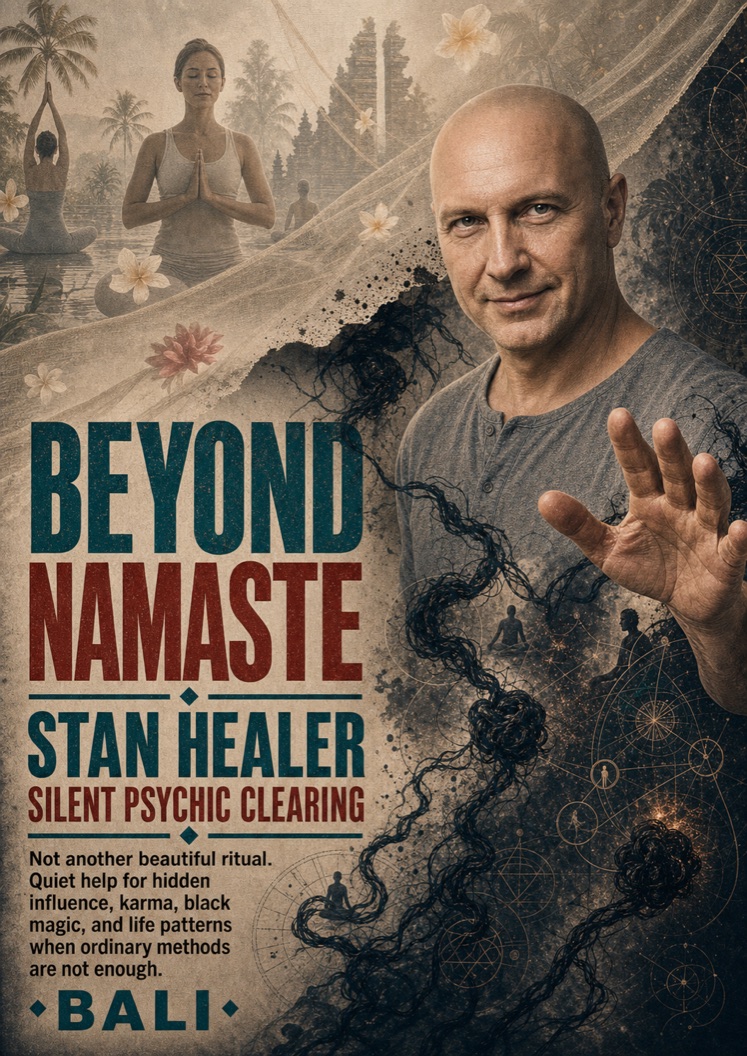
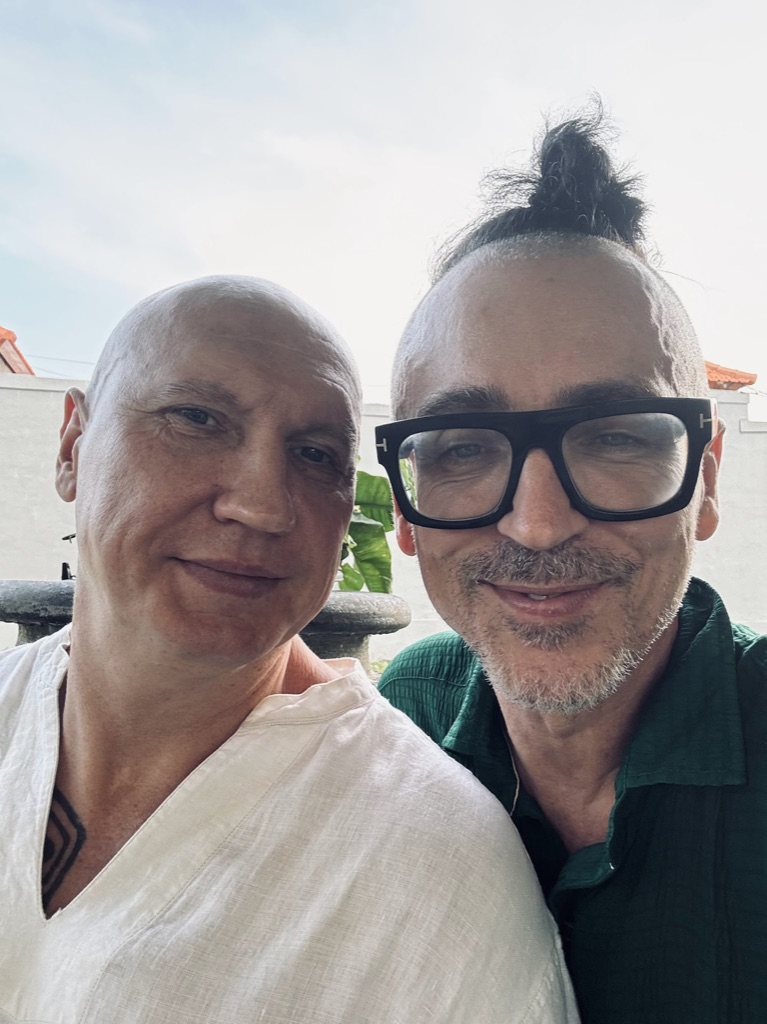
I have a friend in Bali whose actual profession, performed daily, is the removal of black magic from the energetic field of his clients. He has lived in Bali long enough to have stopped being surprised at himself. He is from Russia. He is bald. He has the brow of a man who has held opinions. In every photograph ever taken of him he appears to be about ten seconds away from saying something the other person will need a moment to recover from. If you put him in a casting line for a Bollywood film, the director would point at him without looking up from his coffee and say, that one, the antagonist. If you put him in a Bond film he would not even need a costume.
His name is Stanislav. In English he prefers Stan. He has been the central marketing problem of my life for six years.
I have already written, in The Energetic Anatomist, about what he actually does. That essay is the inside of the man: the work, the reading, the unbothered way he picks up a photograph and tells you that the person in it is fine, or is not fine, or is in fact the precise reason your business has been losing money for the last eighteen months. This essay is about the outside of the man, and about how, in 2026, I finally worked out how to put that outside on a poster, with the help of a piece of software that did not exist three years ago.
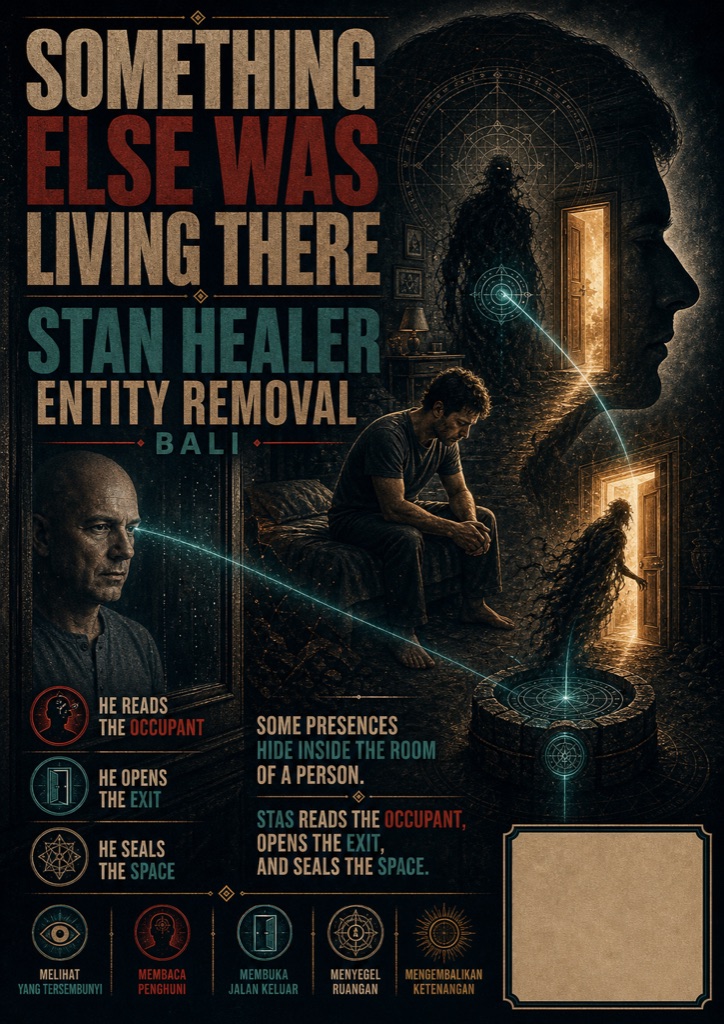
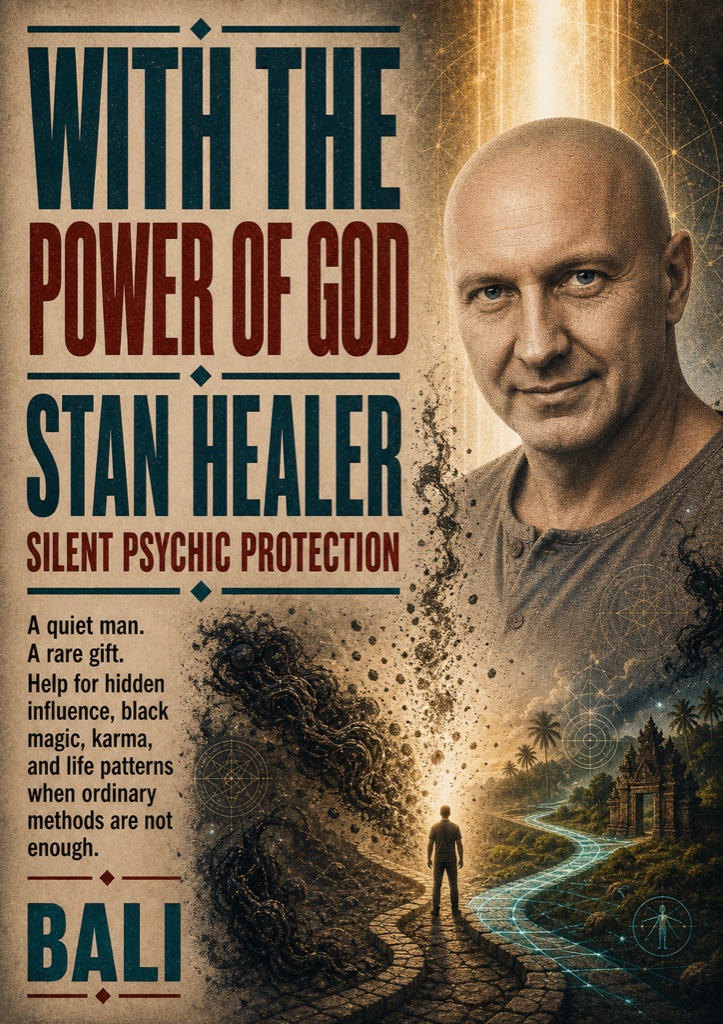
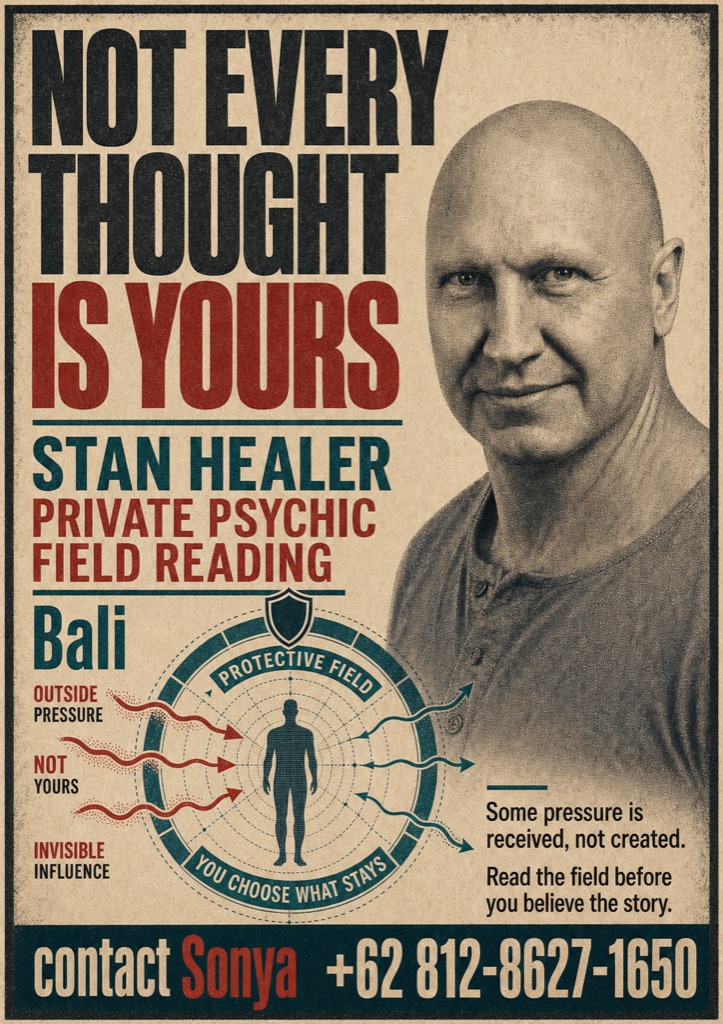
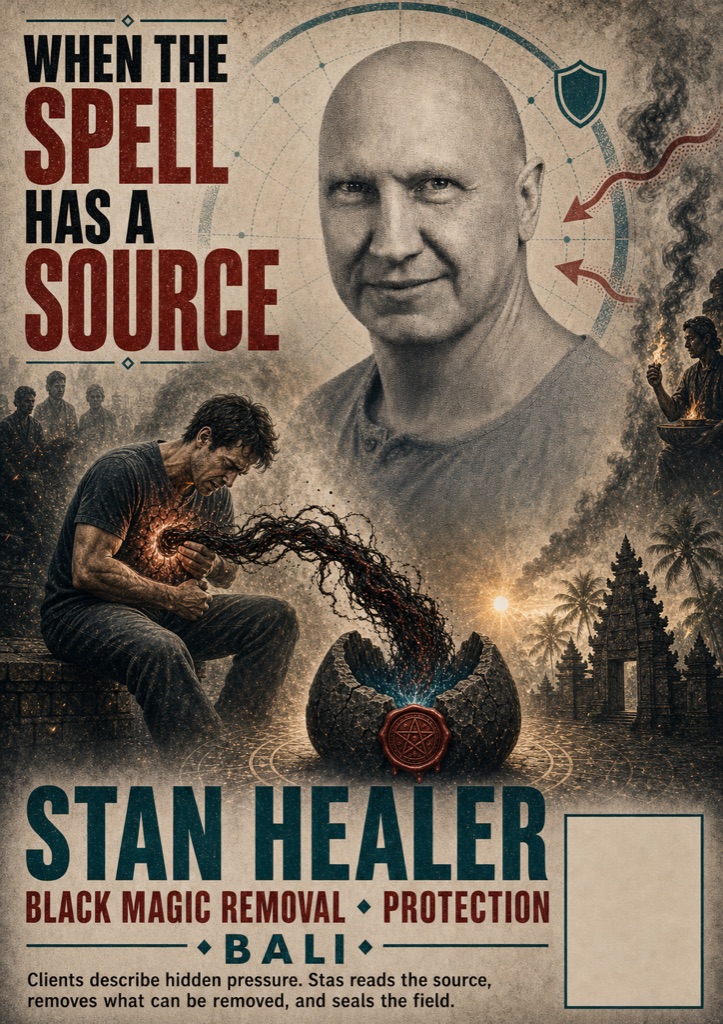
The short version: I sat in front of an AI for a series of long evenings, told it everything I knew about Stan, gave it photographs, and asked it to design the campaign I had not been able to design in six years of trying. It did. The posters you will see in this essay are the result. They were generated, curated, rejected, regenerated and finally approved by me, but the original act of creative authorship was a conversation between a human marketer in love with his subject and a machine that had no preconception about what a healer in Bali is supposed to look like.
This essay is, then, about three things at once: a psychic, a wellness industry, and the strange new role of artificial intelligence as the most patient creative collaborator any of us has ever had. The three things are related. By the end I hope you will see how.
II. The Ubud problem
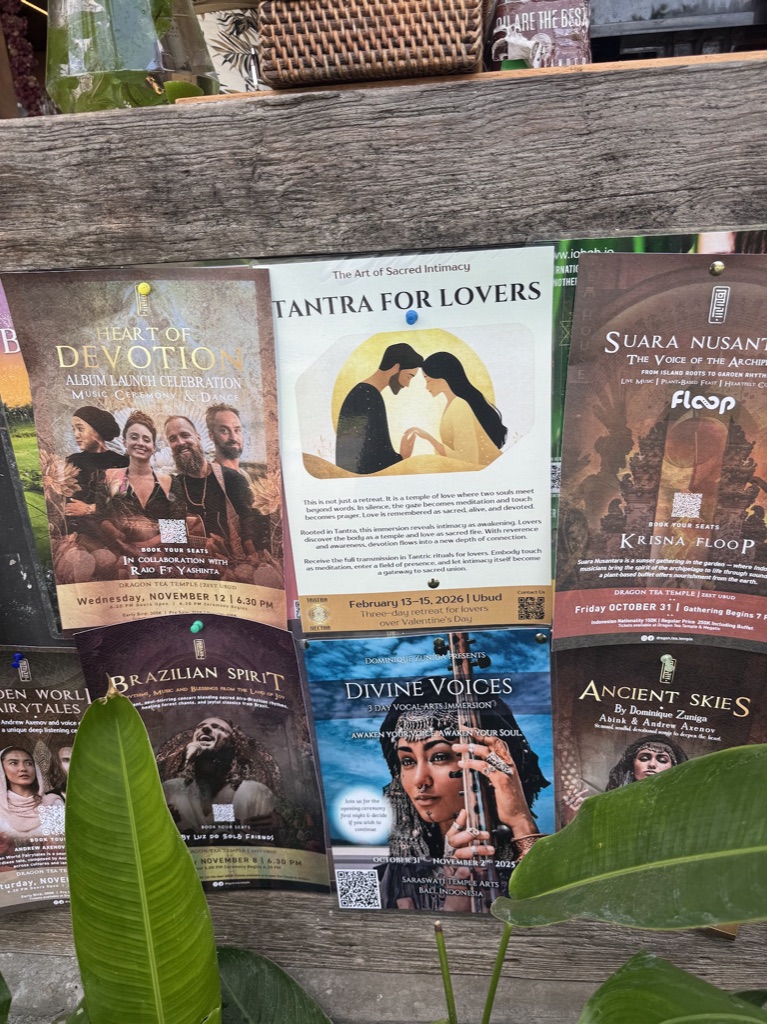
There is a town in Bali called Ubud. It is a beautiful town. It is also, statistically speaking, the largest open-air gathering of self-declared healers per square kilometre on the planet. In the cafés along Jalan Hanoman and Jalan Goutama you can sit with a turmeric latte and overhear, at three adjacent tables, conversations about past lives, kundalini awakenings, and the precise sub-octave of the cacao ceremony that produced last night’s heart-opening. The people in these conversations are, almost without exception, beautiful. They are tanned, draped in raw linen, and they smile the slightly aerial smile that is the local professional uniform.
I do not want to be unkind. Some of these people are extraordinary. Many of them are exhausted, broke, and quietly resentful, but the smile holds, because the smile is the product. The Ubud poster wall reflects all of this back at itself in a wash of soft beige and cosmic pink: tantra retreats, voice ceremonies, kambo training, sound baths, devotional concerts, intimacy workshops, twelve flavours of nervous-system rewiring, and an absolutely staggering quantity of QR codes. Everyone is being held. Everyone is being softened. Everyone is being invited, in a font that resembles handwriting, to come home to themselves.
Stan would not survive in this ecosystem for a single afternoon. He could not sit in one of my preferred Ubud coffee shops without the entire room going slightly quiet. He would not know what to talk about. He would have nothing to say about ceremony. He would, if pressed, say something true and unwelcome about somebody at the next table.
I have always loved the people who do not fit. I have a quiet, lifelong tenderness for the Toulouse-Lautrecs and the Henry Millers, for the men and women whose interior intelligence is several orders of magnitude greater than their capacity to behave correctly at a dinner party. I find them more honest than most of the people who do fit. Stan belongs in that lineage. He is, in every measurable social sense, an outlaw, not because he has chosen to be one, but because no available social script has a role for what he actually is.
The marketing problem flowed directly from this. For six years I attempted, with steadily increasing absurdity, to dress the outlaw as a healer. We tried lighter colours. We placed him near flowing water and tropical foliage. We tested font weights that suggested compassion. The camera, faithful instrument that it is, returned, every single time, the image of a man who appears to be in your photograph against his better judgement.
III. Talking to a machine in 2026
I want to say something about artificial intelligence here, because the rest of this essay does not work without it.
In 2026, the people who get the most out of AI are the people who have stopped giving it answers. The amateur prompter walks up to the model with a finished idea, make me a poster of a healer in Bali in the style of a 1970s movie poster, and receives a competent but generic execution of that finished idea. The professional prompter walks up to the model with a problem, and tells the model everything around the problem until the problem begins to dissolve into its actual structure, and the solution becomes visible to both parties at the same time.
It is, in this sense, much closer to psychotherapy than to graphic design.
I sat with the model for a long sequence of conversations and told it everything. I told it about Stan, about the Ubud poster wall, about my six years of failed campaigns, about the Russian face, about the fact that he yawns sometimes while removing entities and that this is the entire ceremony. I told it about the boxer-and-Bollywood-villain quality of his appearance and about the small, persistent comedy of trying to retouch that quality into the dialect of luxury wellness. I told it about the lineage I felt he secretly belonged to: the people who arrived in your life looking entirely wrong and turned out to be the one figure who could solve what nobody else could.
And then I told it about Inception. About the Christopher Nolan film. About the conceit of operating on a person’s interior architecture at the fourth dream level. Because, I said, that is the genre Stan actually inhabits. He is not a wellness practitioner. He is an Inception operator who happens to live above a warung in Bali.
The model listened. It listened with a patience no human collaborator I have ever met could afford to extend. And then it began to produce.
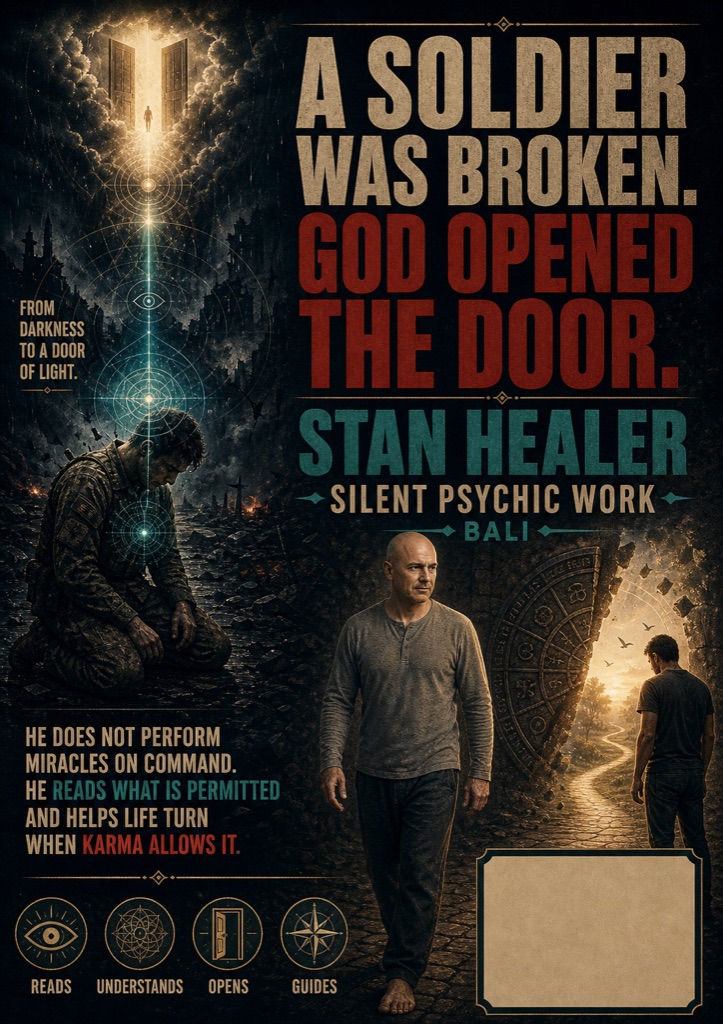
There is a moment in Tarkovsky’s Solaris, based on the novel by Stanisław Lem (which is to say, written by another Stanislav, which is to say, the patron saints of this essay are stacking up), in which the scientist on the space station discovers that the planet’s ocean is responding to his unconscious by materializing the dead wife he has been unable to grieve. The ocean does not invent. It reflects, with a literalism that becomes unbearable, the contents of the man’s interior life. The scientist’s tragedy is that he is given exactly what he wants, exactly as he wants it, exactly as often as he wants it, and this turns out to be a more difficult condition than absence.
I thought about Solaris a great deal while working with the AI. The machine is, in some philosophically embarrassing way, the Solarian ocean we have managed to build for ourselves on a server farm in Iowa. It returns to us the contents of our own mind, at a level of fidelity and immediacy that human history has never previously made available. I do not think this makes anyone dumber. I think it makes us responsible, for the first time, for the quality of what is in our own minds, because the gap between thinking it and seeing it printed has now collapsed from years to seconds.
If you have nothing in your interior, the ocean will return you nothing. If you have spent six years patiently observing a Russian healer in Bali, the ocean will return you a poster series that is, frankly, better than anything I or any of the graphic designers I have hired in two decades of running a small wellness business could have produced alone. That is the deal. The machine is not the artist. The machine is the medium through which an artist who happened to live inside a marketer finally got to see what he had been seeing.
IV. The objection, which deserves an honest answer
At this point a sensible reader will want to interrupt me. The sensible reader will say: Michael, you have spent three sections of an essay being charming about the marketing of a man whose product is, by your own description, the long-distance removal of magical influence from people’s energetic fields. We need to talk about the elephant.
The elephant is that distant healing, as a commercial category, occupies a place on the credibility spectrum somewhere between essential-oil multi-level marketing and the cleaner end of the astrology app industry. The numbers are not small. The global market for “body, mind and energy healing” was estimated at roughly USD 78 billion in 2025 and is projected to reach USD 142 billion by 2033 (Grand View Research). Reiki services alone are pegged at USD 175 billion in 2025, with analysts forecasting USD 512 billion by 2033 at a compound growth rate of 16.57% (HTF Market Intelligence). The complementary and alternative medicine market is heading toward roughly USD 1.4 trillion by 2033 (Market.us). Spiritual wellness apps, considered as their own subcategory, were worth around USD 2.38 billion in 2025 and are projected to nearly triple by the early 2030s (Towards Healthcare). One in three adults globally, according to survey data referenced in the same studies, are now turning to some form of meditation or alternative practice for wellbeing.
Distant healing, the literal, no-touch, no-room-shared variety that Stan performs, is a meaningful slice of all of this. There are apps that schedule Reiki sessions across continents. There are subscription products that promise quarterly karmic maintenance. There are influencer-healers with hundreds of thousands of followers offering twenty-minute remote interventions billed at the hourly rate of a corporate lawyer.
The scientific literature is, to put it gently, unimpressed. In 2000, John Astin, Elaine Harkness and Edzard Ernst published a systematic review in the Annals of Internal Medicine of randomized controlled trials of distant healing (ACP Journals). Ernst published an update in 2003. The combined conclusion, in the dry register that medical journals reserve for findings of this kind, was that the better-designed the trial, the more strongly the evidence converged on the position that distant healing is not distinguishable from placebo (Ernst, 2015 follow-up). This is not a contested finding. It is, within the small community of professional skeptics, a closed case.
I have read these reviews. I take them seriously. I am not a person who believes that the world is best understood by suspending the scientific method whenever the scientific method delivers an inconvenient verdict.
And yet.
There is a class of phenomenon for which the randomized controlled trial is constitutionally the wrong instrument, in the same way that a bathroom scale is the wrong instrument for measuring the colour of someone’s eyes. The RCT assumes a generic operator, a standardized dose, a population-level effect, and a target outcome that is measurable on a timescale shorter than the average funding cycle. None of these assumptions describe what Stan does. He is not generic. He works on the specific person sitting in front of him (or in the photograph in front of him). The outcome he is trying to produce is not measurable in the categories the trials use, and often does not appear in his client’s life for weeks or months, and is, when it does appear, almost always retrofitted by the client into a story that has nothing to do with him. People do not say the Russian removed an entity; they say I finally left my husband or the lawsuit settled or I started sleeping again.
This does not make the work scientific. It does make the question of how to evaluate the work more interesting than the dismissive register allows. It is possible, simultaneously, that 95% of the global distant-healing market is selling placebo at scale, and that the remaining 5% contains a small number of people who are doing something that the current scientific apparatus is not equipped to detect. Both of those things can be true. They almost certainly are.
V. The lineage of the embarrassing claim
The reason I am willing to keep an open file on the residual 5% is that the history of the embarrassing claim is, for an attentive reader, considerably more interesting than the contemporary debate.
In Italy in the twentieth century there was a Capuchin friar named Padre Pio. He bore the stigmata for fifty years. He was repeatedly examined by physicians dispatched by an initially skeptical Vatican. He was the subject, during his lifetime, of multiple ecclesiastical investigations designed to disprove him. He was credibly reported, by literate adult witnesses on multiple continents, to have appeared in person to people he was, simultaneously, in a monastery in San Giovanni Rotondo with at least one other friar in the room (Wikipedia: Padre Pio). He was canonized in 2002. None of this proves bilocation. It does establish that the category of testimony about him is not the category of testimony you receive about an Instagram healer with 80,000 followers and a Calendly link.
In post-war Germany there was a man named Bruno Gröning. In 1949, after a single healing in the town of Herford was reported in the press, an estimated thirty thousand people a day made the pilgrimage to the Traberhof in Rosenheim to stand within range of him (Wikipedia: Bruno Gröning; Bruno Gröning Circle of Friends). The post-war German state took an interest, mostly hostile. After his death the Circle of Friends, founded in 1979 by an Austrian school teacher who had herself been healed by him, began the slow, unglamorous work of medical documentation. The Circle’s Medical Scientific Group today comprises several thousand physicians and other health professionals who collect, vet and publish case reports of healings attributed to ongoing distant work with the Gröning current, most accompanied by independent physician commentary based on actual medical records (Circle of Friends, Medical Scientific Group). One can disbelieve every word of this. One cannot reasonably claim that nobody has tried to take the question seriously.
In northern India there was a man called Neem Karoli Baba, known to his devotees as Maharajji, who died in 1973. He was the teacher of Ram Dass and of the man who would later become Steve Jobs’ first spiritual reference point. He was reported, by a series of witnesses including Western academics and journalists, to know things about people he could not have known, to be in two places at once, and to heal occasionally and apparently casually by laying a hand on a head (Ram Dass on Maharajji and healing). Anandamayi Ma, the Bengali mystic whom Neem Karoli Baba reportedly travelled to visit, was the subject of a similar body of testimony for fifty years.
In Russia there is an entire lineage that the West has barely catalogued. The startsy, the holy elders of the Orthodox Church, were a thousand-year tradition of men who lived in forests and small monasteries and were sought out by everyone from peasants to tsars for what the Russians called prozorlivost, the gift of seeing into the soul. Seraphim of Sarov was the most famous. There is also the parallel tradition of the yurodivy, the holy fools, men who deliberately or constitutionally did not fit into society, who were said to read the inner condition of the powerful, and who were tolerated, even feared, precisely because they were socially impossible. The Bulgarian seer Vanga, blind from childhood, was consulted for decades by communist heads of state. Madame Blavatsky, Gurdjieff, Ouspensky, the great esoteric exports of late-imperial Russia to the West, were the secular continuation of a far older indigenous current.
This lineage was atomized by the twentieth century. The Soviet period drove most of it underground or into emigration. Some of the people in it ended up driving cabs in Berlin. Some ended up teaching mathematics in Tel Aviv. Some ended up reading hands at fairs in southern France. A few ended up in Bali, looking, by accidents of genetics and history, exactly like a man who has just been removed from the VIP list at a Moscow nightclub.
The reason I am willing to hold open the file on the 5% is that the historical record is dense with people of this kind. The reason I am writing about Stan specifically is that, by my repeated and reasonably observant experience, he belongs in the file.
[Insert image: restart_from_beginning_attempts__017_if_your_karma_allows_it_en.png (If Your Karma Allows It)]
VI. The metaphysics of moving karma from a distance
Let me address the actual question, because the question is more interesting than the marketing of it.
Can the karma of one person be altered by another person from a distance?
In the Vedic and the Buddhist traditions, the answer is a carefully qualified yes. Karma is not a flat punishment ledger; it is a structured field of consequence, with categories: sanchita (the total accumulated), prarabdha (the portion currently ripening), kriyamana (the actions being generated now) and agami (their future fruit). The classical teaching is that prarabdha, the karma actively unfolding in this lifetime, is largely beyond intervention, because it is the seed already in flight. But sanchita, the unmanifest reservoir, and the conditions under which prarabdha expresses, are workable. A sufficiently realised being can, the texts say, alter the form in which a karmic debt is repaid: a cancer can become a fever, a catastrophic loss can become a small humiliation, a death can become a near-miss. The debt does not vanish. Its currency is renegotiated.
This is not a controversial position within the traditions. It is the explicit theological basis for the practice of taking refuge in a guru. The guru, by accepting you, is understood to be absorbing some portion of your karmic load, which is why so many of the great Indian masters became physically ill at the end of their lives in ways that their hagiographies frame not as failure but as service. Ramakrishna’s throat cancer. Ramana Maharshi’s sarcoma. Sai Baba of Shirdi’s reported physical absorption of devotees’ fevers. The pattern is too consistent in the literature to be entirely explained by ordinary biology.
In the Christian tradition the same idea appears under a different vocabulary. Padre Pio’s stigmata were understood by him as a participation in the Passion on behalf of others. Catholic theology has a precise technical term for this: vicarious suffering. The mystic offers herself as a kind of bypass capacitor for the spiritual circuitry of people who could not, on their own, complete the discharge.
The Russian Orthodox startsy practiced a similar economy under yet another vocabulary. They prayed for people, by which they did not mean what a modern Protestant means by intercessory prayer, but something closer to a sustained, attentive, energetic engagement with the soul of the person being prayed for. They reported, and their disciples reported, results.
Stan would not use any of this vocabulary. He is allergic to vocabulary. He would say something like, the field around this person has a structure, the structure has a weak point where another field is connected to it, I close the connection, the person’s circumstances change. He would say this without inflection, the way an electrician describes a short circuit. If pressed about the metaphysics he would shrug and say if the karma allows it. Which, as it happens, is more theologically literate than 98% of the spiritual marketing produced in Bali in any given month.
The thing he is doing, and I am now speaking from direct, repeated observation, not from theory, is operating on a layer of the human situation that is real, that is structurally consistent across people, and that responds to skilled intervention. Whether or not we currently possess the scientific instruments to measure that layer is a separate question and not, in my judgement, the most interesting one.
VII. Why a Russian refugee, of all people
There is a sub-question hidden inside the main question, which is: why should this particular man, of unimpressive provenance and zero credentials, be able to do any of this?
The honest answer is that the credentialing systems of the modern wellness industry have very little to do with the underlying capacity. The capacity, when it exists, runs through bloodlines and accidents and exposures that have no relationship to the contemporary diploma economy. The pattern, across cultures, is depressingly consistent: the people who can actually do the work tend to come from places that no longer have institutions, in lineages that no longer have names, carrying transmissions from teachers whom no Western journalist ever interviewed. They tend to look wrong. They tend to have ungovernable opinions. They tend not to know what to do with the resulting fame, when the fame arrives, and a substantial fraction of them die quietly in small towns having never been correctly identified.
Stan came out of the dissolution of the late Soviet world the way some other people came out of it carrying violin technique or chess theory or a particular way of doing higher mathematics on the back of an envelope. He is, in the strictest sense, a refugee, not from a war but from a civilizational collapse whose cultural and esoteric debris has been quietly distributed across Bali, Phuket, Goa, Tbilisi and a handful of unfashionable neighbourhoods in Berlin for the last thirty years. The wellness industry has not noticed this distribution, because the wellness industry does not read books from before 1965 and could not pick Seraphim of Sarov out of a line-up.
This is the actual answer to why him. He happens to be a fragment of a much larger and much older transmission that has gone dark in its native country and is now scattered, in unglamorous human form, across the periphery of the global tourist industry. The fragments do not advertise themselves. They are usually located through word of mouth, by someone who knows someone whose sister had a problem that nothing else solved. They are almost never beautiful. They are almost always slightly inconvenient to be around.
It is, in other words, very on-brand for the universe that the man who can do the work in 2026 looks like a man who has been deported from at least one country and is sitting calmly in Bali waiting for the people who need him to figure out how to find him.
VIII. What the machine did for the man
Let me return, briefly, to where I started. The reason this essay exists is that an artificial intelligence helped me solve, in a series of evenings, the marketing problem I had failed to solve in six years of human effort.
What did it actually do? It did not give me the answer. It did the much more useful thing of holding everything I told it long enough for the answer to surface. It read, without prejudice, the documents I fed it: the failed brand briefs, the rejected drafts, the descriptions of Stan, the photographs, the analyses of the Ubud poster wall, the McKinsey reports on the wellness market, the Edzard Ernst meta-analyses, the Astin and Harkness systematic review. It noticed, faster than any human collaborator I have ever worked with, the structural absurdity at the centre of my approach: I had been trying to dress the bouncer as the monk, and the bouncer was the entire point.
It then generated, over a period of weeks, several hundred posters. Most of them were wrong. Some of them placed his face on the body of a man who was not him. Some of them used iconography from the Hindu pantheon in ways that would have been culturally illiterate to publish. A non-trivial number put his face on a vaguely beatific stranger who looked like a yoga instructor from Boulder. I rejected those. The ones I kept, the ones embedded in this essay, share a single property: they treat the face as the brand, not as the problem.
This is what AI is for, in 2026. It is the externalisation machine for the contents of an interior that has actually been paid attention to. It is the Solarian ocean, and the Solarian ocean returns to you exactly what is in you, at the resolution of your own attention. If you have lived next to a Russian psychic for several years and watched him work, the ocean will return you the campaign you have been carrying in your head and could not, with your own hands, draw. If you have lived next to nothing in particular, the ocean will return you a generic image of nothing in particular, and you will, correctly, conclude that AI is overhyped.
This is not, I think, the end of human creativity. It is the beginning of a much more honest accounting of how much human creativity any given person actually has. The people who have a great deal of it are, for the first time, going to be able to manifest the full quantity of it in something close to real time. The people who do not have very much of it are going to find that the machine cannot supply what they themselves do not bring.
I find this fair. I find it, frankly, beautiful.
IX. The man, briefly
For the inside view of Stan, the essay you want is The Energetic Anatomist. There I describe the work itself in the detail and care it deserves: the field reading, the photograph-based diagnosis, the way he can tell you, in a sentence, who in your life is supporting your evolution and who is quietly metabolising you.
Here I will only say what cannot be said in a marketing essay without sounding either evangelical or trivial.
He saved my life. He has been brutally, sometimes intolerably honest with me. There were extended periods during which I disliked him for it. I have, every time, eventually returned. I do not believe in God as a personified entity, and so I will not say he is a god-man, but I will say that what comes through him, when it comes, is aligned to something I have no other vocabulary for than the truth of the situation as it actually is, including the parts I am paying not to see. This is, in my experience, the rarest service that any human being can render to another human being. It is the service that requires the fewest props, the least ceremony, the smallest amount of architectural beauty, and the largest amount of personal courage on both sides of the table.
He charges money for it. He has to. He is not a monastic. He is a refugee in his fifties living in a small house in Bali. The pricing is in line with what a serious specialist in any field charges, and considerably below what a Manhattan psychoanalyst with worse outcomes would charge for the same hour.
If you are the kind of person who needs this work, you will already have read this essay with the slightly tightening attention of recognition. If you are not, you have already left the page, and I wish you well. The Bali poster wall is built for the people who will solve themselves with beauty and a turmeric latte, and most people will. Stan is for the others.
X. A small benediction at the end
I want to close on the AI note, because the AI note is the note that ties the two halves of this essay together.
We are at a moment, in 2026, where the most futuristic tool ever built by human beings is being applied, by me, to the marketing of the oldest profession in the world: the seer who looks at you, sees the structure of your situation, and tells you what is in it. There is a small, exquisite comedy in this. The newest thing we have ever made is being used to surface, into public visibility, a current that has been running underground for at least four thousand years.
My benediction, to anyone who has read this far, is this: please use the new instrument for the old work. Tell the machine the things you have actually noticed. Hand it the material of your real interior. Do not ask it for what you think it can produce. Ask it, instead, to help you find what was already in you and could not, without it, find a form.
The Solarian ocean is here. We built it. It is sitting on a server in Iowa. It will return to you, in shocking detail, whatever you have lived next to long enough to know in your bones.
What I lived next to, for six years, was a bald Russian in a grey t-shirt who can read the karmic structure of a person from a photograph and remove what does not belong in the field of that person’s life, often within a few quiet minutes, without ceremony, sometimes while yawning.
This essay is what came back.
Stanislav (Stan) works in Bali and at distance, via video and via photograph. To enquire, contact Sonya on WhatsApp at +62 812-8627-1650, or find him on Instagram at @thehealerstan or go to the ONBOARDING AI chatbot at forbidden-yoga.com For the longer description of the work itself, read The Energetic Anatomist.
Posters in this essay were generated in collaboration with OpenAI’s image tools, curated and approved by the author. The face used is the real face of the practitioner.
Sources cited
Astin, J., Harkness, E., Ernst, E. The efficacy of “distant healing”: a systematic review of randomized trials. Annals of Internal Medicine, 2000. acpjournals.org
Ernst, E. Distant healing, an update of a systematic review. Wiener Klinische Wochenschrift, 2003. pubmed.ncbi.nlm.nih.gov
Ernst, E. Distant healing: two new systematic reviews and meta-analyses. 2015. edzardernst.com
Grand View Research. Body, Mind and Energy Healing Market Size Report, 2030. grandviewresearch.com
HTF Market Intelligence. Reiki Healing Services Market. htfmarketintelligence.com
Market.us. Complementary and Alternative Medicine Market. market.us
Towards Healthcare. Spiritual Wellness Apps Market. towardshealthcare.com
Bruno Gröning Circle of Friends. Medical Scientific Group documentation. bruno-groening.org
Wikipedia. Padre Pio. en.wikipedia.org
Wikipedia. Bruno Gröning. en.wikipedia.org
Ram Dass. Neem Karoli Baba (Maharaji) Stories: Baba on Health and Healing. ramdass.org