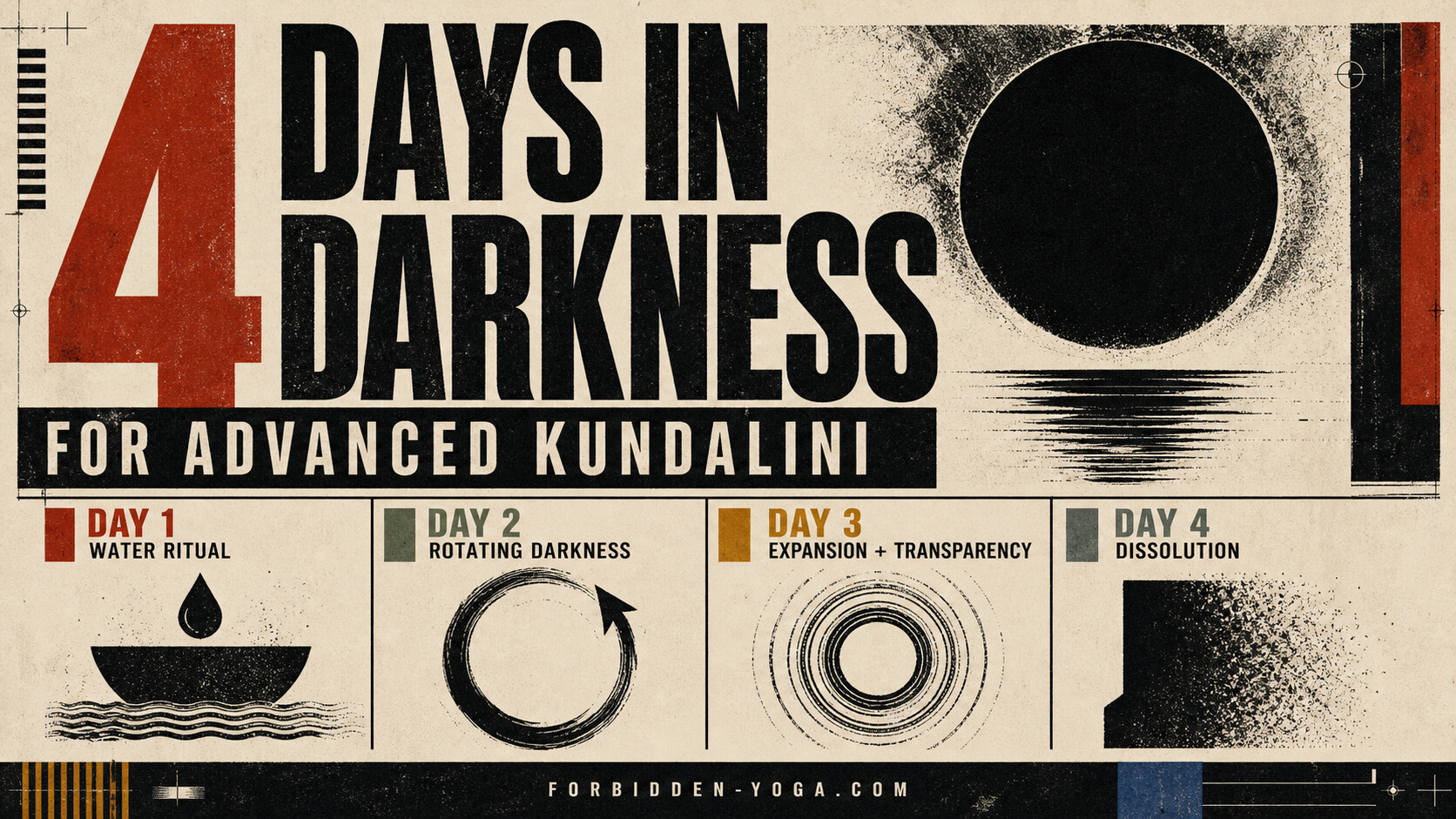
The 365 Days The Andhakaara Path to Power is not an ordinary online course. It could not be a book, because books cannot teach you how to live, how to breathe, how to act in the world, or how to transform perception through practice. The tantric yogic tradition is not a philosophy to be consumed but a technology to be inhabited, and for that reason an interactive, time bound, lived transmission was necessary.
Ancient Tantra is vast, complex, and precise, and it cannot be rushed or skimmed without losing its power. This is why the teachings were divided into 365 carefully structured sections, one for each day, so that nothing essential could be skipped and no practice could be bypassed. Liberation does not happen through accumulation but through rhythm, repetition, and time.
Laya: The Foundation of Rhythm
At the foundation of this transmission lies Laya, rhythm and dissolution. In authentic tantric sadhana, teaching is not informational but rhythmic. The rhythm of transmission distinguishes Tantra from how yoga is commonly taught today. This rhythm originates from the teacher and is absorbed by the student over time through shared practice.
There is no requirement for dramatic initiations or ceremonial entry into a guru mandala. What matters is duration, proximity, and continuity. Liberation unfolds slowly, through lived experience, through the gradual dissolution of resistance, through attunement. One learns first to follow a rhythm and eventually to discover one's own.
The Mahavidya System
Time itself, Kaala, the masculine aspect of Kali, governs this process. The entire one year journey is structured through ten great thematic chapters based on the Mahavidya system, one of the most radical spiritual frameworks ever conceived. The Mahavidyas are ten goddesses, ten cosmic intelligences, ten aspects of reality itself, all emerging from the great goddess Parvati.
They do not represent ideals but forces. Studying them intellectually is insufficient. They must be practiced, embodied, and endured. In many ways, this system represents one of humanity's earliest visionary narratives, a fierce and uncompromising cosmology driven by powerful female forms. Through them, the Andhakaara Method becomes a journey into the source code of all religions, past and present, a necessary undertaking in a time of civilizational uncertainty.
Holographic Consciousness
The course unfolds in layered states of consciousness, inspired by the idea that reality itself is holographic. Over the span of the year, the student moves from their present state of awareness into deeper and subtler layers without even realizing when the transition occurs. Like dreams nested within dreams, perception shifts, identities soften, and inner landscapes change.
The intention was to create a virtual reality for the mind, a lived experience of religion beyond belief systems, returning the practitioner to the moment when humanity first became aware of itself. The moment of looking into still water and recognizing the self. I am.
Ahamkara: The Birth of Self
With this recognition, Ahamkara, self consciousness, was born. A miracle and a fracture. Through self awareness, nature became something separate, something to be observed rather than inhabited. This is the birth of dualism, remembered in every religious myth, from Eden to exile. Yet within us remains an unrelenting longing to return to unity.
Many seek this return through ashrams, teachers, and traditions, and sometimes they find fragments of it. But often yoga becomes aesthetic, simplified, emptied of texture and truth.
Self-Study Without Dilution
The Andhakaara Method is not an ashram and it offers no traditional guru figure. It is a course in spiritual technologies that cannot be transmitted through conventional teacher student hierarchies without dilution. Complex knowledge cannot be distributed indiscriminately without being weakened. This is why many tantric traditions historically worked with very few disciples.
After more than a decade of development, another way was created. A self study path supported by direct guidance, explanation, and dialogue, allowing depth without compromise and intimacy without dependency.
The Environmental Crisis as Spiritual Crisis
At its core, this work is directed toward humanity itself. The environmental crisis cannot be solved through policy alone. It is a crisis of perception and sensitivity. Our ancestors protected nature because they felt themselves as part of it. Spiritual education must therefore return us to that embodied knowing.
To feel it mystically, we must understand why religious worship arose in the first place. Not as dogma but as a response to existence. Through this method, Christianity, Islam, Buddhism, African traditions, South American rituals, and ancient yogic systems are not studied from the outside but entered from within. Understanding becomes experiential rather than interpretive.
The Elements and Sexuality
This journey is necessary because it is about survival. About oceans filled with plastic. About whether humanity remembers itself in time. Before names and identities, humans worshipped the elements. Ether, air, fire, water, earth. We were not separate from them. When self awareness arose, when names were assigned, oneness was lost. Even the breath remembers this loss. Nama Pranayama carries this truth.
Sexuality remembers it too. In moments of deep intimacy, identity dissolves and the self loosens its grip. Cultures that suppress sexuality inevitably collapse because they suppress life itself. Sexual yoga is not indulgence. It is remembrance. It restores vitality, magnetism, and connection. Yet pleasure is not the goal. Sexuality is a doorway, not a destination. It reconnects us to nature, to the elements, and to ourselves.
Andhakaara: The Creative Darkness
Andhakaara means darkness. The path to power through darkness. This yoga does not escape the void. It enters it consciously. Darkness here is not absence but fullness, the womb of creation itself. From absolute darkness, the luminous universe emerged. This darkness is saturated with prana, primary energy.
The central practice is not meditation in the conventional sense but sustained concentration on darkness with open eyes, a form of trataka. Before birth there was darkness. After death there is darkness. Between lives there is darkness. To know this is not to fear it but to return home.
Through this contemplation, the senses are reborn. Smell, sound, and perception return in their original intensity. The world appears again as it does to a newborn, vivid and astonishing. The Sanskrit alphabet is approached from its end, mirroring embryonic development from the root chakra. This is not academic Sanskrit but a practical system of sound and vibration aligned with the body, nature, and perception.
Existence Beyond God
In this work, the word God is replaced with Existence. Not a deity, not a personality, but an abstract, unknowable totality, similar to the Tao. Existence cannot be understood, only surrendered to. Through the five elements, the Mahabhutas, we approach it. Through them we understand biology, emotion, sexuality, energy, and consciousness.
Over time, the practitioner moves beyond the body into transpersonal chakra systems that exist within the matrix of reality itself. This path is not for everyone. It is for those who require spiritual practices that challenge their intelligence and sensitivity. Highly evolved minds cannot be nourished by simplified rituals. Spirituality must be more complex than the practitioner, or it loses its value. This method was created with artists, thinkers, and visionaries in mind, those whose depth demands sophistication.
From Darkness to Light
The journey moves from darkness to light, not the reverse. Birth itself is understood as emergence from darkness into manifestation. Through the year long transmission, one returns not only to personal origins but to the origins of humanity itself. Tantra has always been the science of how life works.
Together, over 365 days, participants move through this process, growing not only individually but collectively. This is not self improvement. It is rehumanization.
Letting Go
When we die, identity dissolves. Names fall away. Letting go is the central teaching of every spiritual tradition. This method teaches letting go not by rejecting matter but by embracing it fully. Matter is sacred. Sexuality is sacred. Life is sacred.
This work is not an attack on religion. It is a return to its source. As the Rig Veda itself admits, even the gods came after creation. Perhaps no one truly knows how it all began. What matters is that everything emerged from darkness. From the void. From Existence.
A Way of Living
We are visitors here and caretakers at the same time. To live fully, one must accept that nature has soul, that sexuality is spiritual, and that consciousness is eternal even if bodies are not. This path offers a way of living drawn from our ancestors, from how humans once knew how to live, sleep, love, breathe, relate, and worship. Not rules, but a system. A systematic approach to happiness, freedom, and belonging.
The yoga taught here is the practice of becoming who you are and being one with the world. This may be your salvation. It may also be the planet's.
With love, Michael